

The Chvaletice Manganese Project is a proposed development in Chvaletice, Czech Republic, targeting manganese production from historic tailings. Euro Manganese Inc. owns the project, which is at the preliminary economic assessment stage. The technical report does not state expected construction timing.
Critical Data
| Parameter | Value | Unit | Notes |
|---|---|---|---|
| Project life | 26 | years | Design basis |
| HPMSM nominal production rate | 150,000 | t/a | Full production after Year 3 |
| CMP tailings extraction rate | Approximately 1.1 | Mt/a | Nominal rate |
| Head manganese grade (average) | 7.32 | % tMn | Design value |
| Head magnesium grade (average) | 1.15 | % Mg | Design value |
| Plant overall availability | 90.4 | % | Design value |
| Operating days per year | 365 | d | Design value |
| Operating hours | 24 | h | Design value |
| Operating shifts per day | 3 | shift/d | Design value |
| Magnetic separation rate | 139 | t/h | Nominal process rate |
| Leaching and dewatering rate | 60 | t/h | Nominal process rate |
| Purification and electrowinning rate | 50,000 | t/a HPEMM | Nominal process rate |
| Magnetic separation manganese recovery | 86 | % tMn | Design recovery, includes dewatering and washing losses |
| Acid leaching manganese recovery | 75 | % tMn | Design recovery, includes dewatering and washing losses |
| Purification, electrowinning, others manganese recovery | 94.6 | % tMn | Design recovery, includes dewatering and washing losses |
| HPEMM to HPMSM manganese recovery | 98.4 | % tMn | Design recovery, includes dewatering and washing losses |
| HPEMM purity | >99.9 | % | Design value |
| HPMSM purity | >99.9 | % | Design value |
| Average magnesium recovery as magnesium carbonate | 46 | % | Design value |
| Sulphuric acid bulk storage capacity | 3,450 | m³ | Three tanks, approximately 10 days production |
| Hydrated lime and quicklime bulk storage capacity | 2,226 | m³ | Seven silos, approximately 10 days production |
| Barium sulphide bulk storage capacity | 28 | m³ | One silo |
| Organic chelating agent bulk storage | 56 | m³ | One tank |
| Ammonium bisulphite bulk storage | 77 | m³ | Two tanks |
| Ammonia water bulk storage | 100 | m³ | One tank |
| Operating days per year | 365 | d | Not stated |
| Operating hours | 24 | h | Not stated |
| Plant overall availability | 90.4 | % | Not stated |
| Operating shifts per day | 3 | shift/d | Not stated |
| Head manganese grade (average) | 7.32 | % tMn | Not stated |
| Head magnesium grade (average) | 1.15 | % Mg | Not stated |
| Magnetic separation rate | 139 | t/h | Not stated |
| Leaching and dewatering rate | 60 | t/h | Not stated |
| Purification and electrowinning rate | 50,000 | t/a HPEMM | Not stated |
| HPMSM production rate | 150,000 | t/a HPMSM | Not stated |
| Magnetic separation manganese recovery | 86 | % tMn | Not stated |
| Acid leaching manganese recovery | 75 | % tMn | Not stated |
| Purification, electrowinning, others manganese recovery | 94.6 | % tMn | Not stated |
| HPEMM to HPMSM manganese recovery | 98.4 | % tMn | Not stated |
| HPEMM purity | >99.9 | % | Not stated |
| HPMSM purity | >99.9 | % | Not stated |
| Average magnesium recovery as magnesium carbonate | 46 | % | Not stated |
| Non-magnetic tailings proportion | Approximately 58 | % of plant feed | Design estimate |
| Washed leach residue proportion | Approximately 46 | % of plant feed | Design estimate |
| Gypsum residue proportion | Approximately 6 | % of plant feed | Design estimate |
| Slimes and anolytic stream proportion | Approximately 0.4 | % of plant feed | Design estimate |
| Total CMP tailings extracted over life | 26,960 | kt | Projection from Table 17-2 |
| Total HPMSM produced over life | 3,651.9 | kt | Projection from Table 17-2 |
| Total magnesium carbonate by-product over life | 505.7 | kt | Projection from Table 17-2 |
| Average manganese recovery to final product over life | 60.0 | % tMn | Projection from Table 17-2 |
Overview
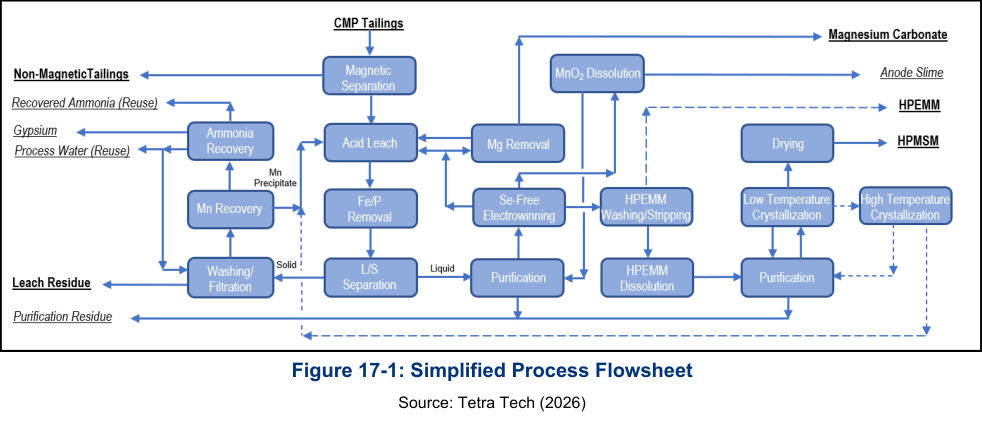
Three organizations designed the process facilities. BGRIMM worked with Euro Manganese Inc. and Tetra Tech Canada Inc. to develop the process flowsheet for high-purity manganese sulphate monohydrate production. The design relied on comprehensive metallurgical test results from CRIMM and verification testwork from BGRIMM. In 2026, BGRIMM performed additional testwork to investigate recovering manganese dioxide from anode sludge collected during pilot plant trials.
The process plant has a 26-year design life. The nominal production rate is 150,000 tonnes per year of HPMSM. To achieve that rate, the plant will extract approximately 1.1 million tonnes per year of tailings from the Chvaletice Manganese Project tailings. Production will start at about 50 percent of the nominal rate during the first three years.
Two types of final product are possible. The study focuses on HPMSM as the primary product, but the intermediate product, high-purity electrolytic manganese metal, may also be sold as a final product if market conditions require. Converting all HPEMM to HPMSM is expected to best meet high-purity manganese market demand for current and future low-cobalt lithium-ion battery formulations. The HPEMM flakes are produced without selenium or chromium. The final HPMSM product is expected to contain no less than 99.9 percent MSM with a minimum of 32.34 percent manganese. The product will be sold in powder form and produced without fluorine.
The process design incorporates three main additions compared to the previous feasibility study. A manganese dioxide dissolution circuit recovers manganese from anode sludge in the electrowinning circuit. A high-temperature crystallization circuit partially generates HPMSM crystals and recycles the barren solution, which contains elevated sodium, potassium, and other impurities, to the leaching circuit. A magnesium carbonate filter cake drying and packing system handles the magnesium carbonate by-product.
Mass, energy, and water balances came from the previous FS study using METSIM modelling, calculations from metallurgical testwork results, and the design teams experience with HPEMM and HPMSM process facilities. The design team sized and selected equipment with input from potential Chinese equipment vendors.
Key Process Stages
Excavated tailings go to a mill feed storage area within the tailings pulping facility. The tailings are reclaimed, pulped, and pumped to the plant site south of the CMP tailings cells. The pipeline crosses a public rail line, Highway 322, and related spurs using an overhead bridge.
The tailings slurry enters a wet, high-intensity magnetic separation circuit. This step upgrades the manganese grade of the leach feed to approximately 15 percent tMn. About 57 percent of the feed reports to non-magnetic tailings. Expected manganese recovery in this stage is 86 percent. The magnetic concentrate and NMT are dewatered using thickeners and filters. Concentrate moves to the downstream leach process. Dewatered tailings combine with washed leach residue for dry stacking at the residue storage facility.
Magnetic concentrate cake is repulped using anolyte solution from the electrowinning tank house. Leaching uses sulphuric acid at 90 degrees Celsius for about six hours. Barren solution from the high-temperature HPMSM crystallization circuit goes to the leach circuit. Powdered lime neutralizes the slurry. Air sparges into the neutralized slurry to co-precipitate impurities that leach with the manganese. Automatic pressure filters separate the pregnant leach solution from the leach residue.
Leach residue is repulped using washing water from the downstream dewatering circuit. The slurry is dewatered by pressure filtration with on-stream LR washing. After dewatering, the LR cake and the NMT go to a lined dry stack tailings storage facility built progressively in excavated areas of the CMP tailings cells.
Wash water from the LR washing circuit is treated for manganese and ammonia recovery. The wash water recovery system recovers soluble manganese to the leaching circuit in the form of manganese carbonate. Spent wash water solution undergoes treatment to recover ammonia using a conventional lime boil process. This produces a gypsum by-product planned for sale or offsite handling. The potential value of gypsum is not included in the project economics. Recovered ammonia is reused in the HPEMM production circuits.
The pregnant solution from leaching goes through purification to remove heavy metals and other impurities. The solution is stabilized to prevent uncontrolled crystallization of salts, producing a qualified solution for electrowinning.
Electrowinning occurs in cells after adding sulphur dioxide to the tank house feed solution. The tank house has capacity to produce 50,000 tonnes per year of HPEMM using an energy-efficient, selenium-free process. The design specifies a plating cycle of 24 hours at a cell voltage of 4.2 to 4.4 volts and an average cathode-current density of 320 to 370 amps per square metre. Automatic harvesting machines wash and strip cathodes using industry-standard automatic cathode plate stripping machines. The tank house design includes comprehensive mist emission control and mechanical handling systems that eliminate manual handling of cathodes. Design features include recovery of anode sludge to minimize manganese losses, diaphragm cleaning, and ongoing cell maintenance operations. Collected anode sludge contains mainly manganese dioxide, which is dissolved by ammonium bisulphite. The HPEMM flakes feed into HPMSM production.
A magnesium removal process maintains magnesium concentration in electrowinning solutions at levels that prevent uncontrolled salt precipitation and scaling. The process uses low-cost reagents without significant losses of manganese and reagent units.
All HPEMM flakes are dissolved using high-quality sulphuric acid to produce about 150,000 tonnes per year of HPMSM powder in a dust-free chemical processing facility. The dissolved manganese solution undergoes further purification to remove trace impurities from the HPEMM flakes, sulphuric acid, and other chemicals. The mother solution concentrates using an energy-efficient, low-temperature mechanical vapour recompression crystallization process to generate a single specification of manganese sulphate monohydrate crystals. HPMSM crystals separate from the saturated MVR crystal slurry using centrifuges. Disc type dryers dry the dewatered crystals to produce the final HPMSM powder. Most spent mother solution returns to the purification circuit or crystallization circuit for recrystallization. A portion goes to a high-temperature crystallization unit that rejects sodium, potassium, and other light metals that accumulate during heavy metal removal and low-temperature evaporation crystallization. The spent solution with elevated impurities recycles to the magnetic concentrate leaching circuit. HPMSM crystals from high-temperature crystallization recycle to the low-temperature crystallization feed solution purification circuit or dry together with crystals from the low-temperature circuit.
The dried HPMSM powder packs before shipping in trucks or containers to customers worldwide.
Additional Interesting Data and Summary
Waste management handles several material streams. NMT and washed LR travel by tubular conveyor from the south plant site to the CMP tailings site north of the plant. An overland conveyor moves the reprocessed material to temporary storage in the NMT and LR storage area at the pulping facility. Trucks that deliver extracted tailings backhaul the NMT and LR materials to the lined storage facility where tailings were excavated. Post-deposition bulldozing and compaction levels the reprocessed materials. Progressive reclamation covers the dry stacked tailings pad during operations.
A preliminary market study for gypsum demand and supply in the Czech market was conducted by Mangan. Magnesium carbonate by-product from the magnesium removal treatment is expected to sell to the local market for purposes such as agricultural fertilizer. Further studies into material characteristics, handling, and applications should be conducted.
Slimes from heavy metal removal treatments and the anolytic stream, about 0.4 percent of plant feed, store in dedicated areas before shipment to professional waste recycling and handling companies. Used cathodes and anodes return to suppliers or local metal handling companies for recycling.
Water supply systems include fresh make-up water from the adjacent power plant, supplemented with treated contact rain water as needed. Process water consists primarily of recovered water from magnetic concentrate and NMT thickener overflows, water from the ammonium recovery system, and water from the contact water treatment plant. High-purity water comes from condensed water in the HPMSM production circuit and a dedicated pure water treatment plant using two-stage reverse osmosis. Demineralized water from the adjacent power plant is used for steam production and as feed for pure water generation.
Steam is produced in-house using three 25-tonne-per-hour boilers fired by natural gas and hydrogen recovered from the HPEMM dissolution process.
A central assay laboratory will support overall production with analytical instruments for routine assays of tailings extraction, various processes, and environmental departments. A metallurgical laboratory will undertake testwork to monitor performance and improve the flowsheet and efficiency.
The process control system uses an advanced distributed control system configured as a three-tiered pyramid network. Field instrumentation forms the lowest tier. The middle tier includes monitoring computers, operator stations, and engineer stations. The top tier is the plant-integrated management system that coordinates and controls overall operations from tailings extraction through final product production.
Table 17-2 presents annual production projections developed from metallurgical performance testwork and the proposed tailings extraction plan. Year 1 shows 323 kilotonnes of tailings extracted at 8.13 percent tMn grade and 0.91 percent Mg grade, producing 45.3 kilotonnes of HPMSM with 56.0 percent manganese recovery to final product and 4.3 kilotonnes of magnesium carbonate by-product. Production ramps up to full capacity by Year 4, with approximately 1,079 kilotonnes of tailings extracted at 7.06 percent tMn grade and 0.97 percent Mg grade, producing 139.1 kilotonnes of HPMSM with 59.3 percent recovery and 17.0 kilotonnes of magnesium carbonate. Over the 26-year life, total extracted tailings amount to 26,960 kilotonnes at an average grade of 7.32 percent tMn and 1.15 percent Mg. Total HPMSM production reaches 3,651.9 kilotonnes with an average manganese recovery to final product of 60.0 percent. Total magnesium carbonate by-product reaches 505.7 kilotonnes.
Key Processes
- Wet high-intensity magnetic separation upgrades manganese grade to approximately 15 percent tMn with 86 percent recovery
- Acid leaching at 90 degrees Celsius for six hours using sulphuric acid
- Neutralization with powdered lime and air sparging for impurity co-precipitation
- Automatic pressure filtration to separate pregnant leach solution from leach residue
- Leach residue washing with wash water recovery for manganese and ammonia
- Solution purification to remove heavy metals and stabilize against uncontrolled crystallization
- Electrowinning at 4.2 to 4.4 volts and 320 to 370 A/m² current density over 24-hour plating cycle
- Anode sludge recovery and dissolution using ammonium bisulphite
- Magnesium removal to control scaling in electrowinning solutions
- HPEMM dissolution using high-quality sulphuric acid
- Low-temperature mechanical vapour recompression crystallization for HPMSM crystal generation
- High-temperature crystallization to reject sodium, potassium, and other light metals
- HPMSM crystal dewatering by centrifuges and drying by disc type dryers
- Dry stacking of non-magnetic tailings and washed leach residue with progressive reclamation
Source: Preliminary Economic Assessment, NI 43-101 Technical Report, for the Chvaletice Manganese Project in Chvaletice, Czech Republic, May 14, 2026. Project website: Chvaletice Manganese Project
