

Overview
The Yerington Mine, located in the historic Mason Valley of Lyon County, Nevada, represents one of the most significant copper porphyry districts in North America. Historically known as the Anaconda Mine, the site has evolved from a mid-20th-century industrial titan into a modern-day benchmark for sustainable mineral processing and brownfield redevelopment. Currently under the stewardship of Lion Copper and Gold Corp., the Yerington Copper Project is undergoing a technical renaissance through a strategic partnership with Rio Tinto’s Nuton™ technology. This collaboration aims to unlock the value of primary sulfide ores and historical stockpiles that were previously considered uneconomic or technologically challenging.
The project is situated approximately 80 miles southeast of Reno and encompasses several high-value deposits, including the Yerington pit, MacArthur, and Gallagher. Its significance lies not only in its massive copper resource but also in its proximity to established infrastructure and the shift toward domestic mineral security. By utilizing cutting-edge bio-leaching processes, the Yerington Mine is positioned to become a low-carbon producer of copper cathode, a critical component for the global energy transition. This transition from traditional high-energy grinding and flotation to advanced heap leaching reflects a broader industry trend toward reducing environmental footprints while maximizing resource recovery from complex mineral suites. The project integrates historical site remediation with new production, setting a precedent for responsible mining in the 21st century.
Key Process Stages
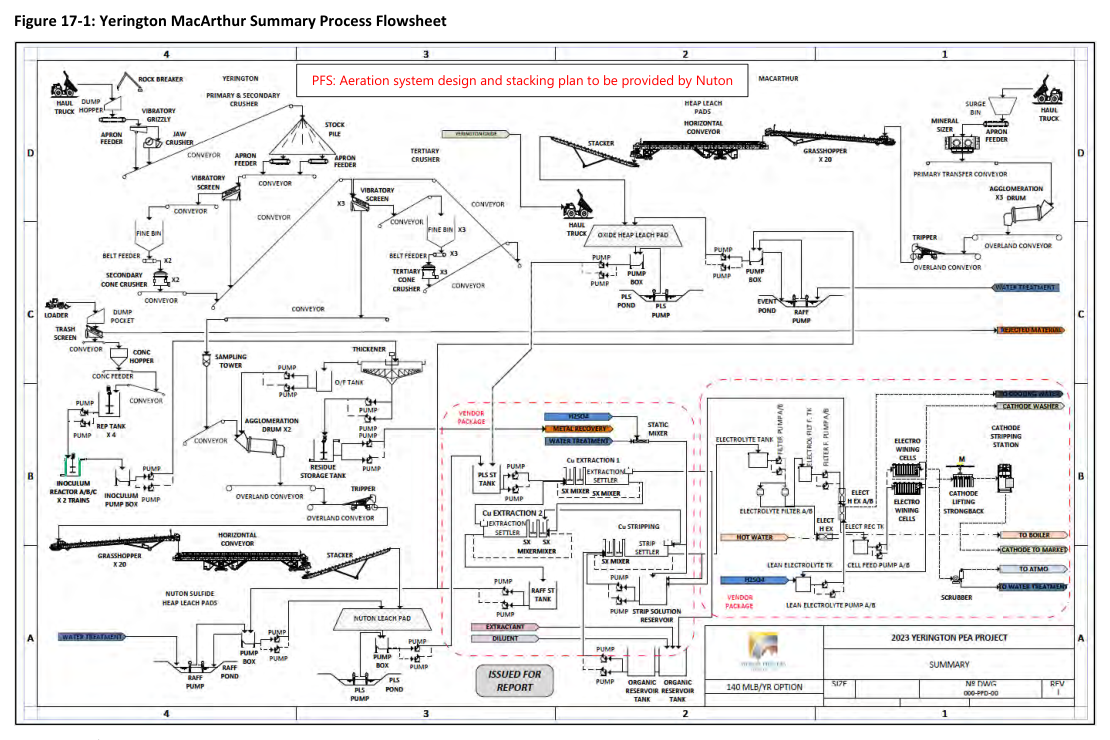
The mineral processing circuit at Yerington is designed for high-efficiency recovery of copper from both oxide and primary sulfide mineralizations. The circuit follows a rigorous sequence of comminution and advanced leaching stages:
- Primary Crushing: Run-of-mine (ROM) feed is processed through a primary crusher designed with a 75% availability factor to achieve initial size reduction.
- Secondary Crushing Circuit: Material is transferred to a secondary feed bin and processed through vibrating sizing screens and cone crushers. This stage is designed to handle a nominal rate of 1,553 STPH.
- Tertiary Crushing: Utilizing five parallel trains, each equipped with an apron feeder and cone crusher, the circuit achieves a final crushed product size (P80) of 0.5 inches.
- Agglomeration: The fine ore is reclaimed and processed through three high-capacity agglomerators where leaching reagents and binders are added to ensure heap permeability.
- Nuton™ Technology Bio-Leaching: A cornerstone of the modern circuit, this stage utilizes proprietary bacterial solutions to catalyze the leaching of primary sulfide ores, specifically targeting chalcopyrite and other refractory minerals.
- Heap Leaching: Agglomerated ore is stacked on leach pads where a recirculating lixiviant solution extracts the copper.
- Solvent Extraction and Electrowinning (SX/EW): The pregnant leach solution (PLS) is processed through SX/EW circuits to produce high-purity copper cathodes (99.99% Cu), bypassing the need for a traditional smelter.
Critical Data
The following technical parameters outline the design capacity and metallurgical expectations for the Yerington site based on recent technical reporting.
| Parameter | Value | Unit |
|---|---|---|
| Phase 1 Throughput (Average) | 25.5 | kt/d |
| Phase 2 & 3 Throughput (Average) | 51.0 | kt/d |
| Secondary Crusher Nominal Rate | 1,553 | STPH |
| Tertiary Crusher Product Size (P80) | 0.5 | inches |
| Primary Sulfide Recovery (Nuton Phase 1) | 73.0 | % |
| Yerington Oxide Recovery | 68.0 | % |
| Residual VLT Extraction | 75.0 | % |
| Net Acid Consumption (Sulfide) | 30.0 | lb/t |
| Secondary Crusher Bin Capacity | 750 | ST |
Technical Details and Sustainability
The technical sophistication of the Yerington Mine centers on the integration of Nuton™ Technology, a suite of proprietary bio-leaching processes developed by Rio Tinto. Unlike traditional smelting and refining, which are energy-intensive and produce significant carbon emissions, the Nuton™ process leverages naturally occurring microorganisms to oxidize sulfide minerals at ambient temperatures. This is particularly critical for the Yerington primary sulfide ore, which primarily consists of chalcopyrite. Historically, chalcopyrite has been resistant to conventional heap leaching; however, the Nuton™ process effectively breaks down the mineral matrix, allowing for copper extraction rates that compete with traditional flotation circuits but at a significantly lower capital and environmental cost.
From a sustainability perspective, the Yerington Mine is a model for environmental stewardship. The site has a complex history as an Anaconda-operated facility, leading to its status as a Superfund-managed area. The modern redevelopment plan by Lion Copper and Gold Corp. focuses on “Circular Mining”—a concept where new mineral extraction is used to fund and facilitate the cleanup of legacy environmental issues. By re-processing historical waste rock and tailings using modern leaching techniques, the project reduces the existing environmental burden while producing the copper necessary for green technologies like electric vehicles and renewable energy grids.
Water management is another technical highlight. The circuit is designed for high rates of solution recycling, minimizing the need for fresh water withdrawal in the arid Nevada climate. The use of a closed-loop SX/EW circuit ensures that reagents are reclaimed and reused, and net acid consumption is carefully balanced through the processing of varying ore types. Furthermore, the absence of a traditional tailings dam for the sulfide circuit—replaced by spent heap leach pads—greatly reduces the long-term geotechnical risk and land disturbance. As the project moves into Phase 2 and 3, increasing throughput to 51.0 kt/d, the economy of scale will further enhance the viability of these sustainable practices, ensuring that Yerington remains a cornerstone of the Mason Valley economy while adhering to the highest global ESG (Environmental, Social, and Governance) standards. The future outlook for the mine is inextricably linked to this high-tech, low-impact approach, proving that legacy mines can be transformed into pillars of the modern green economy.
Source: YERINGTON MINE
Source: NI 43-101 Technical Report
This article provides an overview of mineral processing developments based on publicly available technical reports and industry analysis.
