

Overview
Nestled high in the Andes at an elevation of 3,500 meters in the Mariscal Nieto Province of Peru, the Quellaveco mine stands as a testament to modern mineral processing engineering and sustainable mining practices. Operated by global mining giant Anglo American, Quellaveco is a world-class copper mining project that commenced production in mid-2022. This flagship operation is strategically significant, contributing to the global copper supply chain essential for electrification and renewable energy technologies. The mine processes a copper-molybdenum orebody, producing a high-grade copper concentrate containing valuable by-products like silver and a separate molybdenum concentrate. Designed with a nominal capacity that has already been exceeded, the Quellaveco concentrator exemplifies cutting-edge technology, from its massive comminution equipment to its innovative coarse particle recovery (CPR) circuit. The project’s development, detailed in a comprehensive NI 43-101 Technical Report, highlights not only its technical prowess but also its commitment to environmental stewardship, including an impressive water recycling rate. This article provides a comprehensive technical breakdown of the Quellaveco mineral processing circuit, exploring the stages that transform raw ore into marketable concentrates at a staggering rate of up to 142,000 tonnes per day.
Key Process Stages
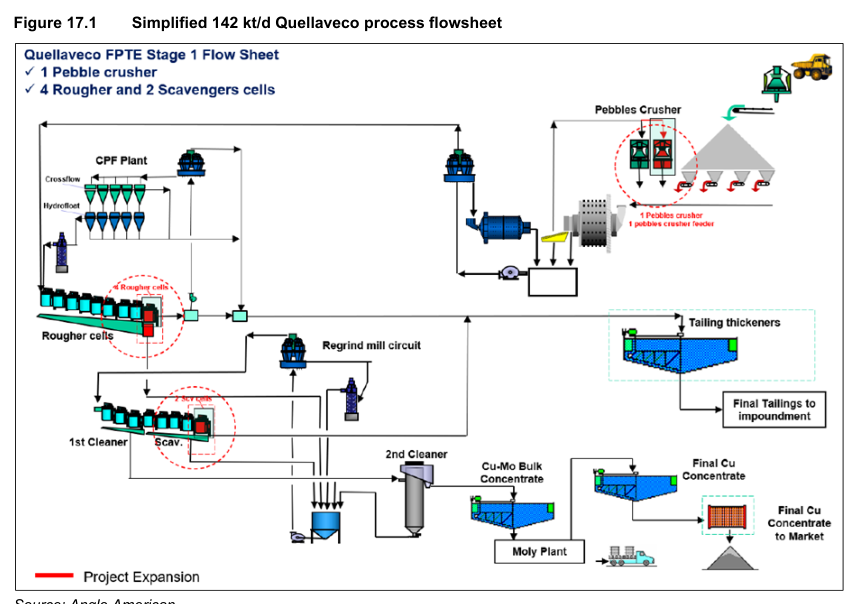
The Quellaveco concentrator employs a conventional yet highly optimized flowsheet designed for high-altitude operation, featuring primary crushing, SAG and ball milling, flotation, and concentrate handling. The circuit is engineered for robustness and high recovery, incorporating advanced technologies like column flotation and a HydroFloat-based coarse particle recovery system. Below is a detailed breakdown of each major stage.
- Stage 1: Primary Crushing & Stockpiling: Run-of-Mine (ROM) ore is delivered by truck to the primary crusher station, which houses twin gyratory crushers. This plant is designed to handle a peak throughput of 10,625 tonnes per hour. The crushers reduce the ore to a nominal size of approximately 150 mm. The crushed product is then transported via a 4.7-kilometer overland conveyor, which includes a tunnel section, to a coarse ore stockpile with a live capacity of 75,000 tonnes, ensuring a consistent feed to the milling circuit.
- Stage 2: SAG & Ball Milling (Comminution): The plant features two parallel, identical milling lines. Each line consists of a primary 12.4m x 6.7m (40′ x 22′) SAG mill, powered by a 23.5 MW drive, working in conjunction with an 8.5m x 13.4m (28′ x 44′) ball mill, powered by a 22.2 MW drive. The ball mills operate in closed circuit with cyclones to achieve the target grind size. The combined power of these massive mills is a key factor in achieving the plant’s high throughput, grinding the ore to a final product size of P80 150–180 µm to liberate the copper and molybdenum minerals.
- Stage 3: Bulk Sulphide Flotation: The ground slurry is conditioned with reagents—including collectors, frothers, and lime for pH adjustment (target pH 11.0–11.5)—and fed to the flotation circuit. Rougher flotation is performed in four banks of large 300 m³ tank cells. The rougher concentrate, containing copper, molybdenum, and silver, is then reground using three regrind Vertimills to further liberate locked particles. The reground product undergoes cleaning in a twin-stream cleaner/scavenger circuit, followed by final cleaning in four column flotation cells to produce a high-grade bulk concentrate.
- Stage 4: Molybdenum Separation & Concentrate Handling: The bulk concentrate is thickened in a 50-meter diameter thickener and pumped to the molybdenum separation circuit. Here, molybdenite is selectively floated from the copper concentrate using a reverse flotation process, aided by sulfuric acid to adjust the pH to around 8. The final copper concentrate (containing silver) is filtered into a low-moisture filter cake, while the molybdenum concentrate is filtered and dried. Both products are trucked for export, with copper concentrate shipped from the port of Ilo.
- Stage 5: Tailings & Water Management: Tailings from the flotation circuit are thickened in twin 120-meter diameter thickeners to approximately 50% solids. This thickened tailings slurry is then pumped through an 18-kilometer launder to the Cortadera Tailings Storage Facility (TSF). A critical aspect of the plant’s sustainability is its water management: reclaim water from the TSF is returned to the plant for reuse, contributing to an overall water recycling rate of approximately 85%.
- Stage 6: Coarse Particle Recovery (CPR) Circuit: A notable technological feature at Quellaveco is the Coarse Particle Flotation (CPF) circuit. This system, utilizing Eriez HydroFloat® technology, treats the tailings from the rougher flotation banks. It is designed to recover valuable coarse particles that are typically lost in conventional flotation, thereby improving the overall metal recovery and efficiency of the plant.
Critical Data
The following table summarizes the key operational and performance data for the Quellaveco concentrator, based on its current performance and design parameters as outlined in the technical report.
| Parameter | Value | Unit | Notes |
|---|---|---|---|
| Design Throughput (Nominal) | 127,500 | tpd | Initial design capacity at commissioning. |
| Current Throughput (LoAP Basis) | 142,000 | tpd | Life of Asset Plan (LoAP) basis, achieved in operation. |
| Potential Expansion Throughput | 150,000 | tpd | Under consideration by Anglo American. |
| SAG Mill Power (per mill) | 23.5 | MW | Drive power for each of the two 40′ x 22′ SAG mills. |
| Ball Mill Power (per mill) | 22.2 | MW | Drive power for each of the two 28′ x 44′ ball mills. |
| Target Grind Size (P80) | 150 – 180 | µm | Final product size from closed-circuit cyclones. |
| Copper Recovery (Avg. H1 2025) | 82% | % | Ranges from 80% to 85%. |
| Molybdenum Recovery (Avg. H1 2025) | 65% | % | Based on a head grade of ~0.015% Mo. |
| Copper Head Grade (Current) | ~0.8% | % Cu | Decreased from initial ~1.0% Cu. |
| Mill Runtime (Monthly Avg.) | 94% | % | Varies between 88% and 99%. |
| Plant Power Requirement | ~170 | MW | At full production. |
| Water Consumption | 35 | ML/d | Megalitres per day, with 85% recycled. |
| Concentrate Production | ~100,000 | t/month (dry) | Copper concentrate. |
Additional Interesting Data and Summary
Since its commissioning in June 2022, the Quellaveco concentrator has demonstrated a successful ramp-up, achieving a steady-state milling rate of approximately 4.0 million tonnes per month by the end of 2023. This performance is a result of robust engineering tailored to its challenging high-altitude environment, which necessitates designs accounting for oxygen deprivation and extreme cold. The plant’s operational efficiency is reflected in its excellent average mill runtime of 94%. Beyond throughput, the metallurgical performance is key. The copper concentrate grade produced ranges from 27% to 33% Cu, and the circuit also recovers an average silver head grade of 2.3 g/t. The integration of the Coarse Particle Recovery (CPR) circuit using HydroFloat® technology is a forward-thinking innovation, setting a benchmark for the industry by improving recoveries on particles that are often considered unrecoverable, thus enhancing the overall resource efficiency and economics of the project.
From a sustainability and ESG (Environmental, Social, and Governance) perspective, Quellaveco is designed with significant environmental controls. The most notable is its water management system, which recycles and reuses approximately 85% of its process water, drastically reducing freshwater extraction—a critical consideration in the arid Andean region. The tailings are managed in a modern, engineered facility (the Cortadera TSF) with water reclaim integral to the process. The plant consumes roughly 100,000 tonnes per year of process consumables, including grinding media (balls), lime, and flotation reagents, all of which are managed with on-site storage for operational continuity. The Qualified Persons responsible for the NI 43-101 report concluded that the selected milling and flotation process is well-suited for the Quellaveco ore and that the concentrator’s performance is “fair and reasonable.” As Anglo American considers potential expansions towards 150 kt/d, Quellaveco solidifies its position not just as a major copper producer, but as a model of modern, efficient, and responsible mineral processing.
Source: NI 43-101 Technical Report | Feasibility Study | Project: Quellaveco Property | Date: March 2025
Further Reading
- Anglo’s Quellaveco to receive the coarse particle recovery treatment
- Commissioning a HydroFloat® in a Copper Concentrator: A Case Study from El Soldado
- Water Recycled and Reused
