

This technical report presents the results of the Kiniero Project Feasibility Study Update, including mineral processing design comprising carbon-in-leach with gold electrowinning and gravity circuits for doré production.
Report context
This Technical Report on the Kiniero Gold Property, situated within the Kouroussa Prefecture of the Kankan Region in the Republic of Guinea, has been prepared by AMC Consultants Pty Limited on behalf of Robex Resources Inc. and is in accordance with the requirements of National Instrument 43-101. The report is an update to the Technical Report with an effective date of 30 June 2023. The effective date for this Technical Report is 6 December 2025, with a report date of 16 January 2025. Currency used throughout this report is United States dollars unless otherwise stated.
Processing route
Proposed plant design
Mineral processing for the Project will comprise carbon-in-leach (CIL) with gold electrowinning, in addition to gravity circuits to produce doré.
Metallurgical testwork
Various metallurgical testwork campaigns have been completed by SMG in support of the Project, relying on sample material selected from the differing deposits, with the purpose of validating historical metallurgical processing plant performance data and determining feasibility study-level design parameters for the process plant.
Canadian-registered independent mineral process engineering consultancy Soutex Inc was appointed in 2022 to increase the level of confidence in the plant design and economic assumptions. The main goals of the 2022-2023 testwork were to identify the leaching conditions and reagents consumption for the plant’s CIL circuit. CIL testing was favoured because previous results (Intertek, 2022) showed better kinetics than direct leaching. The direct leaching route was also studied to validate the premises of faster kinetics using CIL. Additionally, acid mine drainage, gravity concentration, oxygen consumption, and cyanide detoxification were also realized as part of this testwork.
Testwork results
Compared to previous studies, the recent testwork led to reduced leach time and reagent consumption design criteria, combined with new information about oxygen consumption and detoxification parameters. The recovery hypotheses are similar to the 2022 Mining Plus Technical Report, showing a decrease of recovery with depth in the various pits.
Key reported parameters
| Parameter | Unit | Value | Basis |
|---|---|---|---|
| Processing method | , | Carbon-in-leach with gold electrowinning and gravity circuits | Proposed design |
| CIL testing outcome | , | Favoured over direct leaching due to better kinetics | Testwork (Intertek, 2022; Soutex, 2022-2023) |
| Leach time criteria | , | Reduced compared to previous studies | Testwork (2022-2023) |
| Reagent consumption criteria | , | Reduced compared to previous studies | Testwork (2022-2023) |
| Recovery with depth | , | Decrease with depth in various pits | Testwork hypothesis (consistent with 2022 Mining Plus report) |
| Mineral Resource effective date | , | 30 November 2024 | Report basis |
| Gold price for resource reporting | US$/oz | 2,200 | Report basis |
Project website: https://robex.atta.ch/en/our-projects/kiniero-mine/
Technical qualifications
The Qualified Persons have referenced World Bank and other long-term gold price forecast information, prices used in recent NI 43-101 reports, three-year trailing averages, and prices current as of October 2024 for use in pit optimization and cut-off calculations. The gold price selected for Mineral Resource cut-off estimates is considered reasonable by the QPs.
Mineral Resource estimates could be materially affected by significant changes in environmental, permitting, legal, title, taxation, socio-economic, marketing, political, or other relevant factors, although no such changes are expected or known by the QPs.
Mineral Resources are not Mineral Reserves until they have demonstrated economic viability.
Source: Technical Report, Kiniero Gold Project, Guinea, effective date 6 December 2025, report date 16 January 2025, Sections 1.1 and 1.10.
Consolidated report summaries
The following former standalone pages about this operation were consolidated here on October 25, 2026. They are retained for source traceability; dates and figures reflect each report’s own effective date and may be superseded by the current information above.
Kiniero Plant Delivers Throughput Above Design After Restart
The Kiniero gold project in Guinea houses a 5.0 Mtpa carbon-in-leach processing facility designed for flexible operation across oxide and fresh ore types. Operated by PDI Gold Limited, the plant has been running since January 2026.
The Kiniero Gold Project is located in the Kouroussa Prefecture of the Kankan Region in the Republic of Guinea, approximately 440 km east-north-east of Conakry. The site is an operating gold mine owned and operated by PDI Gold Limited, a dual-listed Australian and Canadian company. PDI Gold was formed through an April 2026 merger between Robex Resources Inc. and Predictive Discovery Limited. Mining at Kiniero has recommenced, construction of infrastructure is in progress, but mineral processing has not yet re-commenced as of the report's effective date. The process plant, which began operating in January 2026, treats oxide, laterite, transition, and fresh ores through a carbon-in-leach (CIL) flowsheet with gravity circuits to produce doré.
Critical Data
| Parameter | Value | Unit | Notes |
|---|---|---|---|
| Annual Throughput (Nominal) | 5,000,000 | t/y | Design value |
| Annual Throughput (High Oxide Blend) | 6.0 | Mtpa | Design capacity |
| Gold Recovery (Average) | 88 | % | Metallurgical test result |
| Gold Recovery (Fresh Ore) | 86 | % | Metallurgical test result |
| Gold Recovery (Oxide Ore) | 92 | % | Metallurgical test result |
| Gold Recovery (Transition Ore) | 89 | % | Metallurgical test result |
| Gold Production | 155,450 | ozt/y | Design value |
| SAG Mill Diameter | 7 | m | Equipment specification |
| SAG Mill Length | 9.1 | m | Equipment specification |
| SAG Mill Motor Power | 7,800 | kW | Equipment specification |
| Ball Mill Diameter | 6.1 | m | Equipment specification |
| Ball Mill Length | 11 | m | Equipment specification |
| Ball Mill Motor Power | 7,800 | kW | Equipment specification |
| Cyclone Overflow P80 | 106 | µm | Metallurgical test result |
| CIL Number Trains | 2 | – | Design value |
| CIL Residence Time | 24 | h | Metallurgical test result |
| CIL Tanks Per Train | 6 | – | Equipment specification |
| CIL Live Volume per Tank | 2,350 | m³ | Calculated value |
| Oxide Ore Lime Consumption | 3 | kg/t | Metallurgical test result |
| Fresh Ore Lime Consumption | 0.9 | kg/t | Metallurgical test result |
| Oxide Ore Cyanide Consumption | 0.4 | kg/t | Metallurgical test result |
| Fresh Ore Cyanide Consumption | 0.8 | kg/t | Metallurgical test result |
| Operating pH | 10.5 | – | Design value |
| Elution Type | Split AARL | – | Design value |
| Electrowinning Cells | 3 | – | Equipment specification |
| Oxygen Plant Units | 2 | – | Design value |
| Oxygen Purity | 93 | % | Technology supplier criterion |
| Average Power Demand | 17 | MW | Estimate |
| Annual Power Consumption | 145.4 | GWh | At 5.0 Mtpa processing rate |
| Ore Blend Au Grade | 1.1 | g/t | Average, design value |
| Laterite/Oxide/Transition Feed Proportion | 65 | % | Design value |
| Fresh Ore Feed Proportion | 35 | % | Design value |
Overview
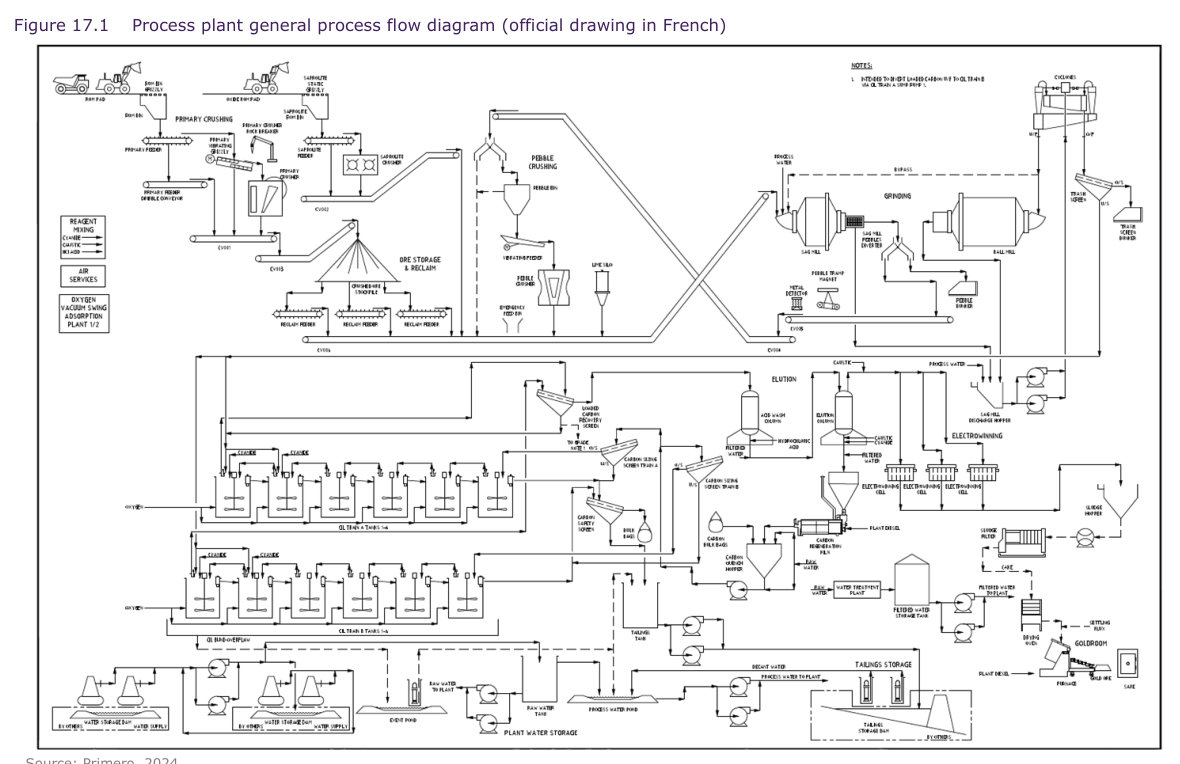
The process plant design supports flexible operation between oxide, transition, and fresh ore while maintaining throughput and gold recovery. Oxide and upper transition ores require less comminution energy than fresh ore but present handling challenges due to the sticky nature of saprolite. The flowsheet includes two crushing circuits, semi-autogenous grinding (SAG) and ball milling, pebble crushing, dual CIL circuits, split AARL elution, gold electrowinning, and carbon regeneration. Ore from the Project is processed on-site at close distance to the various pits. The plant has been operating since January 2026 and has performed above design expectations. Plant throughput over the past eight months is approximately 200 kt higher than the designed capacity.
Key Process Stages
The crushing area includes two parallel lines. Laterite, transition, and fresh ores are crushed using a primary jaw crusher. Ore is reclaimed from the ROM pad by front-end loaders or direct tipped by trucks. The ROM bin has a static grizzly ensuring only -900 mm material enters. A mobile rock breaker handles oversized material. The jaw crusher circuit uses an apron feeder with variable speed drive feeding a vibrating grizzly. The grizzly allows undersized material to pass through while larger lumps report to the crusher. Crushed ore combines with grizzly undersize on the discharge conveyor and transfers to the crushed ore stockpile. A weightometer on the conveyor provides feedback to control the apron feeder speed.
Saprolite ores are reclaimed by front-end loaders and delivered to the saprolite bin. A static grizzly ensures only -500 mm material enters the bin. An apron feeder with variable speed drive controls feed rate. The saprolite crusher is a mineral sizer. Crushed saprolite reports to a discharge conveyor equipped with a weightometer and delivers onto the SAG mill feed conveyor.
Three apron feeders in the reclaim tunnel draw crushed ore from the stockpile. The reclaim area includes a reverse pulse dust collector that returns fugitive dust to the SAG mill feed conveyor. A ventilation fan provides fresh air. A sump pump transfers clean-up slurry to the SAG mill discharge hopper. The saprolite tonnage rate is set by the operator as a fixed target with the SAG mill feed conveyor weightometer controlling reclaim feeder speed for ore blend ratios.
A plant clean-up hopper sits over the SAG mill feed conveyor. Material collected from around the plant returns to the processing circuit through this hopper. Grinding media also enters the SAG mill through this hopper. A lime silo adds lime at a controlled rate to elevate downstream slurry pH. The pebble crusher discharges onto the SAG mill feed conveyor with a flopgate diverting pebbles around the circuit if needed.
Milling uses a SAG mill, ball mill, and pebble crusher in an SABC circuit. Single stage SAG operation is available when required. Crushed ore combines with process water in the SAG mill feed box. Ground slurry exits through the SAG mill trommel with undersize reporting to the mill discharge hopper. Oversize pebbles report to the pebble crushing circuit. Pebbles transfer through an oversize chute and diverter to the pebble feed conveyor. A tramp magnet and metal detector sit on the pebble transfer conveyor, with activated metal detection bypassing the pebble bin automatically.
The mill discharge hopper receives feed from the SAG mill trommel underflow, ball mill trommel underflow, and several sump pumps. Process water is introduced for density control. Slurry pumps through the cyclone cluster with combined underflow reporting to the splitter box and ball mill feed box. Knife gate valves divert cyclone underflow to the SAG mill for single stage operation. Cyclone overflow reports to a trash screen that removes tramp material such as plastic and wood fibre. The underflow hopper beneath the trash screen splits slurry evenly between the two CIL trains.
The CIL circuit consists of dual trains of six 2,350 m³ tanks. Sodium cyanide is stage dosed into the first two tanks of each train. Cyanide concentration is monitored and controlled automatically. Side-wall lances sparge oxygen to maintain high dissolved oxygen levels. pH is monitored in the initial three tanks with the first tank's reading controlling lime addition onto the SAG mill feed conveyor. Slurry progresses downstream through tanks equipped with agitators, pump-style mechanically wiped interstage screens, and carbon transfer pumps. Barren carbon enters the last tank and progresses counter current to the slurry. Loaded carbon from tank 1 or 2 pumps to a loaded carbon screen common to both trains.
Tailings slurry from tank 6 of each train flows by gravity to a carbon safety screen. Screen undersize reports to the tailings tank where slurry pumps to the tailings storage facility. Two oxygen plants provide oxygen enriched gas up to 93% purity to both trains.
A lined event pond contains any unforeseeable spillage from the CIL trains. The pond was designed to contain a catastrophic failure of one CIL tank. A pump can return accumulated solution to the process water pond or transfer slurry to the tailings tank.
Tailings slurry pumps from the tailings hopper to the TSF using centrifugal pumps in duty/standby configuration. A leak detection system with flow monitoring operates between the pumps and TSF. The TSF has decant return pumps returning supernatant water to the process water pond.
Carbon handling was designed for up to seven elution cycles per week. Loaded carbon discharges into a 7-t acid wash column where dilute hydrochloric acid removes carbonates. Split AARL elution desorbs gold from the carbon using preheated filtered water containing cyanide and caustic solution. Pregnant solution cools via heat exchangers before transferring to pregnant solution tanks. Eluted barren carbon goes to the regeneration kiln with a bypass option returning carbon directly to the CIL trains.
Gold room operations recirculate pregnant solution through three electrowinning cells. Gold plates onto stainless steel cathodes. Gold sludge is washed off, settled, filtered, and dried. Dried filter cake mixes with flux and charges into a diesel-fired furnace producing slag and doré. The doré is cleaned, assayed, stamped, and stored in a secure vault. Furnace slag periodically returns to the grinding circuit.
Additional Interesting Data and Summary
The main process water source is decant water recirculated from the TSF with residual cyanide and lime. Raw water adds through the raw water tank overflow. During May to October, water extracts from the local river and/or mine pit dewatering to fill the West Balan pit for raw water storage. From November to April, pontoon pumps in the West Balan pit provide raw water to the plant. The raw water tank has a dedicated lower-level outlet for fire water with electric and diesel pumps plus a jockey pump.
The electrical supply uses an off-grid hybrid system. Heavy fuel oil generating sets provide 28 MW combined capacity. A solar photovoltaic farm delivers 21.54 MWdc / 16 MWac. Battery energy storage provides 5.37 MWhr capacity with 4 MW power capacity. Main power distribution runs at 11 kVac, 50Hz. Average power demand for the process plant is estimated at 17 MW with annual consumption of 145.4 GWh at 5.0 Mtpa throughput.
Expected annual reagent consumption rates at 5.0 Mtpa throughput include 2,783 t of sodium cyanide, 136 t of caustic soda, 11,325 t of lime, 125 t of carbon, 499 t of 32% hydrochloric acid, 1,800 t of grinding balls, and 10 t of smelting reagents. Major reagents include sodium cyanide in 1,000 kg briquettes, caustic soda pearls in 1,000 kg bags, hydrated lime in 850 kg bags, activated carbon in 550 kg bags, 32% HCl in 1,000 L IBCs, and grinding balls of 80 mm, 100 mm, and 125 mm diameters. Sulfamic acid is required periodically to de-scale the elution heat exchangers.
The process plant has operated above design expectations since January 2026. Throughput is approximately 200 kt higher than designed capacity over the past eight months.
Key Processes
- Primary jaw crushing of laterite, transition, and fresh ores with grizzly screening to -900 mm
- Mineral sizer crushing of saprolite ore with grizzly screening to -500 mm
- SAG and ball mill grinding in SABC configuration with pebble crushing and single stage SAG capability
- Cyclone classification targeting 106 µm P80 overflow
- Dual train carbon-in-leach with 24-hour residence time and oxygen sparging
- Split AARL elution with acid wash and carbon regeneration
- Gold electrowinning with three cells and doré production
- Zero discharge process solution design with lined event pond
Source: Kiniero NI 43-101 Technical Report, 2026-09-28. Project website: Kiniero
