

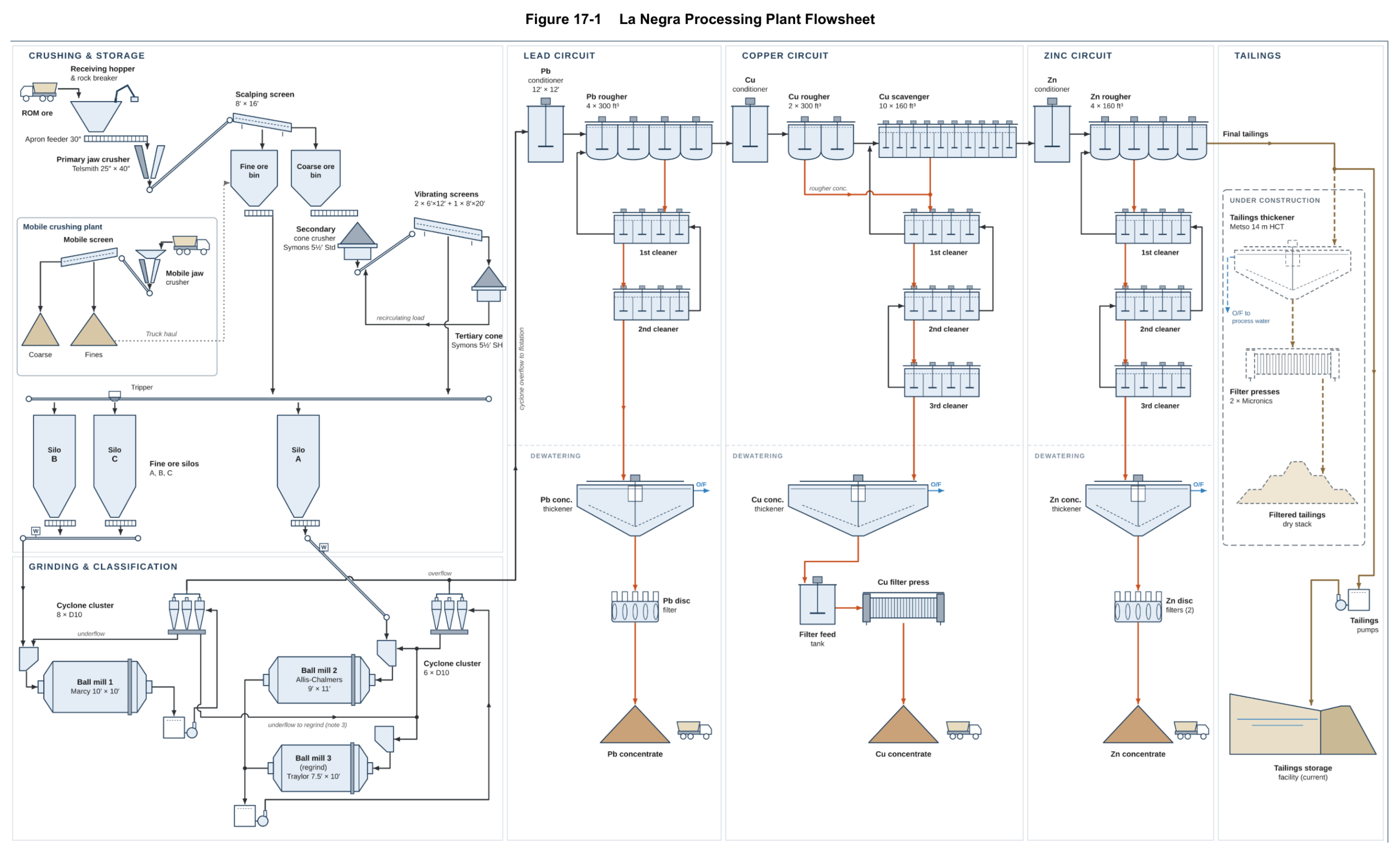
The La Negra concentrator in Querétaro, Mexico, runs a well-established flowsheet built on three-stage crushing, parallel ball milling and sequential lead, copper and zinc flotation, with filtration and dry-stacking plans for tailings.
The La Negra Mine sits in the Sierra Gorda range of central Mexico, roughly 90 km in a direct line northeast of the city of Querétaro, in the district of Maconí within the municipality of Cadereyta de Montes. It is an operating polymetallic underground mine producing lead-silver, copper-silver and zinc concentrates from a Pb-Zn-Ag + Cu skarn deposit. The mining concessions are held 100% by Minera La Negra, which became wholly owned by Silverco Mining Ltd. on May 19, 2026. The property comprises 12 contiguous concessions covering about 4,438.59 ha. The operation benefits from extensive existing underground infrastructure, and the current mine plan schedules production to ramp up through 2027 to an annualized rate of 2,500 tpd in the second half of that year, over an estimated life of mine of 8.2 years. The technical report is a Preliminary Economic Assessment prepared by SGS Geological Services Inc..
Critical Data
| Parameter | Value | Unit | Notes |
|---|---|---|---|
| Concentrator operating capacity | 3,000 | tonnes per day | |
| Nominal processing rate | 2,500 | tonnes per day | 912,000 tpa basis |
| Operating days per year | 337 | days | Reopening plan; three eight-hour shifts |
| Mine life | 8.2 | years | |
| Mill availability | 90-99 | % | Design range |
| Crushing availability | 86-88 | % | Design range |
| Mineralized material moisture | 1.5-2.0 | % | |
| Mineralized material specific gravity | 3.1-3.5 | g/cm3 | |
| Primary crusher feed P80 | 635 | mm | Design |
| Secondary crusher feed P80 | 102 | mm | Design |
| Tertiary crusher feed P80 | 38 | mm | Design |
| Ball mill feed P80 | 8 | mm | Design |
| Ball mill product P80 | 150 | µm | |
| Bond Work Index | 13 | kWh/t | Design |
| Abrasion Index | 0.41 | g | Design |
| Silver grade, LOM average | 114.3 | g/t | |
| Silver recovery, LOM average | 83.6 | % | All concentrates |
| Lead feed grade, LOM average | 0.8 | % | |
| Lead recovery, LOM average | 80.3 | % | |
| Lead concentrate grade, LOM average | 60.2 | % | |
| Silver in lead concentrate | 8,362 | g/t | |
| Zinc grade, LOM average | 1.92 | % | |
| Zinc recovery, LOM average | 80.7 | % | |
| Zinc concentrate grade, LOM average | 44.1 | % | |
| Silver in zinc concentrate | 70 | g/t | |
| Copper grade, LOM average | 0.35 | % | |
| Copper recovery, LOM average | 79.2 | % | |
| Copper concentrate grade, LOM average | 23.9 | % | |
| Silver in copper concentrate | 1,740 | g/t |
Overview
The processing facility has a long operating history, and its flowsheet has been well established beyond the throughput expansions carried out over the years. The plant is based on conventional crushing, grinding and differential flotation to produce lead-silver, copper-silver and zinc concentrates, in that order. Historically the facility ran three eight-hour shifts for 336 calendar days per year. The reopening plan assumes three eight-hour shifts across 337 operating days, and the technical study treats a nominal 2,500 tonnes per day, or 912,000 tonnes per annum, as the processing basis. The concentrator's operating capacity stands at 3,000 tonnes per day.
Key Process Stages
Ore reaches the plant site in 23 tonne trucks operated by a community-based contractor. Blending controls head grade and arsenic content before the material is tipped into a 60 tonne coarse hopper fitted with a 25" x 25" grate; oversize is broken with a BT200 hydraulic breaker. A Gator 30" x 42" primary jaw crusher with a 150 hp motor reduces the feed to a P80 of minus 4 inches at 220 tonnes per hour, with 88% availability. Belts carry the primary product to a 25 hp grizzly in closed circuit, which separates material ranging from 5/16" to 4". The 4" to 7" fraction goes to a 400 tonne coarse feed bin, while the minus 5/16" fraction enters a 100 tonne fine feed hopper.
Secondary crushing uses a 5½ ft Symons standard head cone crusher with a 200 hp motor, historically available 86% of the time and projected to run about 4,350 hours per annum at 300 to 340 tonnes per hour to a P80 of 1½ inches. Two parallel 6" x 12" vibrating grizzlies split the secondary product, sending the plus 5/16" stream to the tertiary crusher. That unit is a 300 hp 5½ ft Symons short head cone crusher producing a P80 of 3/8", available 86% of the time and projected for 4,349 hours per annum at 150 to 190 tonnes per hour.
Crushed material is held in three fine material silos, each with a capacity of 450 tonnes. The grinding circuit runs two parallel ball milling lines, each closed with a bank of hydrocyclones to reach a P80 of about 150 µm. The first line is a Marcy 10' x 10' ball mill with an 800 hp motor, rated at 46 tph in a single grinding stage and closed with two D20 hydrocyclones. The second line pairs an Allis Chalmers 9' x 11' mill rated at 36 tph with a 500 hp motor and a Taylor 7½' x 11' regrind mill rated at 22 tph with a 450 hp motor in a two-stage arrangement, feeding a bank of six D10 hydrocyclones. Overflow from both circuits passes to differential flotation. Zinc sulfate and sodium cyanide are added during milling at a 2:1 ratio.
Flotation recovers lead, then copper, then zinc. The lead circuit begins in a 12' x 12' conditioning tank with 12 minutes of retention, where Aero 404 acts as promoter. Pulp then enters four 350 ft3 Outotec BC-10 flotation cells, with CC-1064 added as frother in the first cell, and four Denver 50 ft3 cells provide two stages of cleaning. Lead tails pass to a 10' x 10' conditioning tank with 10 minutes of retention ahead of copper flotation, where ammonium bisulfite adjusts pH and depresses zinc and iron while S-7583 promotes copper. Two Wemco 300 ft3 cells handle copper roughing, with rougher concentrate routed to the concentrate thickener or, at the operator's discretion, to cleaning. Scavenging takes place in ten Denver 160 ft3 cells followed by three stages of cleaning in Denver 50 ft3 cells. Copper tails enter a 12' x 12' conditioning tank where milk of lime raises pH to 9.0 to 10.0 and copper sulfate activates zinc. The zinc circuit comprises four Denver 160 ft3 cells followed by three cleaning stages in Denver 50 ft3 cells.
Reagents include sodium cyanide, zinc sulfate and sodium hydroxide in the grinding circuit, AERO 404 and CC1064 in lead flotation, S-7583, ammonium bisulfite, CC1064 and xanthate in copper flotation, and lime, Aero 5160, copper sulfate and CC1064 in zinc flotation.
Each concentrate stream is thickened and filtered. The lead thickener, 18' x 6', raises solids to 30 to 40% by weight, with Zetag 4125 flocculant dosed as needed. Two PIPSA 5' x 4' disc filters, one operating and one standby, run under vacuum to produce material at 18 to 20% humidity, and aeration brings moisture to a nominal 10.8%. The copper thickener, 30' x 10', reaches 65 to 70% solids, and its underflow feeds a Clever 1000 x 1000 plate filter producing cake at 15 to 20% moisture, nominally 10.9% after airblow and rehandling. Zinc concentrate passes to a 12' x 12' thickener and then to two PIPSA 6' x 5' disc filters, yielding cake at 80 to 82% solids, or about 10% moisture after aeration. Concentrates are stored in a compartmentalized shed awaiting truck shipment to the offtaker.
The site has procured a tailings filtration system. Under the proposed configuration, tailings thickener underflow will be filtered and the resulting cake dry-stacked on site. With filtered tailings, the study estimates 90% of plant water will be recycled.
Additional Interesting Data and Summary
A separate 200 tph, 150 hp 30" x 42" mobile jaw crusher handles bespoke jobs, including batch processing of certain material types as required by the geology team and production of construction material such as crushed rock for the TSF buttress. Its product ranges from 4" to 7", with finer material fed to an Allis Chalmers vibrating grizzly that yields material under 1" and over 3/8". The onsite laboratory assays exploration samples, definition drilling, mill samples and concentrate specifications, using atomic absorption, ICP and fire assay. Minera La Negra has operated since 1971, and the mineral processing and recovery parameters are well understood. The flowsheet in the technical study shows an operating plant whose parameters and recoveries have been established through decades of production.
Key Processes
- Three-stage crushing: primary jaw, secondary standard cone and tertiary short head cone
- Fine material storage in three 450 tonne silos
- Two parallel ball milling lines in closed circuit with hydrocyclones to a P80 of 150 µm
- Sequential differential flotation of lead, copper and zinc concentrates
- Reagent addition for depression, activation, pH control, collection and frothing
- Thickening and filtration of each concentrate stream
- Filtered tailings with dry stacking under the proposed configuration
- Onsite laboratory for assay and concentrate verification
Source: Technical Report on the Preliminary Economic Assessment for La Negra Mine, Querétaro, Mexico, November 5, 2026. Project website: La Negra Mine
