

The Luanga Project in Pará State, Brazil, is a PFS-stage PGM, gold and nickel sulphide project owned by Bravo Mining Corp. that pairs a 10 Mtpa sulphide concentrator with a dedicated downstream smelter in Barcarena.
The Luanga Project sits in Pará State, Brazil, and is the subject of a Pre-Feasibility Study prepared by GE21 Consultoria Mineral Ltda. for Bravo Mining Corp. The project targets platinum group metals (PGMs), gold and nickel sulphides hosted in ferromagnesian silicates, with a processing route built around a sulphide ore (fresh rock) flow sheet. The technical report carries an effective date of September 16, 2026, and describes plant capacity of 10 Mt per year. Mining, concentrator construction and the smelter form one integrated project, and the report assumes an accelerated ramp-up that reaches nominal capacity as early as the second year of operation.
Critical Data
| Parameter | Value | Unit | Notes |
|---|---|---|---|
| Annual capacity | 10 | Mtpa | Concentrator design basis |
| Crushing circuit availability | 70 | % | Process criteria |
| HPGR and grinding circuit availability | 85.7 | % | Process criteria |
| Nominal feed rate, crushing plant | 1,631 | t/h | Design |
| Nominal feed rate, HPGR and grinding | 1,332 | t/h | Design |
| Ball mill Bond index (BWi) | 19 | kWh/t | Design criterion |
| Axb | 32 | Not applicable | HPGR parameter |
| Specific capacity of HPGR | 250 | ts/h·m³ | Design |
| Specific energy consumption of HPGR | 1.50 | kWh/t | Design |
| Mass recovery in flotation | 1.7 | % | Design |
| PGM 3E metallurgical recovery | 80.0 | % | Concentrator design |
| Palladium recovery | 81.5 | % | Concentrator design |
| Platinum recovery | 80.0 | % | Concentrator design |
| Rhodium recovery | 55.0 | % | Concentrator design |
| Gold recovery | 88.0 | % | Concentrator design |
| Nickel recovery | 70.6 | % | Concentrator design |
| 3E PGM grade in concentrate | 100 | g/t | Design criterion |
| Nickel grade in concentrate | 8.44 | % | Design criterion |
| Target grind size | 26 to 30 | µm | Liberation requirement |
| Ball mill installed power | 18 | MW | Single mill |
| Concentrate thickener diameter | 30 | m | Final concentrate |
| Tailings thickener diameter | 125 | m | Tailings circuit |
| Nominal electrical demand, concentrator | 58 | MW | Grid connection planned |
| Storage capacity, main reservoir | 2,700,000 | m³ | Water supply |
| Smelter annual concentrate throughput, wet | 200,000 | t/a | Design |
| Smelter plant availability | 85 | % | Design |
| Roaster operating temperature | 1,000 | °C | Bubbling fluidized bed |
| Sulphur removal in roasting | 98 | % | Design |
| Furnace nominal rating | 20 | MW | DC electric arc, single electrode |
| Slag tapping temperature | 1,650 | °C | Design |
| Alloy tapping temperature | 1,600 | °C | Design |
| Acid plant SO₂ conversion efficiency | 91 | % | Design |
| Smelter Pt, Pd, Rh and Au recovery to alloy | 98 | % | Design |
| Smelter nickel recovery to alloy | 90 | % | Design |
| Residual precious metals in furnace slag | Approximately 4 | g/t | Design |
Overview
The concentrator flow sheet begins with primary crushing in a gyratory unit rated at 1,631 t/h. Crushed material passes over two double-deck screens measuring 3.05 m by 6.10 m with 80 mm and 50 mm openings, and the oversize feeds two cone crushers in parallel. Secondary crushing product returns to the screens in closed circuit, while screen undersize goes to a buffer pile. Reclaimed ore moves by apron feeders and conveyor to a High Pressure Grinding Rolls unit, and the HPGR discharge is classified on a 3.7 m by 8.5 m double-deck screen with oversize returned to the rolls.
Grinding relies on a bank of ten hydrocyclones with eight in operation, feeding an 18 MW ball mill in closed circuit. The overflow from that cluster passes to a second cluster of six cyclones with four operating, and the underflow feeds a vertical stirred mill. Its product combines with the second cluster overflow and feeds the flotation thickener.
Flotation uses Jameson cells arranged as one rougher stage, two scavenger stages in series and one cleaner stage. Rougher and cleaner concentrate combine as the plant's final concentrate. Scavenger tailings form the final tailings. Cleaner tailings return to the first scavenger cell, and each stage recirculates a portion of its tailings through the cell itself.
Test work at Base Metal Laboratories in Canada returned concentrate grades above 100 g/t for 3E (Pt, Pd, Rh) and nickel grades of roughly 8%, with estimated overall recoveries of 80% and 70% respectively. The design mass balance uses 1,332 t/h of flotation feed and produces 21.3 t/h of final concentrate.
Key Process Stages
Comminution. Variability testing showed moderate to high ore hardness, and the central zone offered the greatest resistance to grinding. Bond ball mill work indices of 14.98 kWh/t, 18.91 kWh/t and 14.43 kWh/t were recorded for the north, central and southwest zones, with the central zone classified as hard. Bond rod mill work indices came in at 16.4 kWh/t, 19.3 kWh/t and 16.5 kWh/t, classified hard, very hard and hard. Bond abrasion indices of 0.070, 0.091 and 0.044 fell in the low class across the three zones. SAG specific energy measured 10.56 kWh/t, 11.75 kWh/t and 9.44 kWh/t.
Water and tailings. The water balance works from steady operation at 10 Mtpa from the second year. Reclaimed water from the thickeners supplies 3,420 m³/h, reclaimed water from the tailings storage facility supplies 827 m³/h through a floating pump barge, and fresh water from the main reservoir adds 400 m³/h. A Rio Sereno pipeline holds 136 m³/h in reserve for extreme drought. Water losses and retention are estimated at 485 m³/h. The system was designed around a minimum recovery rate of 60%, and the main reservoir stores 2,700,000 m³ behind an embankment under 25 m high, with a surface area of 0.95 km² at normal operating level. Potable water is supplied at a nominal 30 m³/h, and a dedicated 50 m³ fire reservoir with motor pumps rated at 40 m³/h supports fire suppression.
Power. The concentrator carries a connected load of 49,145 kW and estimated annual consumption of 349,521 MWh. Coarse grinding and the vertical mills account for the largest shares. A 3,000 kW reserve covers possible changes to the comminution route. Connection is planned at 230 kV to the Carajás Substation through a dedicated line of about 34 km.
Chemical and process laboratories. A chemical laboratory of about 1,000 m² is planned near grinding and flotation, sized for about 500 samples per day. A metallurgical laboratory would house comminution testing and a Jameson L150 flotation mini-plant.
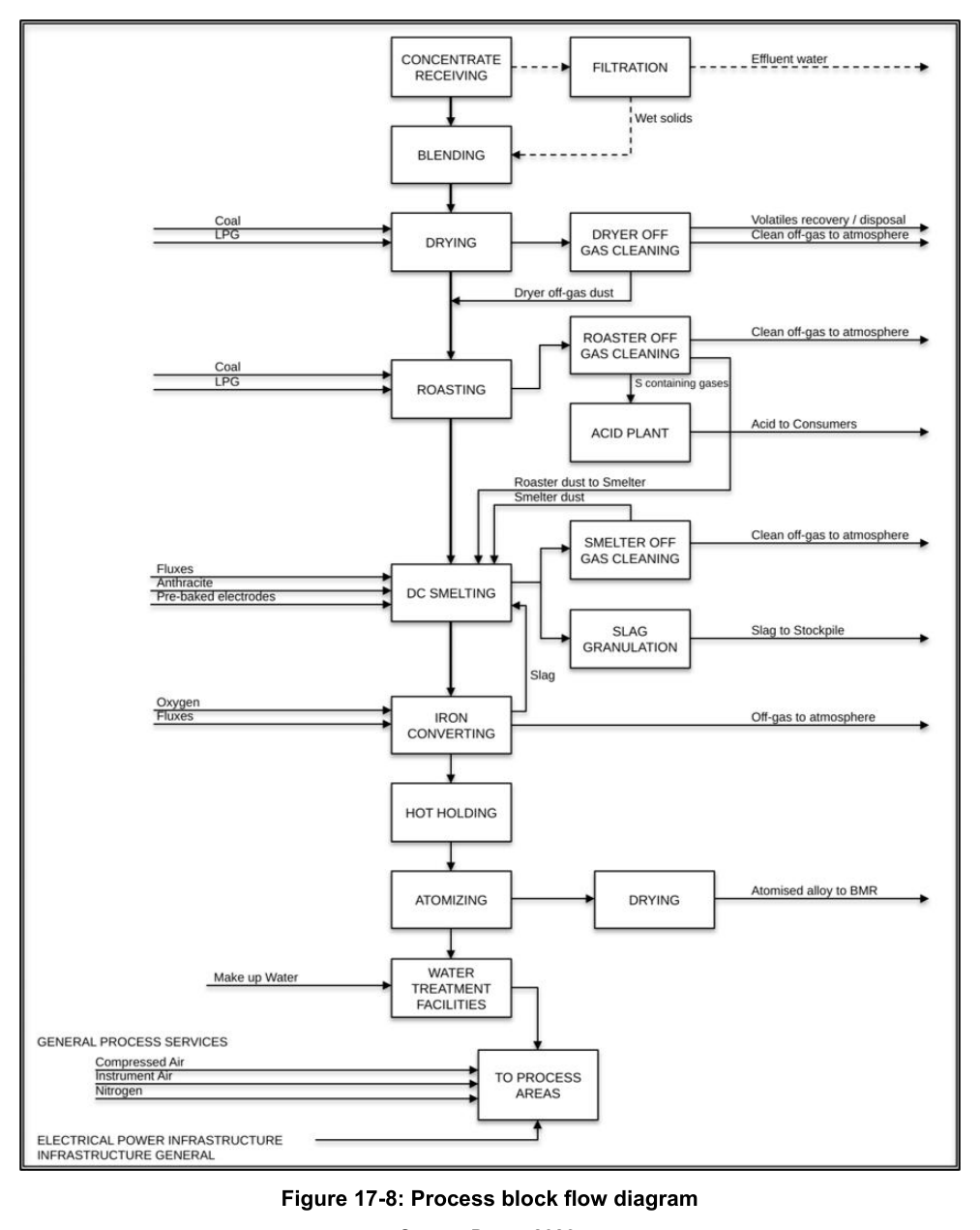
Downstream smelting. Bulk sulphide concentrate moves about 500 km by road from the mine to a dedicated smelter in Barcarena, Pará State, inside the Vila do Conde Export Processing Zone and 8.5 km from port loading berths. The site selected oxidative fluidized bed roasting ahead of reductive smelting in a DC electric arc furnace.
Concentrate arrives as filter cake and is blended, then dried from 8% moisture to about 1% in a natural gas fired rotary dryer that evaporates 1.9 t/h of water. Dried concentrate at 24.9 t/h enters the roaster at 1,000 °C under oxidizing conditions. Sulphur in the solids falls from 18.7% to 0.37%, a removal of about 98%. Arsenic volatilizes to the off-gas and is removed with chloride and fluoride in wet gas cleaning. The roaster runs autogenously at design feed sulphur grade, and calcine leaves at 20.1 t/h.
Calcine charges hot to the DC arc furnace with anthracite reductant and magnesia flux. Carbon reduces iron oxide to metallic iron, which collects precious metals, nickel, copper and cobalt in an alloy that separates from slag by density. Furnace off-gas, mostly carbon monoxide, is cooled and cleaned, and recovered dust returns to the furnace. Furnace alloy goes by ladle to a top-blown converter, where oxygen and silica flux oxidize iron at an assumed 97% removal. Converter alloy is held molten in an induction furnace and water-atomized at 100 MPa into powder sized 10 to 150 µm, then leached in sulphuric acid. Roaster off-gas feeds a double-contact acid plant producing 98% sulphuric acid.
The smelter draws power from the Vila do Conde substation about 1.5 km away through a 138 kV line and a 40 MVA transformer. Installed load is 30.05 MW, average demand 27.20 MW, and annual consumption 202.6 GWh. Raw water make-up is 220 m³/h with a circulating duty of 720 m³/h.
Additional Interesting Data and Summary
Smelter test work spans more than a decade. In 1998, about 30 t of PGM-bearing sulphide concentrate was roasted in a fluidized bed at about 1,000 °C, cutting sulphur from 4.55% to 0.13%, then smelted in a pilot DC arc furnace at an average 1,650 °C, with average precious metal loss to slag of 2.9 g/t and a specific energy requirement of 650 kWh/t of calcine.
Between April 2004 and August 2008, more than 37,000 t of PGM-bearing feed was dried and smelted in a 1.5 MW DC arc furnace over four and a half years of continuous toll treatment. Across 36,952 t processed, weighted average feed grade was 51 g/t 4E and weighted average slag grade 1.1 g/t. Gross energy consumption fell from 1.22 MWh/t in the first campaign to 0.83 MWh/t in the fifth, and electrode consumption averaged 1.5 kg per MWh.
Two later campaigns in a 3 MW DC arc furnace treated higher-sulphur material that produced a reductive matte, and superheated matte attacked sidewall refractories. In the second campaign, roughly a quarter of the precious metal fed was locked in the furnace hearth.
Bravo ran exploratory bench-scale work on Luanga concentrate at Arxo Metals in 2024. A 68 g/t 4E sample roasted at 1,000 °C for 120 minutes brought sulphur to 1.23% against a target below 2%, and smelting in a 35 kVA DC furnace produced a nickel-iron alloy grading 716 g/t 4E with precious metals and nickel in the slag below detection limits. The report notes that calculated recoveries from this work are not relied upon.
The furnace is designed for 30% recovery of total iron into alloy. Adopted deportments are 98% for Pt, Pd, Rh and Au, 90% for nickel, 80% for cobalt, 80% for copper and 1% for chromium. At design throughput the smelter balance shows drying at 26.9 t/h in and out, roasting at 29.2 t/h, smelting at 22.0 t/h in and 22.1 t/h out, and converting at 4.5 t/h. Smelting carries 14.70 MW of process energy and 17.70 MW including losses, while roasting shows a net energy surplus.
Smelting 20.1 t/h of calcine with 0.4 t/h of anthracite and 1.5 t/h of magnesia flux yields 3.9 t/h of alloy and 17.5 t/h of slag, at a specific energy requirement of 0.731 MWh/t of calcine and 83% electrical thermal efficiency. The acid plant converts 9.1 t/h of SO₂ into 12.7 t/h of 98% sulphuric acid.
Annual production at design throughput is 21,455 t of atomized converter alloy, carrying 769,000 oz of Pt, Pd and Rh, 88,000 oz of gold, 13,860 t of nickel, 5,920 t of copper and 688 t of cobalt, along with 94,400 t of sulphuric acid, 130,200 t of granulated furnace slag and 14,200 t of converter slag for re-treatment.
Key Processes
- Primary gyratory crushing at 1,631 t/h followed by two-stage screening and cone crushing in closed circuit
- HPGR comminution with closed-circuit screening and a specific energy consumption of 1.50 kWh/t
- Two-stage cyclone classification feeding an 18 MW ball mill and a vertical stirred mill
- Jameson cell flotation with one rougher, two scavenger and one cleaner stage
- Thickening and filtration of concentrate in a 30 m thickener
- Tailings thickening in a 125 m thickener with water recovery to the process tank
- Trucking of bulk concentrate about 500 km to the Barcarena smelter
- Natural gas drying of concentrate from 8% to about 1% moisture
- Bubbling fluidized bed roasting at 1,000 °C with 98% sulphur removal
- DC electric arc smelting at 20 MW with anthracite reduction and magnesia flux
- Top-blown converting with 97% iron removal and water atomization at 100 MPa
- Sulphuric acid leaching of atomized alloy and double-contact acid production from roaster gas
Source: NI 43-101 Technical Report Pre-Feasibility Study on the Luanga Project – Pará State, Brazil, 2026-09-16. Project website: Luanga Project
