

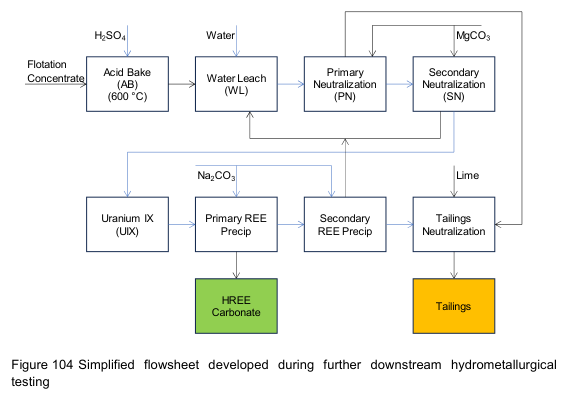
Source: Namibia Critical Metals Inc (2026)
Website: https://www.namibiacriticalmetals.com/projects/lofdal-heavy-rare-earths-project
Critical Data
| Parameter | Value | Unit | Notes |
|---|---|---|---|
| Throughput (Crushing & Sorting) | 3,010,000 | tpa | Total ROM feed for crushing and XRT sorting |
| Processing Capacity (Concentrator & Refinery) | 1,482,000 | tpa | Feed after sorting to milling and downstream processes |
| Target Grind Size | 38 | µm | P80 of ball mill circuit product |
| Head Grade (High Grade Feed) | 0.262 | % TREO | Feed grade for high-grade ore circuit |
| Head Grade (Low Grade Feed) | 0.125 | % TREO | Feed grade for low-grade ore circuit with sorting |
| Overall REO Recovery | 59.4 | % | Total REO recovery across entire process plant |
| Heavy REO Recovery | 62.2 | % | HREO recovery including Y2O3 |
| Bond Ball Mill Work Index | 16.7 | kWh/t | Grindability parameter for mill design |
| Sulphuric Acid Dosage | 1,500 | kg/t conc. | Acid consumption in sulphation roast |
| Flotation Recovery Range | 52-68 | % | Overall float TREO recovery from rougher-cleaner circuit |
Overview
Namibia Critical Metals Inc. is advancing the Lofdal Heavy Rare Earths Project 2B-4 in Namibia, a strategic source of heavy rare earth elements (HREOs) including dysprosium and yttrium. The Preliminary Feasibility Study (PFS), dated April 2024, outlines a comprehensive recovery plant designed to process 3.01 million tonnes per annum (Mtpa) of run-of-mine ore through crushing and sorting, with 1.482 Mtpa fed into the concentrator and refinery. Located approximately 2.5 km west-northwest of Area 4, the project benefits from established infrastructure and nearby uranium producers, enabling a unique by-product recovery stream. The significance of Lofdal lies in its high HREO-to-TREO ratio, with indicated resources of 0.09% HREO and inferred resources of 0.07% HREO, positioning it as a critical supplier for clean energy and defense technologies. The recovery process begins with dual high-grade and low-grade crushing circuits, incorporating X-ray transmission (XRT) ore sorting to upgrade feed. The concentrator uses ball milling to a P80 of 38 µm, followed by a flotation circuit consisting of roughers, cleaners, and re-cleaners to produce a rare earth concentrate. The refinery section employs a sulphation roast at 600°C, water leach, impurity precipitation, and uranium ion exchange before final REE carbonate precipitation. Water is recycled extensively, and tailings are thickened and sent to a dedicated storage facility. This integrated flowsheet achieves overall REO recovery of 59.4% and HREO recovery of 62.2%, demonstrating robust metallurgical performance for a complex heavy rare earth deposit.
Key Process Stages
- Stage 1: Crushing and XRT Ore Sorting – High-grade ore undergoes primary jaw crushing (P80 79 mm), secondary cone crushing in closed circuit (P80 24 mm), and tertiary VSI crushing (P80 17 mm). Low-grade ore uses a separate circuit with similar stages plus XRT sorting at coarse (50–25 mm) and fine (25–10 mm) sizes, rejecting fines (<10 mm) to waste. Sorter product reports to the crushed ore stockpile.
- Stage 2: Ball Milling – Crushed ore (F80 12 mm) feeds a single-stage ball mill in closed circuit with flat-bottom cyclones. The mill operates wet with 250% recirculation load, achieving a final product P80 of 38 µm. The Bond ball mill work index is 16.7 kWh/t, and the circuit availability is 90%.
- Stage 3: Flotation Circuit – The milled slurry is conditioned at 35% solids with high-intensity mixing (1,800 rpm). Rougher flotation uses five 70 m³ tank cells, followed by three 20 m³ cleaner cells and two 5 m³ re-cleaner cells. Collectors (Florrea 3900Z at 1,235 g/t and Florrea 3000 at 260 g/t) and depressant (sodium silicate at 213 g/t) are added. Overall mass pull is 3.78% with TREO recovery of 52–68%.
- Stage 4: Refinery – Sulphation Roast and Water Leach – Flotation concentrate cake is mixed with concentrated H₂SO₄ (1,500 kg/t concentrate) in a pug mill and fed to a rotary kiln at 600°C for 1.5 hours. The sulphated product is cooled and leached in four tanks at 50°C for one hour at 16–18.4% solids, selectively dissolving rare earth sulphates.
- Stage 5: Purification and REE Precipitation – Leach liquor undergoes primary impurity removal with MgCO₃ (707 kg/t conc.) followed by secondary neutralization. Uranium is recovered via ion exchange (99.9% recovery) and precipitated as ammonium di-uranate (ADU) using NH₄OH at pH 7.3. REEs are precipitated with Na₂CO₃ at pH 6.75, thickened, filtered, dried, and packaged as mixed rare earth carbonate.
Additional Interesting Data and Summary
Beyond the core flowsheet, the Lofdal project incorporates several critical design features that enhance sustainability and economic viability. The concentrator section includes a tailings thickener producing underflow at 50% solids, with overflow water recycled to the process water dam. The refinery employs a closed-loop sulphuric acid recovery system via kiln off-gas scrubbing, minimizing reagent consumption. Uranium by-product recovery is a key economic driver: ion exchange captures 99.9% of uranium from the leach liquor, and the resulting ADU slurry is shipped to a local Namibian uranium producer, generating additional revenue while reducing waste. The process water balance is optimized through thickener overflows and filtrate returns, with separate front-end and back-end water storage facilities to manage quality. Environmental controls include neutralization of tailings using milk of lime, and all spillages are directed back to process or neutralization tanks. Reagent handling is designed for safety: sulphuric acid storage includes desiccant dryers and spill containment, while flocculant and collectors are prepared in dedicated mixing areas. The plant’s design criteria are based on extensive testwork by Mintek, SGS Lakefield, Geolabs SA, and other laboratories, confirming the suitability of the flowsheet for Lofdal’s mineralogy. The PFS assumes a 90% availability for the ball mill and 68% for crushing circuits, with a 250% recirculation load in milling. Future optimization work may focus on reducing acid consumption and improving flotation selectivity, particularly for low-grade ores. The project’s location in Namibia provides access to established mining infrastructure, skilled labor, and existing uranium processing facilities, reducing capital and operational risks. With a total indicated resource of 4.4 kt TREO and inferred resources of 6.6 kt TREO at a cut-off of 0.1% TREO, the Lofdal project represents a significant opportunity for heavy rare earth supply chain diversification. The recovery methods outlined in the PFS demonstrate a technically robust and environmentally conscious approach to processing a complex HREO deposit, positioning Namibia Critical Metals to become a key Western-world supplier of dysprosium and other strategic rare earths.
Key Processes: Flotation, Ball Mill, Crushing
Target Commodities: Uranium
Technical report and processing history
The following archived source profiles have been consolidated here to preserve the project’s processing history and study context.
Lofdal Heavy Rare Earths Project — Preliminary Feasibility Study
Lofdal Heavy Rare Earths Project — Preliminary Feasibility Study
| Company | Namibia Critical Metals |
| Date | 2024 |
| Region | Namibia |
| Commodities | Heavy Rare Earths, Uranium |
| Mine Type | Open Pit |
| Throughput | 3.01 million tpa |
| Status | Development |
Executive Summary
The Lofdal Heavy Rare Earths Project Preliminary Feasibility Study outlines a comprehensive processing plant designed to recover Heavy Rare Earth Elements (HREE) and Uranium from ore in Namibia. The proposed flowsheet, based on testwork results, handles a throughput of 3.01 million tonnes per annum of run-of-mine ore. The plant is divided into three main sections: crushers and sorters, the concentrator, and the refinery. Key operational parameters include a primary jaw crusher, secondary cone crusher, and tertiary VSI crusher, followed by X-ray transmission (XRT) ore sorting to upgrade low-grade ore before further processing.
The concentrator section utilizes a single-stage ball mill circuit operating in a closed loop with cyclones to achieve a P80 of 38 microns. Flotation is conducted using rougher, cleaner, and re-cleaner banks with specific collectors and depressants to maximize TREO recovery. The concentrate then undergoes hydrometallurgical treatment, including sulphation roasting and water leaching to solubilize rare earths. Uranium is selectively removed via ion exchange, followed by precipitation of the final Rare Earth Carbonate product. The overall process plant recovery is estimated at 59.4% for Total REO and 62.2% for Heavy REO.
Processing Methods
Reports
Website: https://www.namibiacriticalmetals.com/projects/lofdal-heavy-rare-earths-project
Report Date: 2024
Region: Namibia
Project Status: Development
Commodity: Heavy Rare Earths, Uranium
Throughput: 3.01 million tpa
Mine Life:
Mine Type: Open Pit
Ore type:
Lofdal Heavy Rare Earths Project 2B-4 Preliminary Economic Assessment
Lofdal Heavy Rare Earths Project 2B-4 Preliminary Economic Assessment
| Company | Namibia Critical Metals |
| Date | 2021 |
| Region | Namibia |
| Commodities | Rare Earth Elements, Uranium, Thorium |
Executive Summary
This NI 43-101 Technical Report presents a Preliminary Economic Assessment for the Lofdal Heavy Rare Earths Project in Namibia. The study outlines a processing facility designed to handle 5,918 tonnes per day of run-of-mine ore from the A4 and A2B deposits. The flowsheet focuses on producing a mixed rare earth oxide product, with by-product recovery of uranium and thorium.
The process design emphasizes simplicity, adaptability, and cost sensitivity, utilizing proven equipment. Key stages include crushing, ball milling, flotation, magnetic separation, and extensive hydrometallurgical processing involving acid bake, water leaching, ion exchange, and solvent extraction. The estimated operating cost is approximately $69.1 million annually, with a feed cost of $32.00 per tonne of ROM feed.
The capital estimate is presented as an Order of Magnitude estimate with a base date of August 2021. The project is currently in the development phase, with the final concentrate intended for shipment to separation facilities abroad.
Website: https://www.namibiacriticalmetals.com/projects/lofdal-heavy-rare-earths-project
Report Date: 2021
Region: Namibia
Project Status:
Commodity: Rare Earth Elements, Uranium, Thorium
Throughput:
Mine Life:
Mine Type:
Ore type:
Lofdal Project — 2014 Technical Report
Lofdal Project — 2014 Technical Report
| Company | Namibia Rare Earths Inc. |
| Date | 2014 |
| Region | Namibia |
| Commodities | Rare Earth Elements, Thorium |
| Mine Type | Open Pit |
| Throughput | 2,500 t/d |
| Status | Development |
Executive Summary
This Preliminary Economic Assessment (PEA) outlines the technical basis for the Lofdal Rare Earth Project in Namibia, developed by Namibia Rare Earths Inc. The project focuses on the extraction and processing of xenotime-bearing carbonatite ore to recover Total Rare Earth Oxides (TREO) and manage thorium as a by-product. The proposed flowsheet is designed for a 2,500 t/d primary processing facility coupled with a remote xenotime cracking facility to remove radioactive thorium from the concentrate before shipping to overseas refineries.
The processing design emphasizes simplicity, adaptability, and capital sensitivity while prioritizing safety regarding radiation and chemical hazards. Key operational steps include primary and secondary crushing, XRT ore sorting to reduce mass, ball milling, wet magnetic separation, and gangue acid leaching using hydrochloric acid. The concentrate is then transported to a cracking facility where caustic digestion breaks down the xenotime matrix to facilitate thorium removal via acid leaching and precipitation.
Safety and risk assessments are integral to the design, particularly concerning ionizing radiation from thorium and chemical handling of hydrochloric acid and caustic soda. The project addresses water management in an arid region through recirculation and thickening strategies. Recommendations include further testwork on grind optimization, gangue leach robustness, and water availability confirmation to finalize the flowsheet and economic viability.
Website: https://www.namibiacriticalmetals.com/projects/lofdal-heavy-rare-earths-project
Report Date: 2014
Region: Namibia
Project Status: Development
Commodity: Rare Earth Elements, Thorium
Throughput: 2,500 t/d
Mine Life:
Mine Type: Open Pit
Ore type:
