

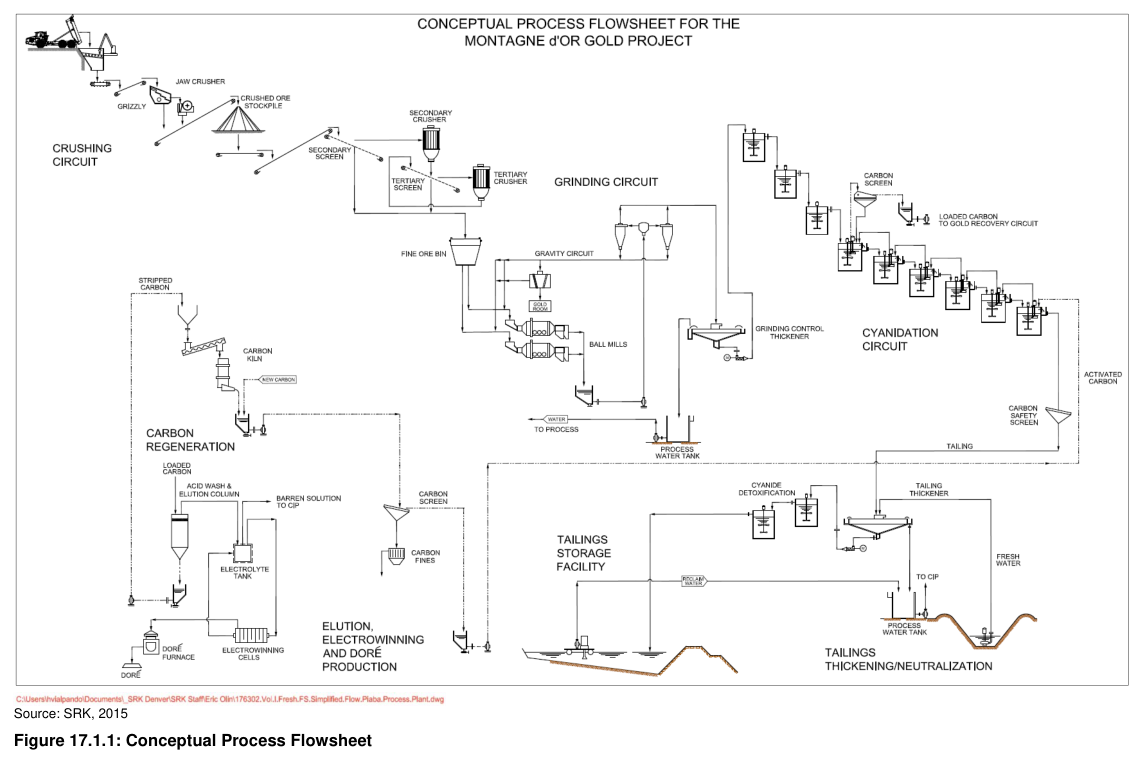
The 2015 Preliminary Economic Assessment for the Montagne d’Or gold deposit at the Paul Isnard Project in French Guiana presents a proposed process flowsheet based on gravity concentration followed by cyanidation of gravity tailings, with supporting metallurgical testwork and conceptual capital and operating cost estimates.
Report context
This NI 43-101 Technical Report and Preliminary Economic Assessment (PEA) for the Montagne d’Or gold deposit, part of the Paul Isnard Project, was prepared by SRK Consulting (U.S.), Inc. for Nord Gold N.V. and Columbus Gold Corporation. Columbus Gold Corporation is the project owner and operator, exploring the deposit under an option agreement with Nordgold. The project is operated through Société de Travaux Publiques et de Mines Aurifères de Guyane (SOTRAPMAG), a 100% owned subsidiary of Columbus Gold. The report date is July 8, 2015. The PEA is preliminary in nature and includes Inferred Mineral Resources that are considered too speculative geologically to have economic considerations applied that would enable them to be categorized as Mineral Reserves.
Processing route
Selected process flowsheet
Metallurgical testwork was conducted to evaluate three process flowsheet options: whole-ore cyanidation; gravity concentration followed by cyanidation of the gravity tailing; and gravity concentration followed by gold and silver flotation from the gravity tailing and cyanidation of the flotation concentrate. A trade-off study selected the flowsheet that includes gravity concentration followed by cyanidation of the gravity tailing. This option offered higher overall gold and silver recoveries and resulted in the highest project net present value and internal rate of return.
The selected process flowsheet will incorporate process unit operations that are standard to the industry, including crushing, grinding, agitated cyanide leaching, gold and silver adsorption onto activated carbon, gold and silver desorption, electrowinning and refining. The cyanidation tailings will be detoxified to less than 1 ppm CN wad using the INCO SO₂/air process. The process plant is designed for a throughput capacity of 12,500 t/d.
Metallurgical testwork program
The metallurgical test program was conducted on two master composites formulated from available whole core intervals representing the UFZ and the LFZ, as well as selected variability composites. Three process options were investigated on the two master composites. The preferred process option and optimal conditions were further verified on ten variability test composites. Processing by gravity concentration followed by cyanidation of the gravity tailings yielded the highest overall gold recoveries, with gold recovery projected at approximately 95%.
Process operating costs
Process operating costs are estimated at US$14.55/t processed, based on a throughput capacity of 12,500 t/d. Operating costs have been estimated by major categories including labor, power, consumables and other items. The major contributors to operating cost are power and reagents. Power is estimated at US$6.00/t, reagents at US$4.50/t, comminution consumables at US$1.70/t, labor at US$1.50/t, maintenance supplies at US$0.50/t, and other costs at US$0.35/t.
Process capital costs
The capital cost for the 12,500 t/d process plant is estimated at US$136.7 million and is considered at a conceptual level with a +/-50% level of accuracy. The capital cost estimate is based on Infomine’s CostMine Model for a CIP processing plant and includes a 30% adjustment factor applied by SRK based on experience with the CostMine models. The estimate includes escalation to the 12,500 t/d design using the industry accepted cost-capacity relationship with an exponent of 0.65. Tailings pond capital cost and working capital are excluded from the process plant estimate.
The process plant capital cost by area is estimated at US$42.4 million for comminution, US$30.2 million for CIL leaching, US$9.0 million for solid-liquid separation, US$10.5 million for general areas, and US$13.1 million for engineering and management.
Tailings and infrastructure
Tailings operating costs are estimated at US$0.47/t processed. The tailings storage facility (TSF) and other major infrastructure items have been conceptually located. Nordgold indicated that a sterilization drilling program will be carried out in 2015 to test these locations for suitability.
Infrastructure capital cost, not related to mining and processing, is estimated at US$84.6 million, including a 20% contingency. This covers US$33 million for HFO/palm oil power generation (28 MW nominal), US$12.5 million for a potential water treatment plant, and US$25 million for road upgrades and other items. A site water balance was recommended during feasibility study work, with the aim of the TSF design to provide a net neutral water balance that could prevent the need for a water treatment plant.
Key reported parameters
| Parameter | Unit | Value | Basis |
|---|---|---|---|
| Indicated Mineral Resource | Mt | 83.24 | April 11, 2015 resource statement, 0.4 g/t cut-off |
| Indicated grade | g/t Au | 1.455 | April 11, 2015 resource statement |
| Indicated contained gold | Moz | 3.893 | April 11, 2015 resource statement |
| Inferred Mineral Resource | Mt | 22.37 | April 11, 2015 resource statement, 0.4 g/t cut-off |
| Inferred grade | g/t Au | 1.550 | April 11, 2015 resource statement |
| Inferred contained gold | Moz | 1.115 | April 11, 2015 resource statement |
| Gold recovery (projected) | % | ~95 | Metallurgical testwork, preferred option |
| Plant throughput capacity | t/d | 12,500 | Design basis |
| Process operating cost | US$/t mill feed | 14.55 | PEA estimate, by category |
| Process plant capital cost | US$ million | 136.7 | Conceptual level, +/-50% accuracy |
| Tailings operating cost | US$/t mill feed | 0.47 | PEA estimate |
| Infrastructure capital cost | US$ million | 84.6 | Including 20% contingency |
| Support operating cost | US$/t mill feed | 5.42 | Placeholder based on analogous projects |
| Total operating cost (LoM) | US$/t mill feed | 31.83 | PEA estimate |
| Total initial capital cost | US$ million | 366.4 | Including pre-stripping and contingency |
| Total sustaining capital | US$ million | 216.1 | LoM estimate |
| Reclamation/closure cost | US$ million | 25.0 | Based on similar projects |
| Mine life | years | 13 | PEA production schedule |
| Annual recovered gold (first 11 years) | koz/yr | ~265 | PEA estimate, prior to stockpile feed |
| Gold price assumption | US$/oz | 1,200 | PEA base case |
| After-tax NPV (8% discount) | US$ million | 324 | PEA base case |
| After-tax IRR | % | 23.0 | PEA base case |
| AISC | US$/oz | 711 | PEA base case |
Project website: https://en.wikipedia.org/wiki/Montagne_d%27Or_mine
Technical qualifications
The following specific limitations are documented in the report:
The PEA is preliminary in nature and includes Inferred Mineral Resources that are considered too speculative geologically to have economic considerations applied that would enable them to be categorized as Mineral Reserves. There is no certainty that the PEA will be realized.
All mine planning, production scheduling, mine operating and capital cost estimation were conducted to a level of detail greater than that of a normal PEA, but with more detail on labor rates, burdens, support costs and geotechnical factor of safety analysis the mine plan could be considered at pre-feasibility level.
The process plant capital cost estimate is considered at a conceptual level with a +/-50% level of accuracy.
The support operating cost of US$5.42/t mill feed is a placeholder based on similar analogous projects and not a build-up from first principles.
The economic analysis reports Indicated and Inferred Mineral Resources, with Inferred Resources included; the sensitivity analysis shows the project would reach breakeven NPV at a gold price of approximately US$947/oz.
Source: NI 43-101 Technical Report – PEA for the Montagne d’Or Gold Deposit, Paul Isnard Project, July 8, 2015, Sections 1.5, 1.8, 1.9, 1.10, 1.11, 1.12, 1.13.
