

This 2020 technical report presents a conceptual processing route for sulphide mineralization via bio-oxidation and cyanidation, with oxide mineralization treated on a conventional heap leach pad, based on scoping-level testwork.
Report context
The technical report for the Mother Lode Project, dated 2020, describes conceptual processing methods developed for the treatment of run-of-mine (ROM) sulphide and oxide mineralization. Metallurgical testing discussed in Section 13 of the report was used to project process recoveries for both the bio-oxidation mill and the heap leach process. Design criteria were developed with the objective of sizing equipment for the two processes based on limited scoping-level testwork, with assumptions made where data were not available.
Processing route
Conceptual bio-oxidation mill process flowsheet
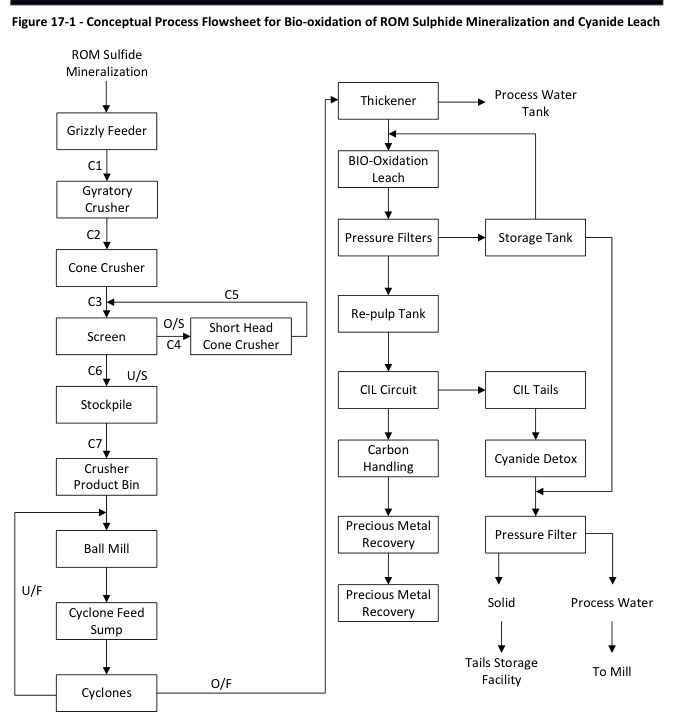
A conceptual process flowsheet was developed for the bio-oxidation milling of ROM sulphide mineralization followed by cyanidation for gold extraction, based on scoping-level testwork. The conceptual flowsheet (Figure 17-1 in the report) shows the following proposed circuit.
ROM sulphide mineralization would be fed to a primary gyratory crusher. The primary crusher product would be conveyed to a secondary cone crusher. The crusher product would be screened to remove 19 mm (0.75 in; P80 of 0.5 in) product. Screen oversize would be conveyed to a short-head cone crusher, and the product from that crusher would be returned to the screen. Screen undersize would be stockpiled.
Fine crushed mineralization would be conveyed from stockpile to the crusher product bin. Mineralization in the bin would be fed to a ball mill, with the discharge pumped to a cyclone pack. The cyclones would produce an overflow product having a P80 of 150 mesh (104 micrometers). The ground product would be sent to a thickener. Thickener underflow would be pumped to a series of rubber-lined bio-oxidation leach tanks. Initially, acid would be added to adjust the Eh/pH of the slurry to the desired level and mesophilic culture would be added for bio-oxidation of the sulphides.
Bio-oxidized mineralization would be pressure filtered and washed, then sent to a repulp tank. The acidic solution would be recycled, with any excess solution sent to the tails storage facility (TSF). The oxidized slurry would be pumped to a carbon-in-leach (CIL) circuit for cyanidation. Carbon from the CIL tanks would be sent for acid wash, elution, and regeneration via a common kiln before being returned to the CIL circuit. Electrowinning sludge would be filtered, dried and melted to produce doré. CIL tails would be detoxified prior to disposal. Excess acidic solution would be mixed with the CIL tails at the tails storage facility and pressure filtered. The resulting material at 75% solids would be stored at the tails facility. Filtrate and any reclaimed solution from the TSF would be pumped back to the mill.
Design criteria for the proposed bio-oxidation process are presented in Table 17-1 of the report, developed from limited scoping-level testwork. The major equipment list for the 8,200 tonnes per day plant is provided in Table 17-2.
Heap leach processing of oxide mineralization
Mineralization from the Mother Lode open pit would be mined and placed onto a heap leach pad. ROM mineralized material would be mined at an average rate of approximately 13,200 tonnes per day and placed on a conventional heap leach pad in nominal 9.1 m (30 ft) lifts. Quicklime (CaO) would be added to the mineralized material prior to placement on the leach pad for pH control. Barren solution containing dilute sodium cyanide would be applied via drip emitters at an application rate of 7.3 L/h/m² (0.003 gpm/ft²). Pregnant solution would be collected in a divided pond where sediment would settle before overflowing an internal berm. Pregnant solution pumps would feed a pair of vertical carbon-in-columns (VCIC). Gold and silver extracted from the pregnant solution onto activated carbon would be further processed via the desorption and recovery circuit to produce a final doré product.
A simplified process flow diagram (PFD) for the heap leach/ADR circuit is shown in Figure 17-2 of the report. Process design criteria are presented in Table 17-3.
The leach pad would be designed as a double-lined facility consisting of a layer of geosynthetic clay liner (GCL) with a hydraulic conductivity less than or equal to 1×10⁻⁶ cm/s as the secondary liner system. A layer of 80-mil geosynthetic liner made from high-density polyethylene (HDPE) would be placed over the GCL as the primary liner. A leak detection system would be installed between the GCL and HDPE liner. ROM mineralization would be stacked in lifts averaging 9.1 m (30 ft) high to a maximum of 91.4 m (300 ft). The pad would have an area of approximately 579,000 m² with a capacity to hold 41.1 million tonnes of mineralized material.
Key reported parameters
| Parameter | Unit | Design/Actual/Testwork Basis | Value |
|---|---|---|---|
| Bio-oxidation mill throughput | dmtpd | Design | 8,200 |
| Bio-oxidation mill throughput | dmtph | Design | 341.7 |
| Plant operation | dpy | Design | 365 |
| Plant operation | hrs/d | Design | 24 |
| Crushing circuit availability | % | Design | 75 |
| Grinding circuit availability | % | Design | 92 |
| Grinding P80 | microns | Design | 104 |
| Bio-oxidation leach time | hrs | Assumed | 72 |
| Bio-oxidation feed pulp density | % | Assumed | 40 |
| CIL leach time | hrs | Design | 30 |
| Detoxification time | hrs | Design | 4 |
| Sulphide gold recovery (biox-mill) | % | Projected from testwork | 91 |
| Heap leach throughput | tonnes per day | Design | 13,200 |
| Heap leach pad area | m² | Design | 579,000 |
| Heap leach pad capacity | tonnes | Design | 41.1 million |
| Heap leach lift height | m | Design | 9.1 |
| Barren solution application rate | L/h/m² | Design | 7.3 |
| Average leach cycle | days | Design | 90 |
| Oxide gold recovery (heap leach) | % | Projected from testwork | 74 |
| Oxide silver recovery (heap leach) | % | Projected from testwork | 7 |
| Head grade, Au (heap leach) | g/t | LOM average | 0.44 |
| Head grade, Ag (heap leach) | g/t | LOM average | 0.86 |
Project website: https://www.juniorminingnetwork.com/junior-miner-news/press-releases/1084-tsx/kor/33087-corvus-gold-acquires-mother-lode-property-from-goldcorp.html
Technical qualifications
The process design criteria for the bio-oxidation mill were developed from limited scoping-level testwork. Assumptions were made where data were not available and are listed in Table 17-1 of the report. Metallurgical testwork discussed in Section 13 was used to project process recoveries, but the report does not provide detailed testwork methodology or results. The conceptual process flowsheet was developed for scoping-level evaluation only. No actual operating data from a bio-oxidation mill at this site are presented; the proposed design remains conceptual. Bio-oxidation leach time, feed pulp density, pressure filtration rates, and certain other parameters are noted as assumed values with no testwork basis provided.
—
*Source: Mother Lode Project , 2020 Technical Report, Recovery Methods and Processing sections.*
