

A 2012 NI 43-101 technical report for the Invicta gold project in Peru describes metallurgical testwork and a proposed conventional flotation flowsheet producing separate copper and lead concentrates. The testwork reported here supersedes an earlier unconventional gravity–cyanidation–sequential flotation design.
Report context
This NI 43-101 technical report, effective April 6, 2012, was prepared by SRK Consulting (U.S.) for Andean American Gold Corp. covering the Invicta project in Huaura province, Peru. Section 11 of the report documents mineral processing and metallurgical testing, while Section 17.2 describes the proposed recovery methods.), with testwork undertaken at the National University of San Augustine of Arequipa, Peru. A single large composite sample exceeding one tonne was used. The report is a resource estimate and does not constitute a feasibility study; the processing description is based on testwork and a proposed commercial flowsheet, not an operating plant.
Processing route
The test programme moved from an earlier unconventional flowsheet (gravity concentration followed by cyanidation of gravity concentrate, then sequential flotation of copper, lead and zinc) to a conventional bulk copper-lead flotation route with subsequent copper-lead separation.
Feed preparation and bulk rougher flotation
The composite sample assayed 1.34% Cu, 1.32% Pb, 0.93% Zn, 5.95 g/t Au and 47 g/t Ag. Grind size optimisation tests indicated that a primary grind P80 of 200 mesh (75 micrometres) was optimum for recovery of copper, lead, gold and silver. At this grind size in the bulk Cu/Pb rougher circuit, recoveries were 69.97% Cu, 96.07% Pb, 60.36% Au and 80.31% Ag in an 8.19% mass pull grading 12.17% Cu, 15.91% Pb, 1.75% Zn, 43.08 g/t Au and 567.81 g/t Ag. Zinc minerals were depressed in the bulk circuit using zinc cyanide (Zn(CN)₂) at 300 g/t, identified as the optimum dosage. Higher addition (500–700 g/t) depressed copper, gold and silver.
Bulk cleaner flotation
Testing established that no regrind of the bulk Cu/Pb concentrate was required for the cleaner circuit. Two stages of cleaner flotation were sufficient for upgrading. A two-stage locked-cycle test (Test 89) produced a bulk first cleaner tail sent to final tailings and a second cleaner tail recycled to first cleaner feed. The bulk cleaner concentrate then reported to copper-lead separation.
Copper-lead separation
Over 30 rougher and bulk cleaner tests generated approximately 6 kg of bulk concentrate for separation testwork. After evaluating various reagent schemes, the selected approach was to depress lead minerals using sodium hydrosulfite and potassium dichromate while floating copper minerals. The copper concentrate was cleaned once to reject additional lead.
Locked-cycle test results (proposed design basis)
Duplicate locked-cycle tests (Tests 89 and 90) provided the metallurgical basis for plant design. From a calculated feed grading approximately 1.42–1.44% Cu, 1.83–1.87% Pb, 1.20–1.23% Zn, 5.17–5.41 g/t Au and 51–55 g/t Ag, the following concentrate products were reported:
- Copper concentrate: 31.25–31.45% Cu, 110.67–113.18 g/t Au, 645.78–652.17 g/t Ag. Recoveries to copper concentrate: 79.7–83.3% Cu, 77.3–80.5% Au, 45.3–45.5% Ag.
- Lead concentrate: 48.54–57.20% Pb, 8.31–13.33 g/t Au, 620.99–644.19 g/t Ag. Recoveries to lead concentrate: 82.2–82.4% Pb, 4.8–6.9% Au, 33.8–34.9% Ag.
Pilot plant confirmation
A pilot plant with capacity 125 kg/h was operated semi-continuously using the bench-scale flowsheet to confirm process performance and generate material for sedimentation and filtration testing. The overall metallurgical balance (Table 11.2.7.1) showed results similar to the locked-cycle tests. Pilot plant concentrate grades by ICP analysis were:
- Copper concentrate: 31.3% Cu, 3.47% Pb, 1.77% Zn, 28.05% Fe, 32.2% S, 113 ppm Au, 647 ppm Ag
- Lead concentrate: 53.6% Pb, 2.81% Cu, 3.94% Zn, 9.22% Fe, 9.52% S, 9.75 ppm Au, 623 ppm Ag
Hexavalent chromium (Cr⁺⁶) in recovered water was generally below 0.4 ppm when potassium dichromate addition was less than 90 g/t. Gold, silver, copper and lead losses in bulk tailings were predominantly in the minus 325 mesh fraction. Open and locked-cycle tests with increased solids loading from 32% to 40% in the bulk rougher/scavenger circuit showed increased recovery and decreased reagent consumption.
Proposed commercial flowsheet
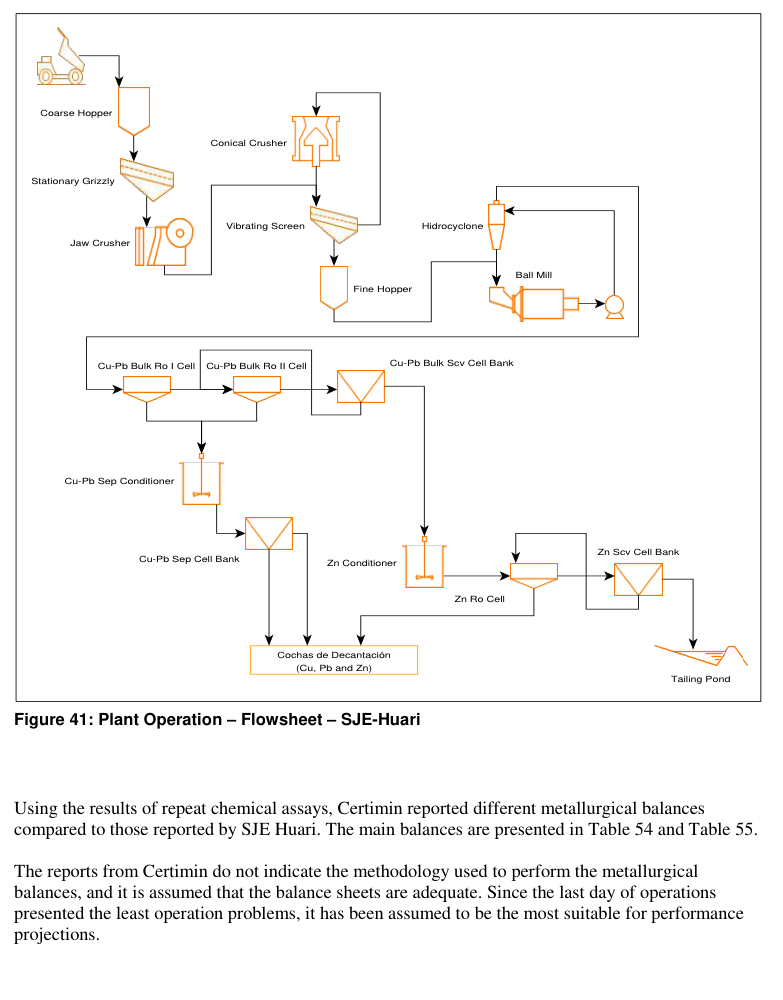
The proposed plant flowsheet (Figure 17-1 in the report) comprised:
- Grinding to P80 200 mesh with zinc depressant added in the mill
- Bulk Cu-Pb rougher-scavenger flotation
- Two stages of bulk cleaner flotation (first cleaner tail to final tailings; second cleaner tail recycled to first cleaner feed)
- Copper-lead separation circuit (lead depressed, copper floated)
- Single cleaning stage for copper concentrate
- Filtration of both concentrates for transport and sale
Zinc recovery from rougher tailings was tested but not incorporated into the flowsheet at this stage.
Tailings and water
The report references that pilot plant concentrates and tailings were used for settling and filtration testing to generate design parameters for commercial operation, but no specific settling or filtration results are provided in the cited sections.
Reagents
Key reagents identified: zinc cyanide (Zn(CN)₂) at 300 g/t as zinc depressant in bulk flotation; sodium hydrosulfite and potassium dichromate for lead depression in the separation circuit. Potassium dichromate addition below 90 g/t maintained Cr⁺⁶ below 0.4 ppm in recovered water.
Key reported parameters
| Parameter | Value | Basis |
|---|---|---|
| Feed grind size | P80 200 mesh (75 µm) | Testwork optimum |
| Bulk rougher flotation time | 8–14 minutes | Testwork |
| Solids loading (rougher/scavenger) | 32–40% | Testwork (higher loading beneficial) |
| Copper concentrate grade | 31.35% Cu, 111.93 g/t Au, 648.98 g/t Ag | Average of duplicate locked-cycle tests |
| Lead concentrate grade | 52.87% Pb, 10.82 g/t Au, 632.59 g/t Ag | Average of duplicate locked-cycle tests |
| Cu recovery to copper concentrate | 81.5% | Average of locked-cycle tests |
| Pb recovery to lead concentrate | 82.3% | Average of locked-cycle tests |
| Au recovery to copper concentrate | 78.9% | Average of locked-cycle tests |
| Au recovery to lead concentrate | 5.9% | Average of locked-cycle tests |
| Ag recovery to copper concentrate | 45.4% | Average of locked-cycle tests |
| Ag recovery to lead concentrate | 34.4% | Average of locked-cycle tests |
| Overall Au recovery (before smelter deductions) | 84.8% | Estimated plant recovery from locked-cycle tests |
| Overall Ag recovery (before smelter deductions) | 79.8% | Estimated plant recovery from locked-cycle tests |
| Plant feed grade (recovery estimate basis) | 1.42% Cu, 1.85% Pb, 1.20% Zn, 5.38 g/t Au, 53.28 g/t Ag | Locked-cycle test composite |
| Pilot plant capacity | 125 kg/h | Design/testwork |
| Zn(CN)₂ addition | 300 g/t | Optimum determined in testwork |
| K₂Cr₂O₇ addition limit | <90 g/t | To maintain Cr⁺⁶ <0.4 ppm |
Project website: https://www.bluefieldresearch.com/our-products/water-market-insights/
Technical qualifications
This profile is based solely on a 2012 NI 43-101 technical report for the Invicta gold project. The processing description represents metallurgical testwork results and a proposed commercial flowsheet, not an operating plant. All recovery figures are before smelter deductions and are not payable recoveries. The report is a resource estimate with historical mineral reserve estimates; no economic analysis or reserve calculation from this report is reproduced here. The pilot plant operated for a few days only and its results are confirmatory rather than production data. The report does not provide flowsheet diagrams, equipment sizes or detailed plant design parameters. Zinc flotation was tested but not incorporated into the proposed flowsheet. No current project status, ownership or operational history is stated in the cited sections.
Source: NI 43-101 Technical Report on Resources – Invicta Gold Project, Huaura Province, Peru. Effective date April 6, 2012, report date April 16, 2012. Prepared by SRK Consulting (U.S.) for Andean American Gold Corporation. Sections 11 (Mineral Processing and Metallurgical Testing) and 17.2 (Recovery Methods).
