

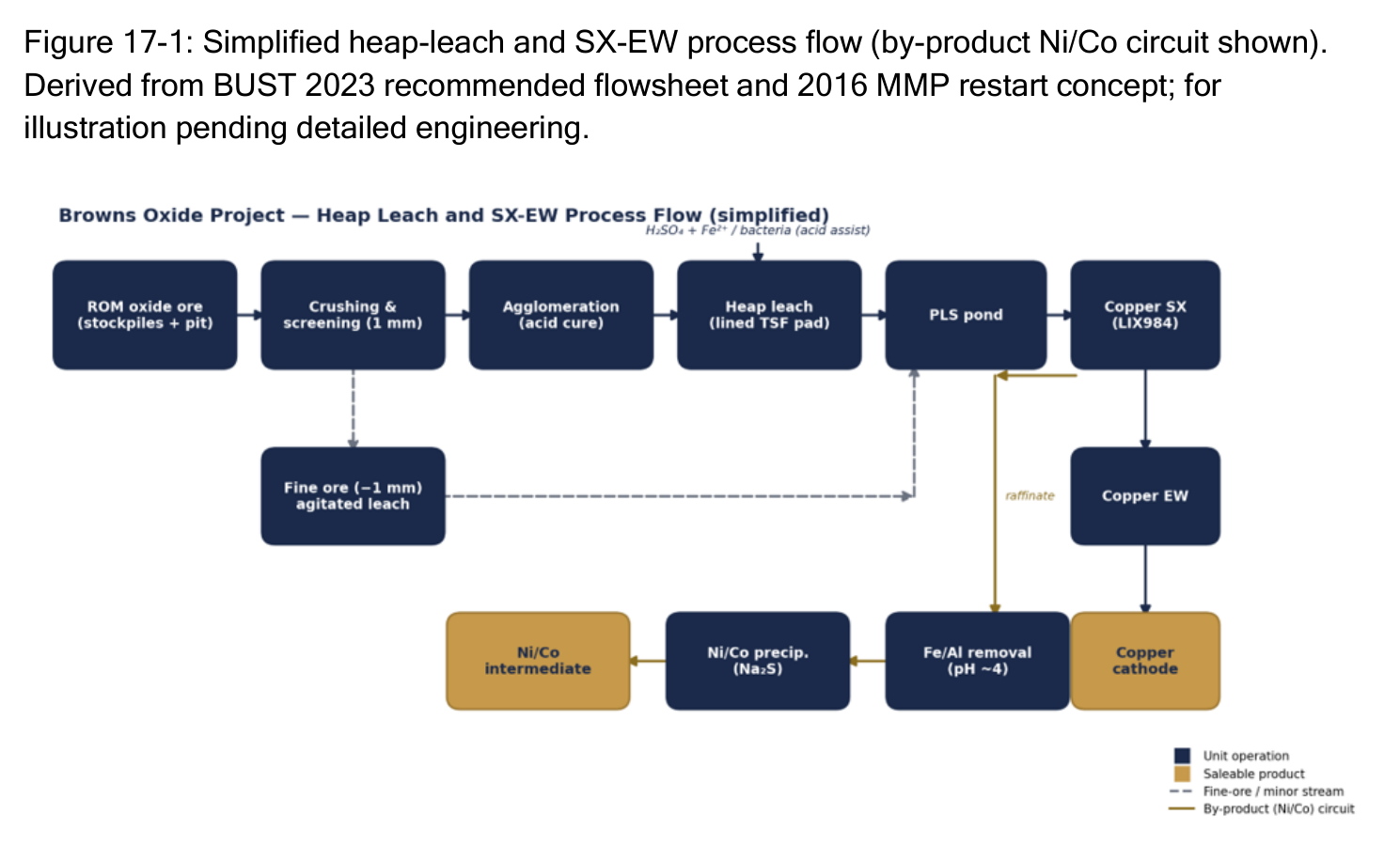
The NVRO Metals Hub Australia Project in the Northern Territory plans to restart copper cathode production through acid heap leaching and existing solvent extraction and electrowinning circuits, with a nickel-cobalt by-product stream.
The NVRO Metals Hub Australia Project is an advanced development project located in the Northern Territory of Australia, operated by NVRO Metals Limited. The project targets copper from oxide mineralisation at the Browns deposit, with nickel and cobalt recovered as by-products. The site previously produced copper cathode and retains substantial installed processing infrastructure. The technical report, prepared by Measured Group Pty Ltd, was completed on July 23, 2026. The project is not currently operating but is positioned for a staged restart using existing infrastructure and above-ground oxide stockpiles. No construction timeline is stated in the source material.
Critical Data
| Parameter | Value | Unit | Notes |
|---|---|---|---|
| Process route | Acid heap leach, copper SX-EW, by-product Ni/Co sulphide | Not applicable | Base case flowsheet |
| Ore feed size (sizer discharge) | Below 100 | mm | Existing MMD sizer |
| Product size after crushing | Below 20 | mm | Before screening |
| Screen aperture | 1 | mm | Coarse and fine fractions handled separately |
| Grasshopper conveyor capacity | ~121 | t/h | From restart concept |
| Heap cell dimensions | ~50 × 50 × 4 | m | Length × width × height |
| TSF floor lined in first year | ~40 | % | Provision stated |
| Ore treated in first year | ~870,000 | t | Provision stated |
| PLS copper concentration | 3 – 6 | g/L | Nominal |
| Leach cycle duration | 120 – 150 | days | Per cell |
| PLS delivery rate | ~140 | m³/h | From restart concept |
| Irrigation rate | ~100 | m³/h | Acidic raffinate |
| Copper extraction in heap | ~75 | % | Preliminary |
| Overall copper to cathode | ~70 | % | Preliminary |
| Acid consumption | 11 – 89 | kg/t | Depends on bacterial/pyrite acid assistance |
| Ni/Co sulphide grade | ~3.6% Ni, ~11.5% Co | % | Via sodium sulphide precipitation |
| Oxide processing plant capacity | ~1.3 | Mtpa | Historical rating |
| Early-cathode stockpile copper | ~2,732 | t | Above-ground oxide, subject to confirmation |
| Pit oxide contained copper | ~15,498 | t | Available after dewatering, subject to confirmation |
| Early cathode production potential | ~13,200 | t | Over initial 3-year period |
| Indicative net recovery (early cathode) | >70 | % | Not a Mineral Reserve |
| Solar generation installed nearby | ~25 | MW | Not yet commissioned |
| Power line voltage | 22 | kV | Active, spare capacity understood |
| Construction timing | Not stated | Not applicable | No date provided |
Overview
The recovery method for the Browns oxide project is acid heap leaching followed by copper solvent extraction and electrowinning to produce LME-grade copper cathode, with a mixed nickel-cobalt intermediate recovered as a by-product. The route was selected for three reasons. The oxide mineralisation is acid-leachable, with copper 95 to 99 percent oxide, and heap leaching accommodates the high fines content at lower capital and operating cost than whole-ore agitated leaching. The site already has solvent-extraction and electrowinning circuits that have produced copper cathode, materially reducing capital cost and execution risk. Acid heap leaching with SX-EW is also among the most widely practised copper hydrometallurgical routes, carrying lower technical risk.
The project is amenable to a staged approach. Low-capital early cathode production from existing oxide stockpiles and readily accessible pit oxide would be established first, using the existing SX-EW circuits, ahead of any larger development.
The simplified process flow sees run-of-mine oxide ore crushed and screened. The coarse fraction is agglomerated with acid and stacked on a lined leach pad, then dilute acid with bacterial or reductant assistance is irrigated through the heap. The testing programme will evaluate whether crushing is beneficial or whether the MMD sizer alone could be used for size reduction.
Pregnant leach solution is collected and pumped to copper solvent extraction. The loaded organic is stripped to a copper-rich electrolyte that feeds electrowinning to produce copper cathode. The copper-depleted raffinate is treated for iron and aluminium removal followed by nickel-cobalt precipitation, and barren solution is recycled to the heap. Alternative flowsheet options will be investigated during the testwork programme to evaluate the technical and commercial aspects of separate copper and cobalt leach circuits.
The parameters for the heap-leach facility, ore preparation and solution handling are drawn from a GHD Pty Ltd oxide scoping study of 2016. That study is a draft document, watermarked throughout, with an express disclaimer that its contents must not be relied upon. It is referenced as the most developed site-specific engineering concept available and as useful context, not as a finalised or independently verified design basis. The parameters cited from it are indicative only and are to be confirmed by detailed engineering and confirmatory testwork.
Key Process Stages
Run-of-mine ore is reclaimed and sized through the existing MMD sizer to below 100 mm, then delivered to a screening and crushing circuit producing a below-20 mm product. The ore is screened at 1 mm. The coarse fraction above 1 mm reports to agglomeration and the fine fraction below 1 mm is treated separately.
Sulphuric acid is added during agglomeration in a rotating drum, which initiates leaching through acid cure and conditions the ore for stacking. Acid addition during agglomeration, rather than into hot tank slurry, was identified in the restart planning as reducing acid loss to mist and improving handling safety. Agglomerated ore is conveyed to the leach pad. The restart concept used grasshopper conveyors at approximately 121 t/h.
The leach pad is established within the existing Tailings Storage Facility footprint, which is regraded, contoured and lined to serve as a controlled leach area rather than purely as a conventional slurry impoundment. The restart design will investigate using existing tailings material as a protective substrate below the geomembrane and HDPE liner. Leaching cells would be configured at approximately 50 m by 50 m by 4 m, with provision to line approximately 40 percent of the TSF floor in the first year and to treat approximately 870,000 tonnes of ore.
Acidic raffinate is irrigated over the heaps, along with an intermediate leach solution that assists in building the copper grade ahead of the SX process. Pregnant leach solution at a nominal copper concentration of 3 to 6 g/L drains to a collection sump for pumping to the recovery plant. Each cell is leached for approximately 120 to 150 days.
Two separate solution-management systems are provided: a leach-solution circuit for PLS collection and return to the plant, and a rainfall-runoff circuit for collection and transfer to the water-treatment plant. The separation, together with the lined-pad design, is central to managing the site's pronounced wet season. The testwork flags that dry screening is impractical during the wet season because freshly mined ore carries high moisture. A wet-screening route with separate handling of the coarse and fine fractions is provided for wet-season operation.
PLS is collected from the pad drainage system and transferred to the PLS ponds, then after filtration to the solvent-extraction circuit. The restart concept provided for PLS delivery at approximately 140 m³/h and use of part of the installed SX capacity, showing the relatively dilute copper tenor of a heap-leach PLS.
Copper is recovered from PLS by solvent extraction using LIX984 reagent in a kerosene diluent. The process transfers copper from the aqueous PLS to a loaded organic phase and rejects iron, manganese and other impurities to the raffinate. The loaded organic is stripped with spent electrolyte to produce a copper-rich advance electrolyte for electrowinning, and the regenerated organic is recycled. Testwork confirmed that raffinate copper can be reduced below 0.1 g/L.
Copper is recovered from the advance electrolyte by electrowinning in the existing circuit to produce copper cathode. The electrowinning circuit and associated electrolyte handling are installed at site and are reported in the most recent project review to be in substantially serviceable condition. Production of copper cathode, rather than the copper-sulphate crystalliser product contemplated in the 2016 restart concept, is the design basis for this report.
Copper-depleted raffinate is treated to recover a nickel-cobalt by-product. Iron and aluminium are first removed by controlled neutralisation to approximately pH 4, and nickel and cobalt are then precipitated. The 2023 testwork identified sodium-sulphide precipitation as the preferred route, producing a mixed nickel-cobalt sulphide intermediate at high recovery. Alternative precipitation methods and intermediate products will be investigated during the testwork programme. The installed plant includes precipitation tanks and filtration that can be repurposed for this duty. Barren solution is returned to the leach circuit.
The principal reagents are sulphuric acid for agglomeration and leaching, LIX984 extractant and diluent for solvent extraction, a reductant such as ferrous sulphate or sodium sulphite where required to improve cobalt extraction, and precipitation reagents including sodium sulphide or a source of carbonate or hydroxide ions, with lime for iron and aluminium control. Where high-sulphur sulphide or pyrite and a bacterial culture are incorporated into the heap, in-situ acid generation can materially reduce purchased-acid consumption. Existing site reagent infrastructure includes acid storage and some lime and limestone handling equipment.
Additional Interesting Data and Summary
A principal feature of the project is the extent of installed, serviceable infrastructure available for reuse. The site hosts the existing oxide processing plant, historically rated at approximately 1.3 Mtpa, including the MMD sizer and feed system, leach and precipitation tankage, thickeners, the solvent-extraction circuit and ponds, and the electrowinning circuit. The most recent review describes the solvent-extraction and electrowinning circuits as being in substantially serviceable, near-new condition.
The deposit has previously produced copper cathode on site, providing operating precedent for the leach and SX-EW route. A staged early-cathode start-up is available. Above-ground oxide stockpiles containing of the order of 2,732 tonnes of copper, and readily accessible pit oxide with of the order of 15,498 tonnes of contained copper available following pit dewatering, can be heap-leached on the lined pad and processed through the existing SX-EW circuits at an indicative net recovery in excess of 70 percent. The potential exists to produce approximately 13,200 tonnes of copper cathode over an initial 3-year period. The QP notes these contained-metal figures are drawn from project review material and are subject to confirmation against the current Mineral Resource model and to mining-access, leach-kinetics and permitting confirmation. They are not Mineral Reserves.
Power is available from an active 22 kV line understood to have spare capacity, subject to commercial terms, with approximately 25 MW of solar generation installed nearby but not yet commissioned. Water management is dominated by wet and dry seasonality. The open pit is currently flooded and requires dewatering. The lined-pad design with separated leach and runoff circuits is intended to manage wet-season water. Treatment and discharge operate under licence, and a hydrogeological review is recommended to confirm the site water balance.
In the opinion of the QP, acid heap leaching with copper SX-EW is an appropriate, conventional and low-technical-risk recovery method for the Browns oxide mineralisation, well supported by the site's operating history and by the 2023 testwork, and advantaged by the availability of installed solvent-extraction and electrowinning circuits. The principal matters to be resolved are confirmation of heap permeability and recovery on representative domain composites at design heap height, validation of the acid-economy assumption under site conditions, a copper SX-EW pilot or locked-cycle programme to establish design recovery and cathode quality, confirmation of the condition and refurbishment scope of the installed circuits, and a current water balance and lined-pad and TSF design consistent with the site's seasonality and the historical seepage record.
Key Processes
- Acid heap leaching with agglomeration for size reduction and acid cure
- Copper solvent extraction using LIX984 in kerosene diluent
- Copper electrowinning in existing circuit to produce LME-grade cathode
- By-product nickel-cobalt recovery via sodium-sulphide precipitation
- Two-circuit solution management separating leach solution from rainfall runoff
- Wet-season wet-screening route for high-moisture ore
- Staged early-cathode start-up using existing infrastructure and oxide stockpiles
Source: NVRO Metals Hub Australia Project NI 43-101 Technical Report, July 23, 2026. Project website: NVRO Metals Hub Australia Project
