

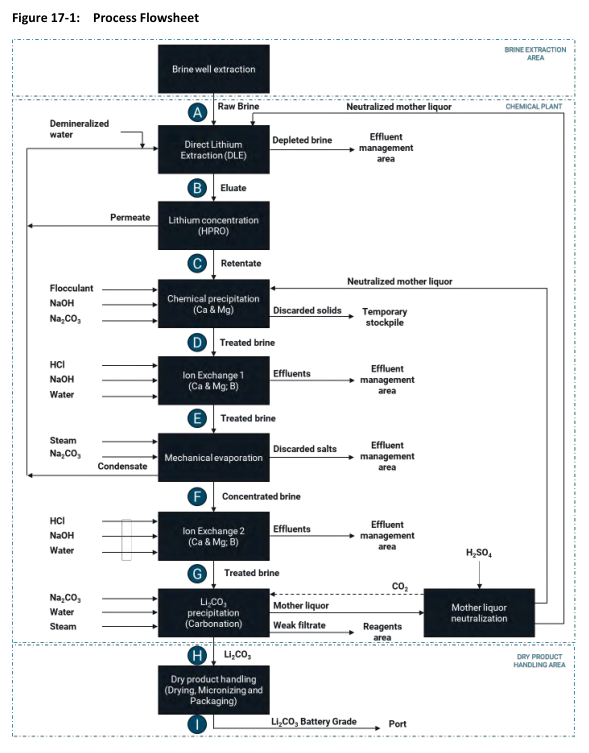
This technical report details a proposed processing route for producing 25,000 tonnes per year of battery-grade lithium carbonate from Salar de Arizaro brine, combining direct lithium extraction, reverse osmosis, and multiple impurity-removal stages.
Report context
The NI 43-101 Technical Report and Pre-feasibility Study, dated July 22, 2024, describes a planned processing facility for the Salar de Arizaro Project. The design considers a production target of 25,000 tonnes per year of battery-grade lithium carbonate, requiring a raw brine feed of 64,080 m³/d extracted from wells within the salar.
Processing route
Brine extraction area
Raw brine from production wells is collected in a wellfield receiving pond that serves as a central operations center, positioned to minimise transport piping. From this pond, brine is pumped to a raw brine feed pond adjacent to the chemical plant. A pigging cleaning system operates between the receiving pond and feed pond to prevent salt deposition; brine and salt deposits collected during cleaning are directed to a flushing pond before being returned to the feed pond.
Chemical plant area , eight stages
Direct lithium extraction
Brine from the raw brine feed pond is combined with recirculated process streams and filtered before entering adsorption columns. The columns contain selective resins that capture lithium. Depleted brine with low lithium concentration is sent to effluents management. Following adsorption, resins are washed with an elution solution composed of demineralised water, reverse osmosis permeate, and mechanical evaporation condensate. The resulting lithium-rich eluate is pumped to reverse osmosis.
The DLE stage includes twelve brine filtration pre-treatment systems and 660 adsorption columns (8.1 m³ each) distributed in twenty-two carousels.
Reverse osmosis
The eluate is filtered before entering high-pressure reverse osmosis (HPRO) membranes to concentrate lithium and recover water. Two streams are produced: a permeate recycled as eluent, and a lithium-enriched retentate directed to chemical precipitation. The HPRO stage includes five pre-filters and seven trains of HPRO.
Chemical precipitation
Concentrated brine from HPRO is combined with recirculated mother liquor in a first reactor, where a 20% w/w caustic soda solution precipitates magnesium hydroxide. The brine then moves to a second reactor where a 25% w/w soda ash solution precipitates calcium carbonate. Sludge from the reactors is processed through a clarifier and filter press; the treated brine is filtered and sent to Ion Exchange 1. Equipment includes three agitated reactors, one clarifier (8 m), two polishing filters, and one press filter.
Ion exchange 1
Treated brine passes through columns containing selective resins that capture residual calcium, magnesium, and boron. Regeneration uses 3% w/w hydrochloric acid and 4% w/w caustic soda solutions, followed by demineralised water rinsing. Waste streams are directed to effluents management. Equipment includes three Ion Exchange 1 Ca & Mg columns and fourteen Ion Exchange 1 B columns for first stage plus five for second stage.
Mechanical evaporation
Brine from Ion Exchange 1 is preheated, deaerated, and fed to a falling film evaporator with a crystalliser. Vapour is compressed and condensed. The concentrate passes through a hydrocyclone and centrifuge; precipitated salts are removed as discarded solids. Concentrated brine proceeds to Ion Exchange 2. Equipment includes one falling film evaporator system, one crystalliser, and one centrifuge.
Ion exchange 2
Brine passes through columns with resins designed to capture remaining trace impurities, with separate columns for Ca & Mg and for boron. Regeneration follows the same acid and caustic procedure as Ion Exchange 1. Waste streams are sent to effluents management. Equipment includes three Ion Exchange 2 Ca & Mg columns and nine Ion Exchange 2 B columns.
Carbonation
Brine from Ion Exchange 2 is heated to 85.5 °C before entering carbonation reactors where it reacts with a filtered soda ash solution to precipitate lithium carbonate. The resulting slurry is processed through a thickener and filter press. A solid dewatering cake is conveyed to the rotary dryer. Equipment includes three heat exchangers, three agitated reactors, one thickener (8 m), and one press filter.
Neutralisation
Mother liquor from carbonation enters stirred tank reactors where sulfuric acid adjusts pH below 4.5. Carbon dioxide produced during reaction is recovered and returned to the carbonation stage. Neutralised mother liquor is recycled to the DLE feed. Equipment includes three agitated reactors and one stripping column.
Dry product handling area
Lithium carbonate from the chemical plant is dried in a rotary dryer to 0.1% moisture, then ground in a microniser to meet battery-grade particle size requirements (D50: 4–6 µm), and finally packaged for export. Equipment includes one indirect rotary dryer system, one microniser system, and one packaging system.
Effluents management
Effluents collected from various stages include depleted brine from DLE, acid and alkaline solutions from reverse osmosis, discarded salts from mechanical evaporation, polishing filter sludge, and acid/caustic/rinse waste from ion exchange. Salts from mechanical evaporation are diluted with ion exchange waste in a stirred dissolution tank, then combined with depleted brine and other waste streams in a residual pulp tank. The intermediate effluent is neutralised in a control pond to pH 6.8–7.1 before being sent to an infiltration zone at the salar beach.
Key reported parameters
| Parameter | Units | Design / Testwork Value |
|---|---|---|
| Plant Production | ||
| Product quality | , | Battery grade (BG) |
| Average production rate | t/a | 25,000 |
| Operational Hours | ||
| Maintenance plant stop | weeks/a | 2 |
| Operating hours | h/a | 7,446 |
| Plant availability | % | 85.0 |
| General Design Parameters | ||
| Design factor | , | 1.20 |
| Temperature limit for requiring equipment insulation | °C | 45 |
| Main Water and Reagents Requirements | ||
| Fresh water consumption | m³/a | 2,769,912 |
| Fresh water demand | m³/h | 372 |
| Soda ash consumption | t/a | 53,830 |
| Caustic soda consumption | t/a | 7,146 |
| Sulfuric acid consumption | t/a | 15,438 |
| Hydrochloric acid consumption | t/a | 1,259 |
| Flocculant consumption | t/a | 2.21 |
| Raw Brine | ||
| Annual throughput | m³/a | 19,880,820 |
| Raw brine flow required | m³/d | 64,080 |
| Raw brine flow required | m³/h | 2,670 |
| Lithium concentration | mg/L | 286 |
| Calcium concentration | mg/L | 523 |
| Magnesium concentration | mg/L | 4,025 |
| Boron concentration | mg/L | 50 |
| Product (Battery-Grade Lithium Carbonate) Properties | ||
| Purity | % | 99.5 |
| Moisture | % | 0.10 |
| Particle Size | ||
| D100 | μm | 40.0 |
| D90 | μm | 12.5 |
| D50 | μm | 4.00 |
| D10 | μm | 1.25 |
| Key Stream Data (Design Mass Balance) | ||
| Eluate from DLE flow rate | m³/a | 12,219,907 |
| Eluate from DLE lithium concentration | mg/L | 455 |
| Brine concentrate from reverse osmosis flow rate | m³/a | 773,031 |
| Brine concentrate from reverse osmosis lithium concentration | mg/L | 6,904 |
| Brine concentrate from mechanical evaporation flow rate | m³/a | 424,279 |
| Brine concentrate from mechanical evaporation lithium concentration | mg/L | 13,512 |
Project website: https://lithiumchile.ca/salar-de-arizaro/
Project website: https://en.wikipedia.org/wiki/Salar_de_Arizaro
Technical qualifications
The processing description and parameters presented in this report represent proposed design criteria and a process flowsheet developed for the pre-feasibility study. The data are derived from design assumptions and mass balance calculations, not from historical operating data or pilot-scale testwork at this site. The figures, process block diagrams, and plant layouts cited throughout the report were prepared by Ausenco (2024). The report acknowledges that energy will be provided by diesel and intermediate fuel oil generators, and that freshwater demand will be met by pumping from groundwater supply wells in the Chascha Sur sub-basin. No actual production performance data or verified economics are provided in the sections summarised herein.
*Source: Salar de Arizaro Project, NI 43-101 Technical Report and Pre-feasibility Study, July 22, 2024, Sections 1.15, 1.16, 17, 17.1, 17.2, 17.3, 17.4, 17.5.*
