

This report details the proposed processing route for producing battery-grade lithium carbonate from brine extracted from Minera Salar Blanco's mineral properties in the Salar de Maricunga area.
Report context
The Technical Report NI 43-101 Definitive Feasibility Study Stage One, Minera Salar Blanco, Atacama Region, Chile, describes the design for facilities to produce an average of 15,200 TPY of battery-grade lithium carbonate over a 20-year mine life. The report presents a proposed processing scheme based on pilot evaporation tests and design work, distinguishing between evaporation pond operations, the Salt Removal Plant (Phase 1), and the Lithium Carbonate Plant (Phase 2).
Processing route
Evaporation pond operation
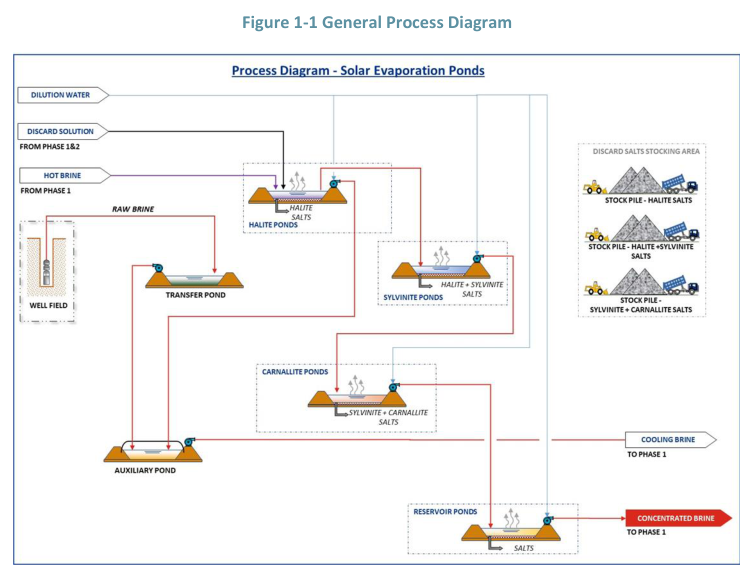
Raw brine extracted from the salar is fed to solar evaporation ponds where various salts precipitate, including halite, sylvinite, and carnallite. The ponds are simple structures of very large size and shallow depth, covered by a geomembrane to guarantee impermeability. Fresh brine from production wells, which has a lower temperature, is first fed to the production plant to act as cooling brine. The outlet cooling brine, at a higher temperature, is then sent to the first evaporation pond. Ponds operate in sequence, with interconnected channels using gravitational energy where possible, and pumping where topography does not allow gravity flow.
Pilot evaporation tests indicated that the high concentration of calcium, magnesium, and lithium in the concentrated brine lowers brine activity significantly, and the eutectic end point of about 3-4% wt lithium is never reached at ambient concentrations. Concentrating to higher levels of about 1.5% wt in summertime showed significant lithium losses as lithium borates and through entrapment in crystallized salt in the ponds. Based on this testwork, the process was designed for a concentration target of about 0.9% wt, which was proved can be reached and maintained consistently.
Approximately 5,400,000 tons of brine are treated annually in the evaporation ponds. Concentrated brine from the final evaporation pond is pumped to reservoir ponds that act as storage and buffer for seasonal variations. Annual salt generation from the evaporation ponds includes halite (978,406 TPY, with 10% entrained brine), sylvinite (81,697 TPY), carnallite (151,756 TPY), and calcium chloride from reservoir ponds (160,757 TPY).
Salt Removal Plant – Phase 1
Concentrated brine from the reservoir ponds feeds the Salt Removal Plant, where calcium and magnesium are removed as tachyhydrite and calcium chloride salts, and boron is removed using solvent extraction. The process begins with an evaporation stage that allows tachyhydrite salt formation, separated using solid-liquid separation equipment. Brine then enters a first stage of crystallizers for further tachyhydrite formation and separation, followed by a second crystallizer stage where calcium chlorides are formed and removed.
Brine is then fed to a boric acid crystallizer. The addition of hydrochloric acid is considered to generate boric acid precipitation, with sodium sulphite added if needed to reduce bromine formation and avoid corrosion damage. The lithium-concentrated brine then feeds a solvent extraction stage where boron is removed using a selective extractant and diluent mixture. Boron extraction stages are carried out at acidic pH, with stripping stages at basic pH producing a boron-rich solution for discard. Boron-free brine enters a third and final crystallizer stage to remove remaining calcium as calcium chloride salts.
The resulting lithium-concentrated brine, with low calcium and magnesium content, is stored in intermediate tanks to feed the Lithium Carbonate Plant. Annual discard salts from Phase 1 include tachyhydrite plus calcium chloride (304,491 TPY, with 13% moisture) and boric acid cake (10,915 TPY, with 50% moisture).
Lithium Carbonate Plant – Phase 2
The Lithium Carbonate Plant receives concentrated brine from the Salt Removal Plant. The first stage involves calcium and magnesium reduction using recirculation of mother liquor, milk of lime, and a soda ash solution mixed in reactors with concentrated brine at 60°C. This promotes precipitation of calcium carbonate and magnesium hydroxide, which are separated using solid-liquid separation equipment.
For final contaminant removal, an ion exchange stage uses specific resins in columns to remove remaining impurities, generating contaminant-free brine. The cleaned brine then enters the carbonation stage, where it contacts a soda ash solution. Formation of lithium carbonate using soda ash is described as optimum at temperatures close to 80°C, allowing lithium carbonate precipitation in a solid state.
The pulp from carbonation undergoes solid-liquid separation with washing. Dewatered lithium carbonate is transported to a dryer, then packed into separate maxi bags and stored in a final product warehouse. Annual discard salts from Phase 2 include calcium chloride and magnesium hydroxide (16,150 TPY, with 51% moisture).
Reagents and water purification
Annual reagent consumption designed for the process includes lime (1,411 TPY solid), soda ash (35,320 TPY solid), caustic soda (2,826 TPY as 20% solution), hydrochloric acid (14,342 TPY as 32% solution), sodium sulphite (137 TPY solid), flocculant (18 TPY), solvent extraction diluent (50 TPY), and solvent extraction extractant (22.5 TPY). Soda ash is prepared as a 28% concentrated solution using recycled water mixed with solids in a tank containing excess soda ash to assure saturation. Lime is slaked with water to generate calcium hydroxide for magnesium hydroxide precipitation.
Process water is treated in a treatment plant using mainly reverse osmosis to generate required water quality and avoid contaminant entry.
Key reported parameters
| Parameter | Value | Basis |
|---|---|---|
| Lithium carbonate production capacity | 15,200 TPY average | Design |
| Mine life | 20 years | Design |
| Brine treated in evaporation ponds | 5,400,000 tons annually | Design |
| Evaporation pond lithium concentration target | ~0.9% wt | Design (based on pilot testwork) |
| Salt Removal Plant (Phase 1) discard salts | 304,491 TPY tachyhydrite + CaCl2; 10,915 TPY boric acid cake | Design |
| Lithium Carbonate Plant (Phase 2) discard salts | 16,150 TPY CaCl2 + Mg(OH)2 | Design |
| Soda ash consumption | 35,320 TPY | Design |
| Lime consumption | 1,411 TPY | Design |
| Hydrochloric acid consumption | 14,342 TPY (32%) | Design |
| Solvent extraction extractant consumption | 22.5 TPY | Design |
| Solvent extraction diluent consumption | 50 TPY | Design |
Project website: https://www.dhigroup.com/projects/feasibility-studies-for-a-lithium-brine-mining-project-in-northern-chile
Technical qualifications
The report states that the design was based on pilot evaporation tests that indicated limitations in reaching higher lithium concentrations. The report notes that concentrating to about 1.5% wt in summertime showed significant lithium losses as lithium borates and through entrapment in crystallized salt. The design target of about 0.9% wt is described as proved to be reachable and maintainable for consistent and continuous feed. The report includes references to figures (Figure 17-1, 17-2, 17-3, 17-4, 17-5, 17-6, 17-7, 17-8) and tables (Table 17-1, 17-2, 17-3, 17-4) that are presented in the original document but whose content is not fully reproducible in text form. The salt generation figures include assumed entrained brine percentages and moisture contents as stated in the tables.
Source: Technical Report NI 43-101 Definitive Feasibility Study Stage One, Minera Salar Blanco, Atacama Region, Chile, Section 17 Recovery Methods.
