

This report describes the existing and proposed processing facilities at the Santa Elena mine for treating a blend of high-grade underground ore and spent heap-leach material, with a planned campaign approach for Ermitaño ore.
Report context
This technical report, dated November 2021, describes the recovery methods for the Santa Elena Silver/Gold Mine in Sonora, México. The processing plant has been operating for several years, using cyanide tank leaching and Merrill-Crowe smelting to produce silver-gold doré bars. The nominal plant capacity is 3,000 tpd, with historical average throughputs of 2,500 tpd in 2019, 2,150 tpd in 2020, and 2,450 tpd in the first half of 2021. Plant feed head grades averaged 90 g/t Ag and 1.48 g/t Au from January 2019 to June 2021.
Processing route
Crushing
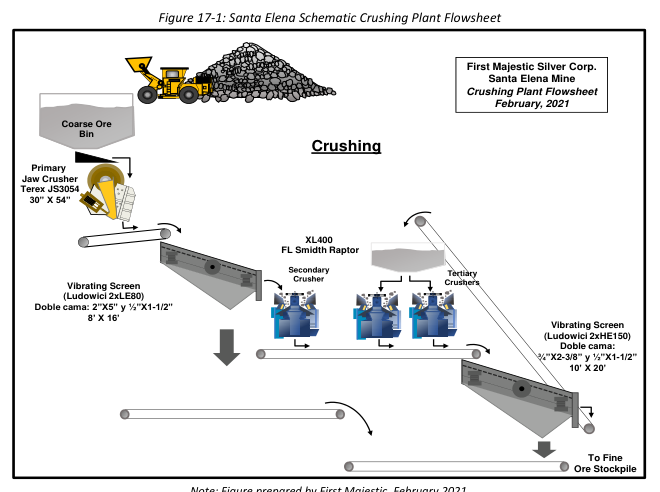
The three-stage crushing circuit has a nominal capacity of 240 t/hr. Run-of-mine material from an intermediary stockpile feeds a coarse ore bin equipped with a vibrating grizzly screen (openings from 1 to 4 inches) that allows fines to bypass the primary crusher. A 20 x 36 inch primary jaw crusher reduces ore to -3 to -4 inches. This product is conveyed to an 8 x 16 foot double-deck vibrating scalping screen. Oversize reports to a secondary XL400 FLSmidth Raptor crusher, reducing to approximately 1 inch. Discharge from the secondary crusher feeds a closed tertiary circuit with two XL400 FLSmidth Raptor crushers and a 10 x 20 foot double-deck vibrating screen (upper deck ¾ x 2⅜ inch openings, lower deck ¼ x 1 inch openings). Screen undersize is 90–97% minus ¼ inch (6,350 µm). The final crushed product in the fine ore stockpiles is approximately 95% minus ¼ inch with average moisture content of 3–4%.
Crushed ore stockpiles
A diverter chute and additional conveyor belts are proposed for installation in Q1-2022 to allow the crushed product conveyor to report to separate stockpiles for the Santa Elena blend and Ermitaño ore, enabling campaign processing with different grinding settings.
Primary grinding
Crushed ore is fed to a 15 ft diameter by 21.5 ft FLSmidth ball mill operating in closed circuit with hydrocyclones. Cyanide solution and lime are added to the grinding circuit. The final ground product contains approximately 65% -200 mesh particles, equivalent to 106 µm P80.
Secondary grinding
The secondary grinding circuit consists of an Outotec High Intensity Grinding Mill (HIG-Mill) with hydrocyclone classification and an agitated buffer tank. The ball mill product reports to the rougher feed tank. A first classification stage produces an overflow of 85% -20 µm (slimes, 30% by weight). The underflow is reclassified in a second cyclopack; underflow from the second cyclopack feeds the HIG-Mill, reducing particle size to 70–75% -45 µm (70% by weight). Both slimes and HIG-Mill product report to separate thickener tanks before leaching.
Cyanide leaching
Two slurry streams from the regrind circuit report to separate 60 ft diameter thickeners (primary for HIG-Mill product, intermediate for slimes). Both thickeners adjust pulp density and recover pregnant leach solution (PLS) in overflow for Merrill-Crowe. Underflow from the primary thickener is pumped to a series of two 45 x 42 ft leach tanks. Discharge from the second tank mixes with underflow from the intermediate thickener, then feeds a series of three 45 x 42 ft leach tanks. A sixth leaching tank is projected for installation by Q4-2022 to provide additional residence time. Cyanide is added as briquettes at four points: the first and third leach tanks, the rougher tank feeding the HIG-Mill, and the PLS prior to precipitation. Lime is added in dry form to the ball mill feed conveyor.
Counter-current decantation system
Slurry from the last agitated tank feeds three 60 ft CCD thickeners working in series (CCD #1, #2, #3). Underflow from CCD #3 feeds a final tailings storage tank before filtration. Overflow from CCD #3 reports to CCD #2, mixing with CCD #1 underflow. Overflow from CCD #2 reports to CCD #1 feed, mixing with slurry from the last leach tank. CCD #3 receives barren solution from tailings filtration. Overflow from CCD #1 reports to the pregnant solution tank. A fourth CCD is projected for installation by Q4-2022 to improve washing efficiency.
Merrill-Crowe and precipitate handling
PLS is sent to a storage tank, then filtered and clarified through three Autojet pressure clarifiers. Clarified solution passes through a deaeration tower to reduce dissolved oxygen from 5 ppm to <1 ppm. Zinc dust is added for cementation, and the precipitate is collected in three 1,500 ft² FLSmidth press filters. PLS production rate is approximately 390 m³/hr. Precipitate is dried in an LPG-fired oven and smelted in a 315 kg LPG smelting furnace, producing 20 kg doré bars with 99% purity (Au + Ag). Flux mixture is 50% borax, 4% sodium nitrate, and 15% soda ash. Slag is crushed, sifted, and returned to the ball mill.
Tailings management
Tailings are fed to two horizontal belt filters, each with 124 m² capacity. Filtered cake (approximately 30% moisture) is stored in the old leach pad area and later transported to a dry stack. Filtered solution returns to CCD #3. A cyanide reduction system uses zero or low-cyanide solution for cake wash on the belts. An Outotec Press Filter FFP 3512 expanded to full capacity (98/98 plates) is projected for installation in Q3-2022 and commissioning by Q4-2022. Once operational, final moisture is expected in the range of 19–21% at finer particle sizes (30 microns P80). Belt filters will remain as backup.
Key reported parameters
| Parameter | Unit | Value | Basis |
|---|---|---|---|
| Nominal plant capacity | tpd | 3,000 | Design |
| Average throughput 2019 | tpd | 2,500 | Historical |
| Average throughput 2020 | tpd | 2,150 | Historical |
| Average throughput H1 2021 | tpd | 2,450 | Historical |
| Target throughput Santa Elena campaign | tpd | 3,350 | Proposed design |
| Target throughput Ermitaño campaign | tpd | 2,350 | Proposed design |
| Average head grade (Jan 2019–Jun 2021) | g/t Ag | 90 | Historical |
| Average head grade (Jan 2019–Jun 2021) | g/t Au | 1.48 | Historical |
| Primary grind product P80 | µm | 106 | Operating data |
| Secondary grind product (HIG-Mill) | % -45 µm | 70–75 | Operating data |
| Final grind P80 (current) | µm | 50 | Operating data |
| Final grind P80 (post Q4-2022) | µm | 30 | Proposed design |
| PLS production rate | m³/hr | 390 | Operating data |
| Doré bar size | kg | 20 | Operating data |
| Doré bar purity (Au + Ag) | % | 99 | Operating data |
| Filter cake moisture (belt filters) | % | ~30 | Operating data |
| Filter cake moisture (press filter, proposed) | % | 19–21 | Proposed design |
| Power consumption | kWh/t | 49 | Projected LOM |
| Cyanide consumption | kg/t | 1.42 | Projected LOM |
| Grinding media consumption | kg/t | 1.57 | Projected LOM |
| Lime consumption | kg/t | 1.85 | Projected LOM |
Project website: https://www.firstmajestic.com/projects/producing-mines/santa-elena/
Technical qualifications
This report section describes the existing plant configuration as of the report date and presents proposed expansions and modifications (additional leaching tank, fourth CCD thickener, press filter, diverter chute and conveyors for separate stockpiles) with projected commissioning in Q3/Q4-2022. Historical throughput and grade data cover 2019 through mid-2021. Testwork results and metallurgical performance at different grinding sizes for Santa Elena blend versus Ermitaño ore are referenced to Section 13 of the report but are not detailed here. The flowsheet figures (17-1, 17-2, 17-3, and 17-4) mentioned in the text are not reproduced. Consumable requirements are projected for the life-of-mine plan as presented in Table 17-1.
Source: Santa Elena Silver/Gold Mine, Sonora, México, NI 43-101 Technical Report on Mineral Resource and Mineral Reserve Estimates, November 2021, Section 17.
