

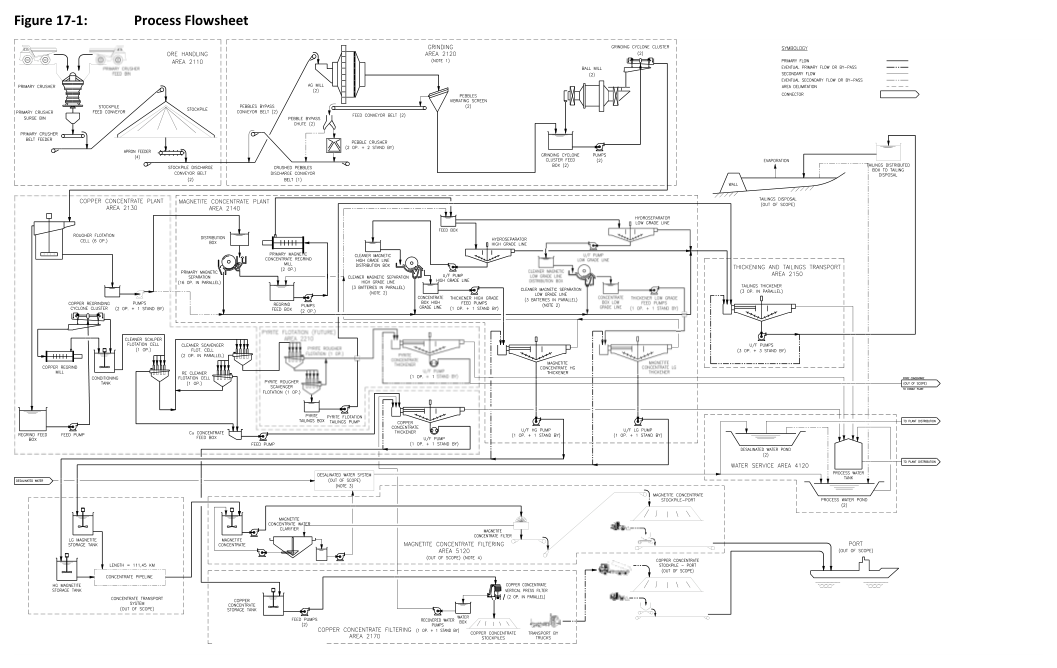
The Santo Domingo process plant design uses a conventional flowsheet with industry-standard equipment to process ROM ore into separate copper and magnetite concentrates and tailings.
Report context
The process plant design described in this article is based on a technical report dated 28 September 2011 (report number 2114-RPT-002, Revision 0). The report covers the Santo Domingo project and presents a proposed process plant design incorporating an open-air layout that minimizes overhead cranage requirements by maximizing accessibility for mobile cranes for maintenance. The layout takes account of site topography and limits imposed by preliminary locations of the pit, stockpiles, and waste dumps.
Processing route
General flowsheet
The proposed process encompasses crushing and grinding of the ROM ore, copper rougher flotation, regrinding and cleaner flotation, magnetite rougher magnetic recovery on copper rougher tailings, magnetic rougher concentrate regrind, and cleaner magnetic separation. Concentrates will be thickened and stored on site prior to being pumped down a concentrate pipeline to the port for dewatering and shipping to third-party smelters. The magnetic separator tailings will be combined with cleaner scavenger flotation tailings for thickening before placement in the TSF.
Comminution circuit
Ore from the open pit is crushed using a primary gyratory crusher (60" x 89") to a crushed product size of nominally 80% passing (P80) 100 mm and fed onto the stockpile feed conveyor. The coarse ore stockpile has a live capacity of 18 hours, with two apron feeders each capable of feeding 120% of the full mill throughput. The stockpile has a total capacity of approximately 3.5 days of nominal SAG mill feed capacity and is covered by a circular dome 110 m in diameter and 41.5 m in height.
The grinding circuit consists of a 22 MW SAG mill (11.58 m diameter by 6.60 m EGL) in closed circuit with pebble crushing, followed by two 12 MW ball mills (7.32 m diameter by 10.97 m EGL) in closed circuit with hydrocyclones. The SAG mill is equipped with a gearless motor and variable-speed drive system. Pebble crushing comprises a single 750 kW cone crusher crushing to a product size of nominally P80 12 mm. A pebble circulating load of 25% of the new feed rate has been assumed for design purposes. The classification circuit has been designed for a maximum circulating load of 300%, requiring two clusters of ten 760 mm hydrocyclones.
The design throughput is 60,000 t/d (60 kt/d), with the ability to handle increased throughputs of up to 70 kt/d for softer ores. Design availability is 93% (after ramp-up), equating to 8,147 operating hours per year, with standby equipment in critical areas. The target primary grind size is P80 of 180 µm.
Copper flotation circuit
The design flowsheet consists of copper rougher flotation, copper concentrate regrind, cleaner 1, cleaner scavenger, cleaner 2, and cleaner 3 flotation stages. Rougher flotation uses ten 300 m³ forced-air tank cells configured as two parallel trains of five cells each. The regrind stage uses one 3.0 MW horizontal stirred mill grinding to a P80 of 30 µm. Cleaner 1 and cleaner scavenger flotation consist of six 200 m³ forced-air tank flotation cells providing a total of 31 minutes of combined retention time. Cleaner 2 consists of six 38 m³ trough-shaped flotation cells providing 12.5 minutes of retention time. Cleaner 3 consists of four 38 m³ trough-shaped flotation cells providing 10 minutes retention time.
Flotation testwork indicated that copper rougher recovery is relatively insensitive to grind sizes up to about 150 to 200 µm. The testwork flotation times and design residence times are based on locked-cycle tests with a scale factor of 2.5 applied.
Magnetite circuit
Magnetic separation on flotation rougher tailings consists of ten 3.6 m long rougher magnetic separators for a mass recovery of 27% of separator feed (23.8% of flotation feed). Rougher magnetite concentrate regrinding uses a single 6 MW mill (6.1 m diameter by 9.75 m EGL) in closed circuit with hydrocyclones, grinding to a P80 of 50 µm. Cleaner magnetic separation consists of six 3.6 m long, three-stage cleaner magnetic separators for an overall iron recovery of 96% at a concentrate grade of 65% Fe.
Concentrate handling and dewatering
Copper concentrate thickening uses a 20 m diameter high-rate thickener. Copper concentrate filtration at the port uses a horizontal plate and frame pressure filter. Magnetite concentrate filtration at the port uses four Ceramec 144 vacuum disc filters. Copper and magnetite concentrate storage on site is in agitated tanks prior to pumping through a 70 km concentrate pipeline to the port.
Water and services
A 70 km seawater pipeline supplies water to the site. Process water is supplied from water reclaimed from the TSF and process operations, with seawater used as make-up water as required. Potable water is generated by treatment of seawater in a reverse osmosis unit at the process plant.
Key reported parameters
| Criteria | Units | Design |
|---|---|---|
| Crusher Feed | kt/d | 60 |
| Mt/a | 21.9 | |
| Crusher Availability | % | 63.25 |
| Crusher Throughput | t/h | 3922 |
| Crusher Selection – Size | 60" x 89" | |
| Crusher Selection – Quantity | 1 | |
| Mill Throughput | Mt/a | 21.9 |
| Mill/Flotation Availability | % | 93 |
| Mill Throughput | t/h | 2,688 |
| Bond Ball Mill Work Index (BWI) | kWh/t | 15.1 |
| Bond Rod Mill Work Index (RWI) | kWh/t | 17.0 |
| Bond Crushing Work Index (CWI) | kWh/t | 14.8 |
| Drop Weight Index (DWI) | kWh/m³ | 7.0 |
| Specific Gravity | t/m³ | 3.30 |
| Grind Size P80 | µm | 180 |
| Head Grade (Design) – Copper | % Cu | 0.70 |
| Head Grade (Design) – Sulphur | % S | 2.80 |
| Head Grade (Design) – Iron | % Fe | 35.7 |
| Head Grade (Design) – Gold | g/t Au | 0.11 |
| Flotation Recovery – Copper | % | 89 |
| Flotation Recovery – Gold | % | 60 |
| Magnetite Recovery – Mass | % | 20 |
| Magnetite Recovery – Iron | % | 42 |
| Cu Circuit Residence Time – Roughers | min | 32.5 |
| Cu Circuit Residence Time – Cleaner 1 | min | 20 |
| Cu Circuit Residence Time – Cleaner Scavenger | min | 10 |
| Cu Circuit Residence Time – Cleaner 2 | min | 12.5 |
| Cu Circuit Residence Time – Cleaner 3 | min | 10 |
| Magnetite Circuit Recovery – Roughers | Mass % | 27 |
| Magnetite Circuit Recovery – Cleaner 1 | Fe % | 98.2 |
| Magnetite Circuit Recovery – Cleaner 2 | Fe % | 98.5 |
| Magnetite Circuit Recovery – Cleaner 3 | Fe % | 99.0 |
| Cu Concentrate Filtration Rate | kg/m²/h | 495 |
| Concentrates Thickening Flux | t/m²/h | 0.25 |
| Magnetite Concentrate Filtration Rate | kg/m²/h | 1000 |
| Tailings Thickening Flux | kg/m²/h | 1.0 |
| Tailings Thickener Underflow Density | % w/w | 60 |
| Collector Consumption (Aerofloat 3926) | g/t | 20 |
| Collector Consumption (Aerophine 3418A) | g/t | 10 |
| Depressant Consumption (NaHS) | g/t | 0 |
| Depressant Consumption (NaCN) | g/t | 25 |
| Frother Consumption (MIBC) | g/t | 50 |
| Lime Consumption | kg/t | 0.150 |
| Flocculant Consumption (Concentrate and tailings) | g/t | 20 |
| SAG Mill Media Consumption | kg/t | 0.320 |
| Ball Mill Media Consumption | kg/t | 0.364 |
Project website: https://capstonecopper.com/news/capstone-announces-updated-santo-domingo-feasibility-study-building-a-world-class-district-in-chile/
Technical qualifications
The report notes that the range in variability of ore parameters such as hardness and head grade during process design were considered, but due to the preliminary nature of the mining schedule and metallurgical testwork, the most competent and hardest of the three ore types identified were used in the process design criteria. The installed ball mill power of 12,000 kW incorporates allowances for drive train losses and a 10% design contingency to account for the accuracy of the models, calculations, and testwork. The installed motor power for the SAG mill incorporates similar allowances plus an additional contingency to allow adjustment in mill operating conditions to handle ore variability. Flotation testwork and mineralogy indicated that Santo Domingo ores are moderately fine-grained, and the flotation testwork parameters formed the basis for the copper flotation circuit residence times.
Source: Santo Domingo Project Technical Report, 2114-RPT-002, Revision 0, 28 September 2011, Sections 17.1-17.10.2.
