

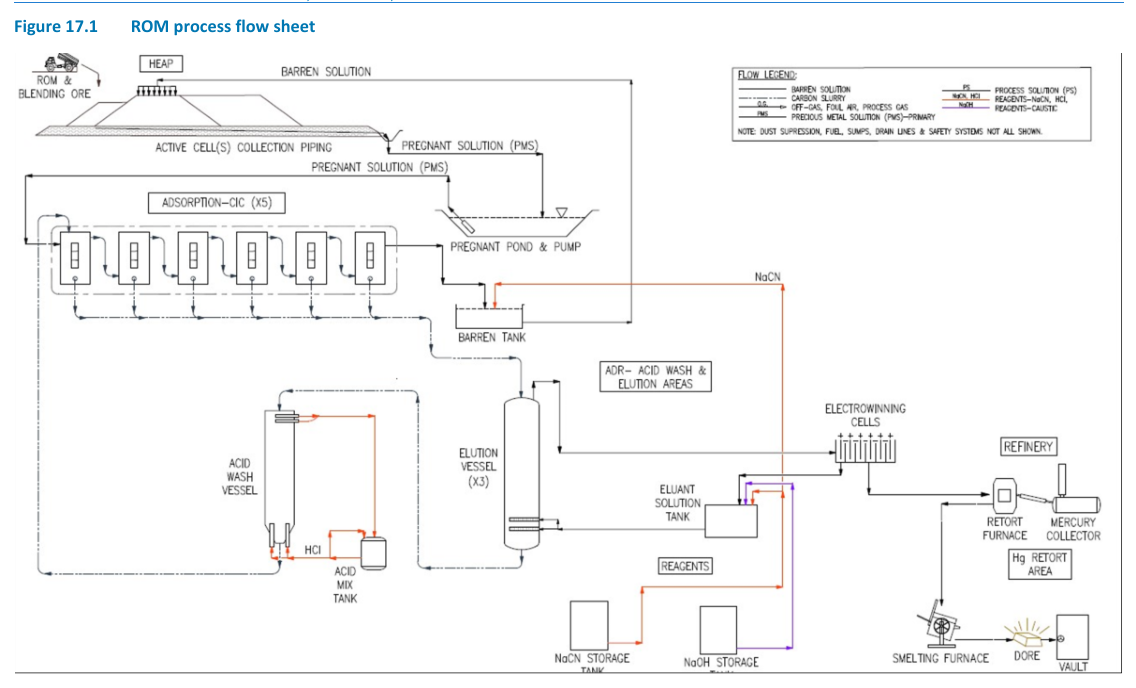
Shahuindo is an open pit heap leach operation using truck-stacked ROM ore with a carbon-in-column adsorption circuit to produce doré.
Report context
This technical report documents the Shahuindo Mine, located in Cajabamba, Peru, as of its effective date in 2022. The operation has been developed in multiple phases since beginning operations in late 2015. The report describes the current recovery methods, processing facilities, and operational performance as of the effective date.
Processing route
Overview of operations
Shahuindo is an open pit heap leach operation. The current operation uses truck stacking of run-of-mine (ROM) ore onto a multiple-lift heap leach pad. Ore is stacked at an average rate of 36,000 tonnes per day (tpd) in approximately 8 m lifts. Pebble lime (CaO) is added to the ore at the leach pads for pH control before the stacked ore is leached with a dilute sodium cyanide solution.
Crushing and agglomeration circuit
Two parallel single stage crushing and screening circuits with drum agglomeration were installed at Shahuindo with capacity to process 36,000 tpd (12,000 tpd and 24,000 tpd, respectively). The crushing and agglomeration circuit is currently not being utilized and is not planned to be utilized for future operations. Permeability issues with argilized ore are currently being managed by blending with more competent material, which has been proven to be successful for the heap leaching operation.
ROM truck stacking
ROM ore from the various pits is delivered to the active heap stacking area by 42-ton haul trucks and dumped on the leach pad to form lifts at an average rate of 36,000 tpd. Pebble lime for pH control is added to the ore at the leach pads by the mining fleet while forming the lifts. Lime consumption to date (2019 to present) has averaged 3.1 kg/tonne ore.
The haul trucks operate on top of the lift being constructed and utilize ramps constructed on the heap to reach the top of each current lift. Ore is direct dumped on the current lift and a dozer is utilized to push ore over the edge of the lift to form the expanding heap. After stacking, the ore is cross ripped with a dozer prior to leaching. The ore is stacked in 8 m high lifts with a maximum planned heap height of 90 m above the liner.
Heap leach facility and solution handling
Leach pad designs have been completed by Anddes SAC and Ausenco, with Anddes being the Engineer of Record (EoR). As of the effective date of this technical report, approximately 55.4 Mt of ore has been stacked onto leach pads 1A, 2A, and 2B/C with remaining capacity estimated to be 136 Mt depending on future Mineral Reserve growth, if any. The heap leach pads are expanded in phases each year to keep ahead of production; only the required mine capacity will be constructed.
Following truck stacking, the ROM ore is irrigated uniformly with a sodium cyanide solution by an irrigation system. Barren solution from the barren solution tank is pumped using horizontal pumps to the active leaching area where it is distributed using HDPE pipes and applied to the heap using No. 7 wobbler sprinklers in a 6 m x 6 m triangular pattern. The ore is irrigated at a rate between 8 to 10 liters per hour per square metre of leaching area for 55 days. As the solution passes through the lift, gold and silver are dissolved, forming a pregnant solution. The pregnant solution percolates through the lifts and flows into the pregnant solution pond. The pregnant solution is pumped from the pregnant solution pond to the carbon adsorption circuit where the gold and silver values are loaded onto activated carbon.
Pond capacities are based on water balance studies conducted by Anddes (2015) with an updated water balance being prepared by Ausenco in 2021. Currently there is not excess water, but the use of raincoats in the future and/or an excess water treatment plant is planned. Water balance is to be updated and an excess water treatment plant is being studied.
Adsorption
Pregnant leach solution discharged from the heap flows by gravity to a pregnant solution pond and is pumped to a carbon-in-column (CIC) adsorption circuit where gold and silver are loaded onto active carbon. Five closed-top carbon adsorption column trains are currently available for the treatment of pregnant solution with each column train consisting of six carbon adsorption columns. Columns in the first two trains each hold approximately four tonnes of activated carbon, with each column in the remaining trains holding five tonnes. The activated carbon adsorbs the gold, silver, and some minor impurities such as mercury and copper. The adsorption circuit has a total treatment capacity of 1,850 m³/h.
Pregnant solution from the pregnant solution pond is pumped to the adsorption circuit and the resulting barren solution leaving the last column in the train returns to the leach circuit through the barren tanks. Concentrated cyanide solution and antiscalant are added at the barren tank prior to being fed back into the process.
Adsorption of gold and silver from pregnant leach solutions from the heap circuit is a continuous process. Once the carbon in the lead column achieves the desired precious metal load, it is advanced to the elution (desorption) circuit using eductors. Carbon in the remaining columns is advanced counter current to the solution flow to the next column in series. New or acid washed/regenerated carbon is added to the last column in the train.
Desorption, electrowinning, and refining
Loaded carbon from the adsorption columns, containing approximately 3 kg of gold per tonne carbon, is advanced to the desorption plant where the gold is extracted from the carbon using a sodium hydroxide solution. This is conducted in either of two 4 tonne desorption reactors or in a 10 tonne desorption reactor. Gold and silver are recovered through electrowinning to obtain a precipitate that is dewatered using press filters prior to drying and smelting to obtain the doré bars.
A specific process has been designed for capture, condensation, and storage of mercury during the precipitate drying process. The mercury is removed and disposed of by a qualified third-party transporter. The plant design includes retort furnace storage to prevent mercury vaporization at ambient temperatures.
Slag produced as part of the smelting process is crushed and any prills of gold are recovered and recycled for smelting.
Carbon acid wash and regeneration
Carbon regeneration takes place in batches in two steps: acid wash every desorption cycle and thermal regeneration every three desorption cycles.
The acid wash adsorption cycle consists of thoroughly washing the carbon with fresh water to ensure that no entrainment of cyanide solution is present. It is then washed with hydrochloric acid (HCl) at a concentration of 5% until the pH stabilizes below 2. The acid wash is required to dissolve and remove carbon scale; the duration of this step, including water rinsing, takes approximately three hours.
The thermal regeneration cycle involves dewatering the carbon solution on a vibrating screen and then heating the carbon up to 650°C for 10 to 15 minutes in the regeneration kiln, which regenerates the carbon. After the regeneration kiln, the carbon is dropped into a water quenching tank at room temperature and is then dewatered and screened to remove fines (minus 6 mesh). The coarse fraction of carbon (6 x 12 mesh) returns to the adsorption circuit, while the fine carbon is filtered and stored. The fine fraction weight is calculated to be approximately 0.5 tonne of carbon per month depending on the quality of the carbon.
Operational performance
Cumulative gold recovery for each of the different leach pads has been reported. Gold recoveries for Leach Pad 1 is 79%, with a process of injection of cyanide solution which will get underway in 2022 that is expected to increase the recovery to over 80%. Recoveries for Leach Pad 2A and Leach Pad 2B-2C are still steadily increasing. Realized recovery for gold for Leach Pad 2A is currently 75% and recovery for Leach Pad 2B/C is 65%. These results lend confidence to the assumed endpoint gold recovery of 80% which has been estimated from test work to date.
Key reported parameters
| Parameter | Value | Basis |
|---|---|---|
| Parameter | Unit | |
| :— | :— | |
| Ore stacking rate | tpd | |
| Lift height | m | |
| Maximum planned heap height | m | |
| Bulk density | t/m³ | |
| Overall leach pad slope | H:V | |
| Nominal irrigation rate | L/h/m² | |
| Irrigation type | , | |
| Maximum irrigation flow | m³/h | |
| Irrigation duration | days | |
| Lime consumption (2019 to present) | kg/t ore | |
| Ore stacked as of effective date | Mt | |
| Remaining pad capacity | Mt | |
| Adsorption circuit capacity | m³/h | |
| Carbon column trains | , | |
| Columns per train | , | |
| Carbon per column (trains 1-2) | t | |
| Carbon per column (remaining trains) | t | |
| Gold load on loaded carbon | kg/t | |
| Desorption reactor sizes | t | |
| Carbon regeneration temperature | °C | |
| Carbon regeneration duration | minutes | |
| Fine carbon generation rate | t/month | |
| Gold recovery – Leach Pad 1 | % | |
| Gold recovery – Leach Pad 2A | % | |
| Gold recovery – Leach Pad 2B/C | % | |
| Assumed endpoint gold recovery | % |
Project website: https://panamericansilver.com/operations/gold-segment/shahuindo/
Project website: https://www.mining.com/web/sulliden-golds-low-cost-shahuindo-project-validated-by-agnico-eagle-investment/
Technical qualifications
This report presents processing methods and operating data as of the effective date of the technical report. The crushing and agglomeration circuit is not being utilized and is not planned for future use; permeability issues are managed by ore blending. Pond capacities are based on water balance studies from 2015 with an update prepared in 2021; water balance updating and an excess water treatment plant are being studied. Cyanide solution injection expected in 2022 may increase recovery above 80% for Leach Pad 1. Remaining pad capacity depends on future Mineral Reserve growth. Gold recovery data for Leach Pad 2A and Leach Pad 2B/C are still increasing.
Source: Technical Report for the Shahuindo Mine, Cajabamba, Peru, effective 2022, Section 17: Recovery Methods.
