

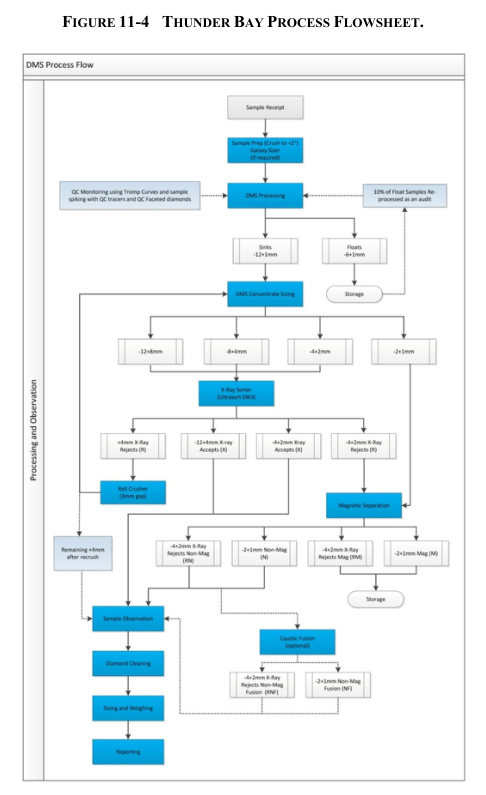
This report details the proposed diamond process plant design for the Star and Orion South kimberlites at Fort à la Corne, Saskatchewan, based on laboratory testwork, bulk sampling operations, and DRA engineering experience.
Report context
This NI 43-101 Technical Report for the Star Orion South Diamond Project presents the recovery methods section of a Preliminary Economic Assessment (PEA). The report date is not explicitly stated in the provided section. The project is located in the Fort à la Corne (FalC) area of Saskatchewan. DRA designed a diamond process plant best suited to treating the FalC kimberlites, which are generally categorized as "soft" and amenable to autogenous grinding (AG) milling. The process plant design draws on specific laboratory test programs and extensive bulk sampling programs that processed underground samples from both the Star and Orion South deposits.
Processing route
Basis of design
The flowsheet was developed using information extracted from an extensive database generated during sampling campaigns and previous studies. A Bulk Sample Plant (BSP) supplied by Bateman Engineering of South Africa (Bateman Reference Number M7007) operated at FalC, Saskatchewan, commencing operations in 2004 and ceasing in February 2009. The BSP comprised a comminution section (crushing and scrubbing), a DMS section, a thickening section, and a recovery section utilising both X-ray and grease technology.
Based on DRA's experience on recent projects at Karowe and Renard, new technology innovations were included in the proposed flowsheet design: wet X-Ray Transmission (XRT) based carbon specific bulk sorters for value preservation, large diamond recovery and coarse dense media separation (DMS) replacement; wet X-Ray Fluorescence (XRF) based X-ray sorting machines to minimise footprint and maximise diamond recovery; dry fine XRT re-concentration sorting machines to produce a high diamond by weight product reducing sorting requirements; and an on-site final sorting facility.
Comminution and classification
ROM material (100% passing 400mm) is supplied to a 20,000 tonne stockpile. Multiple apron feeders per mill stream discharge onto separate conveyors feeding two autogenous mill streams. Dilution water is added to the mills either directly from process water supply or as de-gritted effluent from DMS, XRT and Recovery Plant circuits.
Kimberlite is milled and exits through a discharge grate with 50mm ports directly onto double deck sizing and de-sliming screens. The washed -50 +10mm material gravitates to a dry sizing screen where it is screened at 32mm. The +32mm material is returned to the mill feed by conveyor. The screen undersize -32 +10mm is conveyed to the XRT circuit feed surge bin. The bottom deck product -10 +1mm is conveyed to the DMS feed surge bin.
The -1mm undersize from each mill product sizing screen is collected in the screen underpan and pumped to Pachucas, then to the slimes impoundment facility. The slurry reports to a cyclone cluster positioned on the slimes dam wall. Grits in the cyclone underflow are used to build impoundment walls while cyclone overflow reports to dam paddocks for settling. No flocculants are used in this circuit. No slimes dam wall building is undertaken during winter months.
Coarse XRT sorting
A 200 ton surge capacity bin feeds two bulk sorters. Wash screens ahead of each sorter remove fines and misplaced undersize. Screen undersize and dribbles gravitate to the XRT effluent sump and are pumped to a degrit cyclone where underflow is added to fine tailings Pachuca and overflow reused as mill dilution water.
XRT sorter rejects report to the same conveyor as DMS float screen oversize and are conveyed to the coarse rejects stockpile for possible crushing and reprocessing at a future date. Coarse XRT concentrates are collected in a glove box for hand sorting within the recovery area.
Dense medium separation
A 300 ton surge capacity bin feeds two 300 tph DMS modules. The pump fed DMS circuits each have 4 x 510mm cyclones. The floats product is sized on a double deck screen with a panel size still to be decided but differing from the upper DMS feed size of 10mm (could be 6 or 8mm). Material smaller than the panel cut size is disposed of permanently on the DMS rejects dump. Material above the panel cut size is conveyed to the coarse rejects stockpile.
The concentrate from each DMS is sized into three fractions on the sink screen. These fractions are collected in hoppers ahead of the recovery plant sorting circuit. DMS plant effluent is pumped to a degrit cyclone with underflow added to fine tailings Pachuca and overflow reused as mill dilution water.
Recovery
There is a preference for wet primary processing in the recovery plant. XRT technology recovers diamonds from the Coarse -10 +6mm DMS concentrate fraction. XRF sorting technology is used for wet sorting of the -6 +3mm and -3 +1mm DMS concentrate fractions. Ball milling followed by grease scavenging of all X-ray rejects ensures maximum recovery of diamonds.
The +6mm fraction from each DMS module is combined prior to processing in a single wet XRT sorter. The XRT machine concentrate reports to a glove box for hand sorting. Tailings are routed to the recovery plant rejects stockpile conveyor.
The -6 +1mm DMS concentrates are wet sized at 3mm on the sinks screens. Both fractions are stored in hoppers for each DMS sinks screen module. Material is transferred to the wet X-ray circuit using feeders and jet pumps, dewatered, and reports to bins ahead of each cluster of four double pass X-ray streams. Weighbelt feeders withdraw material from the bins and discharge into primary X-ray sorters. Fluorescent material is ejected, with tails passing to a secondary machine for more concentrate generation.
Re-concentration
Dewatered concentrates from the X-ray clusters report to a small surge bin. Material is drawn out using a vibrating feeder and discharged onto an infra-red (IR) drier pan. The dried and cooled product gravitates to a rotary screen fitted with woven wire screens, sized at 3mm and de-dusted at 1mm on the bottom deck. The dry, sized concentrates report to small surge bins ahead of six re-concentration XRT machines (Debtech BWT1122). The high diamond by weight (DBW) concentrate from the machines gravitates to individual gloveboxes for weighing and de-falsifying. XRT tailings are pumped to the ball mill in the greasebelt scavenging circuit.
Scavenging
Tailings from the X-ray clusters and the XRT re-concentration machines are pumped to the scavenging circuit, dewatered, and fed into a ball mill where they are milled to reduce volume and to polish and condition the surfaces of misplaced and low luminescent diamonds ahead of the greasebelts. The mill product gravitates to a sump, then is pumped to a dewatering/washing/sizing screen where fines (-1mm) are removed and material sized at 3mm. The sized product is stored in surge bins ahead of the greasebelts.
Material is drawn out using vibrating feeders and discharged onto pan feeders that spread the material and feed it onto the grease surface in a mono-layer. Diamonds and some contaminants adhere to the grease surface. The grease layer with attached diamonds is removed by a water jacketed knife and reports to a melting chute where grease is heated and removed from diamonds. Hot water sprays further clean the diamond surfaces. An additional detergent based washing stage ensures diamonds are clean enough for hand sorting. Grease belt tailings are dewatered before reporting to the recovery rejects stockpile feed conveyor.
Water recovery and slimes disposal
Limited opportunity for water recovery exists for re-use in the plant, except for effluent streams from XRT, DMS and Recovery circuits. These individual streams are de-gritted using cyclones, with overflow used as dilution water in the autogenous mills. Grits from cyclone underflows gravitate to slimes Pachucas for disposal.
Autogenous mills are expected to generate significant undersize (-1mm). Effluent streams from mill discharge screens are collected in screen underpans and pumped to large Pachucas to decouple the process plant and slimes disposal circuit. Trains of slurry pumps deliver the minus 1mm effluent to the slimes dam where cyclone clusters on the wall produce wall building grit while finer nominally -100 micron slimes are routed to the impoundment area. There are two operating and one standby stream.
Water circuits in the DMS and Recovery Plant will require surficial water treatment to improve clarity and quality.
Coarse tailings disposal
There are three tailings streams: Coarse -32 +10mm rejects from Primary XRT and DMS circuits are stockpiled to facilitate possible crushing and re-processing at some future point; -10mm DMS Plant floats are routed to the final tailings dump for disposal; and all recovery tailings are kept separate from general tailings streams for possible future treatment.
Key reported parameters
| Description | Units | Value |
|---|---|---|
| Annual Process Plant Throughput | tpa | 14,300,000 |
| ROM | tpd | 45,000 |
| ROM Top Size (100% Passing) | mm | 400 |
| Mill Feed Stockpile Capacity | tons | 20,000 |
| Plant Throughput (head feed) | tph | 2,000 |
| Mill Streams | tph | 2 x 1,000 |
| Mill Product Sizing Screen Feed (Top Deck / Bottom Deck) | mm | -50 / 10 / 1 x 13 (slot) |
| Primary XRT Sizing Screen Feed / Deck | mm | -50 +10 / 32 (Square) |
| Primary XRT Feed Size Range | mm | -32 +10 |
| Combined Primary XRT Capacity | tph | 400 |
| DMS Feed Size Range | mm | -10 +1 |
| Combined DMS Capacity | tph | 500-600 |
| Yield to Recovery (% of Head Feed) | % | 1.12 |
| Recovery Sorting Capacity: Coarse XRT -10 +6mm | tph | 30 |
| Recovery Sorting Capacity: Middles XRF -6 +3mm (4 Streams) | tph | 4.7 |
| Recovery Sorting Capacity: Fines XRF -3 +1mm (4 Streams) | tph | 3.1 |
Project website: https://stardiamondcorp.com/projects/star-orion/project-highlights/
Technical qualifications
The process plant design criteria collates information gathered from metallurgical tests carried out in various laboratories and metallurgical information and experience gathered from the Bulk Sample Plant, in conjunction with industry experience and expertise from DRA. The flowsheet was developed using information from the extensive database generated during sampling campaigns and previous studies. The BSP operated at FalC, Saskatchewan from 2004 to February 2009.
The design criteria and mass balance summarised in Table 17-3 represent proposed design values based on laboratory testwork, bulk sampling data, and DRA experience. The report notes that the panel size on the DMS float screen "is still to be decided." The report also states that conveyor systems for tailings streams "will be finalised during a later design phase."
Specific laboratory test programs quantified various operating parameters. Table 17-1 summarises metallurgical test work conducted on the Star Kimberlite, and Table 17-2 summarises test work conducted on the Orion South Kimberlite. Tests were conducted at multiple organisations including SGS Mineral Services (Lakefield, Ontario), Metso Minerals (Milwaukee, USA), Mintek (Randburg, South Africa), Mineral Services Canada (North Vancouver, British Columbia), De Beers (Johannesburg, South Africa), University of Saskatchewan (Saskatoon, Saskatchewan), Golder Laboratory (Saskatoon, Saskatchewan), Metso Minerals (Sala, Sweden), Steinert (Cologne, Germany), Tomra (Wedel, Germany), and SRC (Saskatoon, Saskatchewan). Tests included scrubbing, HPGR, AG milling simulations, cone crusher tests, diamond recovery and size distribution analyses, magnetic sorting, XRT testing, settling tests, and diamond luminescence and magnetic susceptibility measurements.
Source: "SGS Canada Inc. NI 43-101 Technical Report – The Star Orion South Diamond Project – Fort à la Corne Area – Saskatchewan," Section 17 Recovery Methods.
