

This technical report summarizes the mineral processing and metallurgical testing programs for the Rosebel Gold Mine in Suriname, with an effective date of December 31, 2021.
Report context
This technical report on the Rosebel Gold Mine, dated January 31, 2022, with an effective date of December 31, 2021, presents the processing and metallurgical work completed for the Rosebel operation and the Saramacca deposit. The report documents existing plant configurations, historical operating data, and the results of dedicated testwork programs. The proposed plant improvements and metallurgical testwork are distinguished from actual historical performance throughout the processing sections.
Processing route
Existing plant overview
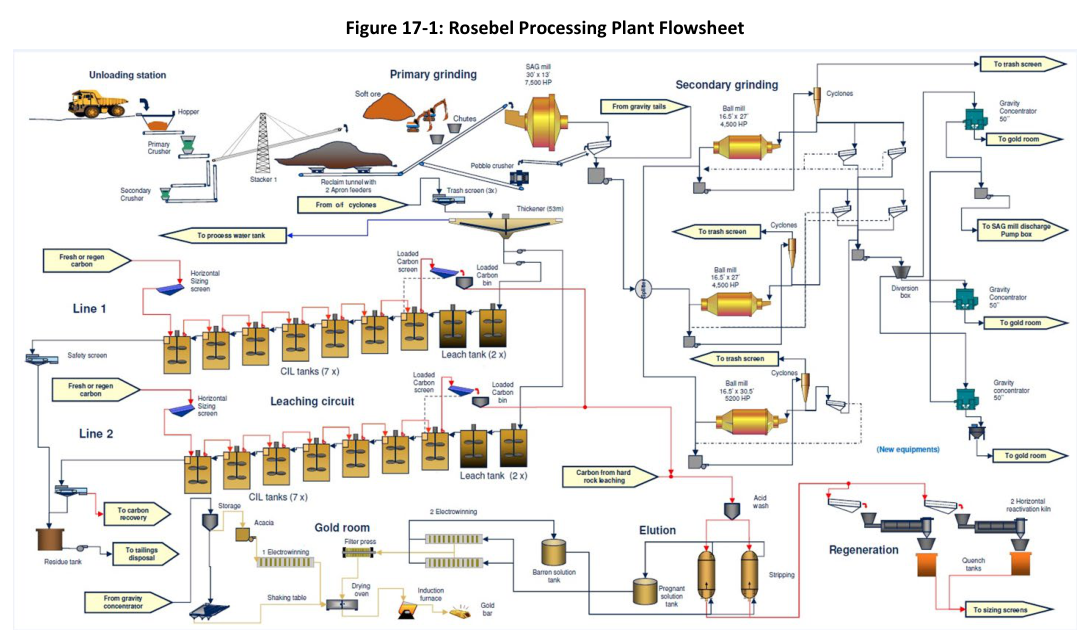
The Rosebel processing plant uses a conventional gold recovery circuit consisting of crushing, stockpiling and reclaim, grinding and classification, gravity concentration, thickening, leaching and carbon adsorption, carbon stripping (elution), and electrowinning.
Crushing, stockpiling, and reclaim
The plant receives ore through a crushing circuit that feeds a stockpile system. Ore is reclaimed from stockpile for feeding to the grinding circuit. The report notes an improvement project to increase hard rock capacity at the Rosebel plant, which represents proposed design work.
Grinding and classification
Grinding and classification are conducted after ore reclaim. The grinding circuit prepares ore at target particle sizes for downstream processing.
Gravity circuit
A gravity concentration circuit is included in the plant flowsheet. This circuit recovers free gold prior to leaching.
Thickening, leaching, and adsorption circuit
After gravity recovery, the material reports to thickening followed by leaching and carbon adsorption. This circuit uses conventional carbon-in-leach (CIL) technology for gold recovery from solution.
Carbon stripping (elution) and electrowinning
Gold-loaded carbon from the adsorption circuit is processed through a carbon stripping (elution) circuit. Gold is recovered from solution via electrowinning.
Power and consumables
Power supply and consumables for the processing operations are described in the report. Specific power sources and consumption rates are documented but are not detailed in this processing summary.
Historical recovery data
Life of mine (LOM) recoveries are reported based on historical operating data from the Rosebel plant. These recoveries show actual plant performance rather than testwork predictions.
Grindability testwork
Grindability testwork was completed as part of the metallurgical testing program. The testwork provides data on ore hardness and grinding energy requirements for process design purposes.
Geometallurgical testwork
A geometallurgical testwork program was undertaken, which included the following components:
Head assay characterization
Head assays were performed to characterize the chemical composition of mill feed materials.
Soft ore characterization and attrition testing
Testing was conducted specifically to characterize soft ore types and evaluate their behavior under attrition conditions.
Leaching capabilities at 75 μm (whole ore leaching versus gravity plus gravity tail leaching)
Leaching testwork compared the performance of whole ore leaching at a grind size of 75 μm against a flowsheet combining gravity concentration followed by leaching of the gravity tailings.
Leaching capabilities at P80 of 75 μm, 106 μm, and 120 μm (gravity plus gravity tail leaching)
Additional leaching testwork evaluated the gravity plus gravity tail leaching flowsheet at three different grind sizes: P80 of 75 μm, 106 μm, and 120 μm.
Saramacca metallurgical testwork
Metallurgical testwork was conducted specifically for the Saramacca deposit. This testwork was carried out in multiple phases:
Phase II testwork
Phase II metallurgical testwork was completed for Saramacca ore. The specific tests and results are documented in the testwork program.
Phase III testwork
Phase III metallurgical testwork was completed for Saramacca ore, representing additional testing beyond Phase II.
Key reported parameters
| Parameter | Unit | Design | Historical Actual | Testwork |
|---|---|---|---|---|
| Plant throughput | Not specified in processing sections | Improvement project proposed to increase hard rock capacity | Historical plant throughput data reported | Not applicable |
| Grind size for leaching tests | μm | Not applicable | Not applicable | 75, 106, 120 (P80) |
| Leaching flowsheet configuration | Not applicable | Not applicable | Not applicable | Whole ore leaching; gravity plus gravity tail leaching |
| Saramacca testwork phases | Number of phases | Not applicable | Not applicable | Phase II; Phase III |
| Geometallurgical testwork | Not specified | Not applicable | Not applicable | Head assay; soft ore attrition; leaching comparisons |
| Life of mine recoveries | % | Not applicable | Historical LOM recoveries reported | Not applicable |
Project website: https://www.rosebelgoldmines.sr/
Technical qualifications
The technical report explicitly states that no qualified person has reviewed or verified the metallurgical testwork or processing data independently. The processing and metallurgical testing sections rely on data provided by the operator and on testwork conducted by contractors. All testwork results are based on laboratory-scale or pilot-scale programs and have not been confirmed in full-scale production. The report qualifies that the improvement project to increase hard rock capacity is proposed design work and has not been implemented or tested. Historical plant performance data show actual operating conditions and do not necessarily predict future performance. Saramacca testwork was conducted on selected samples and may not represent the full variability of the deposit.
Source: Technical Report on the Rosebel Gold Mine, January 31, 2022, effective date December 31, 2021, Sections 17 Recovery Methods, 13 Mineral Processing and Metallurgical Testing, and 1.2.13 Mineral Processing.
