

The preliminary economic assessment for District Metals Corp.'s Viken Energy Metals Project in Jämtland County, Sweden, details a pug roast leach processing route to recover uranium, vanadium, potassium, and other metals.
Opening Background
A preliminary economic assessment for the Viken Energy Metals Project, located in Jämtland County, Sweden at latitude 63° 4' 35" N and longitude 14° 16' 48" E, was prepared for District Metals Corp. The technical report, with an effective date of June 26, 2026, evaluates a proposed open pit mining operation. The project targets the recovery of uranium, vanadium, and potassium, with associated by-products, from a black shale deposit. The technical report is a Preliminary Economic Assessment, which means it is a project-level study at a pre-feasibility stage. The source material does not state an expected construction timeline.
Critical Data
| Parameter | Value | Unit | Notes |
|---|---|---|---|
| Roasting temperature | 220 to 250 | °C | Sulphation roasting range |
| Leach water temperature | 60 to 90 | °C | For water-soluble sulphate salts |
| Carbonate content threshold | ~10 | % | Triggers decarbonisation roasting |
| Decarbonisation roasting temperature | ~550 | °C | Performed in a kiln or fluidised bed roaster |
| Grind size | P80 75 | µm | Target for flotation feed |
| Uranium precipitation pH | 6.5 to 8.0 | – | Using ammonia, at 30 to 60°C |
| ADU calcination temperature | 500 to 800 | °C | Oxidising atmosphere, produces U₃O₈ |
| AMV precipitation temperature | 50 to 80 | °C | Near neutral pH, using ammonium salts |
| AMV calcination temperature | 500 to 700 | °C | Oxidising atmosphere, produces V₂O₅ |
| Mo precipitation pH | 2 to 4 | – | Using lime, at 30 to 60°C |
| Zn and Ni precipitation pH | 8 to 10 | – | Using lime, at 30 to 50°C |
| Tailings filter cake moisture | 7 to 10 | % | Suitable for dry stacking |
| Paste tailings solids content | 65 to 75 | % | Alternative to dry stacking |
| Sulphuric acid concentration | 98 | % | Mixed with flotation concentrate in pug mill |
Overview
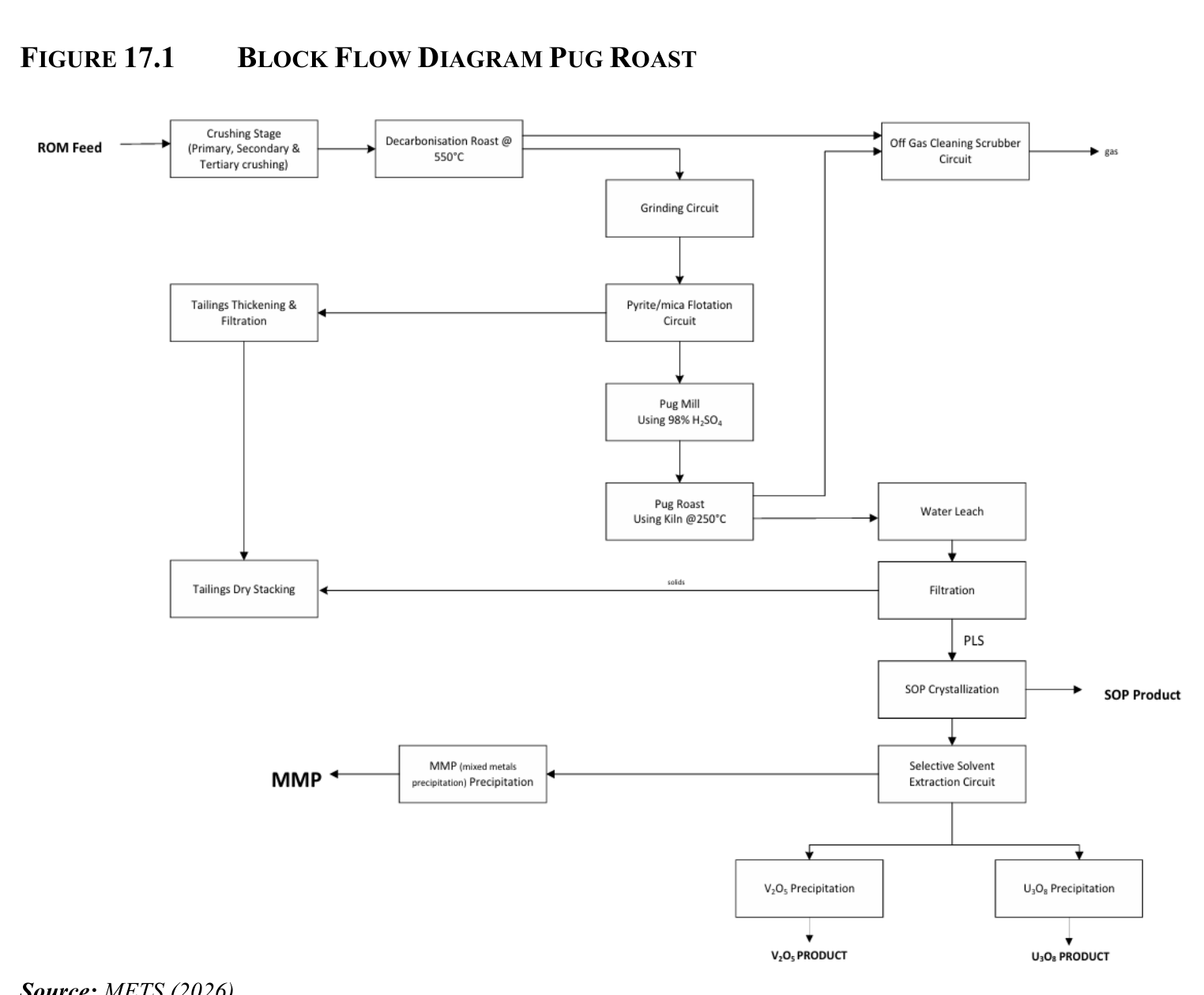
Four recovery methods were studied during the economic assessment. The pug roast leach method, with an on-site acid production plant, resulted in the highest net present value and internal rate of return for the Viken Deposit. The process feed is crushed, ground, and floated before being mixed with concentrated sulphuric acid in a pug mill and thermally roasted. This step converts vanadium, uranium, potassium, and associated metals into water-soluble sulphate species. The chosen configuration targets high leach recoveries, and it allows a more liberal flotation regime, which can enhance the recovery of by-products such as mixed metals precipitate and sulphate of potash.
Key Process Stages
The thickened and filtered flotation concentrate is mixed with 98% concentrated sulphuric acid in a pug mill to produce a uniformly acidulated feed. The material is then fed to a rotary kiln or multiple-hearth furnace for controlled sulphation roasting. The temperature is maintained in the range of 220 to 250°C to convert vanadium, potash, uranium, and other metals into water-soluble sulphate compounds while preventing sulphate decomposition. The off-gas, which contains SO₂, SO₃, acid mist, and water vapour, is treated in a wet scrubber. The cooled calcine is transferred to agitated leach tanks where water at 60 to 90°C dissolves the water-soluble sulphate salts.
After leaching, the slurry goes to a counter-current-decantation thickening circuit. The leached slurry then proceeds to solid-liquid separation where it is washed and pressure filtered. The residue is dry stacked, while the filtrate, which is the pregnant leach solution, is passed to a potassium salt crystalliser for the recovery of sulphate of potash. Ion exchange and solvent extraction are carried out to concentrate and separate the uranium and vanadium ions. The separate solutions containing vanadium and uranium are precipitated, forming V₂O₅ and U₃O₈ respectively. The remaining spent pregnant leach solution is treated to precipitate any remaining metals to form a bulk concentrate.
Run of mine ore will be delivered to the process plant via trucks. The particle size of the run of mine feed determines the number of crushing stages required, which could be primary, secondary, or tertiary. An increase in the number of crushing stages increases the capital expenditure due to additional equipment, conveyors, and infrastructure. If the feed carbonate content exceeds approximately 10%, the crushed feed will undergo decarbonisation roasting in a kiln at a temperature of about 550°C. This step reduces acid consumption during downstream hydrometallurgical processing. The breakdown of carbonate minerals generates CO₂ emissions, which will require off-gas treatment with a scrubbing system.
The feed will then undergo grinding for further size reduction to a fine size of P80 75 microns. Grinding is extremely energy-intensive, which affects operational costs, but it is crucial for mineral liberation before flotation and leaching. The grinding mill discharge passes through a series of classification cyclones. The cyclone overflow reports to flotation while the underflow returns to the mill. Selective froth flotation removes some of the acid-consuming gangue, iron minerals, and residual carbonates while concentrating the vanadium-bearing mica, which is muscovite, and uranium minerals. Most calcite and gangue report to the tailings stream. Flotation tailings are pumped to a thickener and pressure filtered for dry stacking. Pressure filtration is used due to the high degree of dryness required.
The pregnant leach solution is first conditioned with calcite to neutralise acidity and precipitate metals and sulphate as gypsum. The underflow is filtered to tailings, and the overflow is directed to an iron-removal stage. The clarified solution then has its pH adjusted with limestone before evaporative crystallisation. Water removal and cooling increase SOP supersaturation and promote K₂SO₄ crystal growth. The SOP product is recovered by centrifuging or filtering, washed to remove residual liquor and impurities, and dried prior to bulk storage.
Following SOP crystallisation, the pregnant leach solution still contains low concentrations of dissolved uranium and vanadium. An ion exchange circuit is employed ahead of final purification and precipitation. The pregnant leach solution is passed through resin columns that selectively load uranium and, to a lesser extent, vanadium. Once the resin is loaded, uranium and vanadium are stripped using an appropriate eluant to produce a concentrated metal solution. The regenerated resin is returned to the adsorption stage, and the eluate advances to the solvent extraction circuit.
Vanadium and uranium are recovered from the pregnant leach solution by selective solvent extraction in mixer-settler circuits, operated in extraction and stripping stages. The aqueous phase contacts an organic phase containing a tertiary amine extractant dissolved in kerosene with a modifier. Loaded organic is stripped using ammonium sulphate or sodium carbonate solutions to produce a concentrated uranium strip liquor. Vanadium is extracted as V(V) species using an acidic extractant, and stripping is carried out with an alkaline solution such as sodium carbonate. A scrubbing stage can be included to remove co-extracted impurities. The SX raffinate, depleted in uranium and vanadium, is directed to the mixed metals precipitation circuit.
For uranium recovery, ammonium diuranate is precipitated by adding ammonia to raise the pH to approximately 6.5 to 8.0 at 30 to 60°C under agitation. The slurry is filtered and dried, then calcined in an oxidising atmosphere at approximately 500 to 800°C to produce uranium oxide concentrate. The cooled U₃O₈ product is packaged as final uranium concentrate. For vanadium, ammonium metavanadate is precipitated from the alkaline strip liquor by adding ammonium salts or ammonia to adjust the pH to near neutral at approximately 50 to 80°C. The material is filtered, washed, and calcined at roughly 500 to 700°C in an oxidizing atmosphere to form vanadium pentoxide flake. The molten V₂O₅ is cooled, then crushed or flaked to produce the final product. Approximately 35% of the total V₂O₅ production will be directed to vanadium electrolyte production, with the remaining V₂O₅ allocated to ferrovanadium production. The process plant will be able to adjust production of vanadium electrolyte and ferrovanadium depending on market demand and pricing.
The barren SX raffinate typically contains residual base metals including copper, zinc, nickel, and molybdenum, along with sulphuric acid and high sulphate levels. The mixed metals precipitation circuit is designed to recover these metals in saleable or intermediate form while producing a neutralized effluent suitable for recycle or discharge. Molybdenum is removed first to avoid contaminating downstream zinc and nickel products. Lime is added in a conditioning tank to raise the pH to approximately 2 to 4 at 30 to 60°C, precipitating calcium molybdate. After molybdenum removal, zinc and nickel remain in solution. The pH is then increased to roughly 8 to 10 with lime at 30 to 50°C, promoting hydroxide precipitation. The resulting molybdenum, zinc, and nickel precipitates are recovered by filtration, with the filter cakes dried for storage or further treatment. Detailed testwork will be required to confirm selectivity, optimal pH ranges, and final product specifications.
Tailings are dewatered in a high-rate thickener and then filtered in a pressure filter to a target moisture of approximately 7 to 10%, suitable for dry stacking. The filter cake is trucked to the dry stack, placed in layers and compacted. Recovered water is returned to the grinding and flotation circuits to minimise freshwater demand. As an alternative, a paste tailings system may be adopted, in which tailings are thickened to roughly 65 to 75% solids and pumped as paste to a contained storage facility.
Additional Interesting Data and Summary
The recovery methods section provides specific process parameters for each unit operation. The report distinguishes between design values and test results, with several quantities presented as approximations needing confirmation. The solvent extraction and ion exchange circuits are described with key chemical reactions for uranium and vanadium separation. The report includes a block flow diagram of the pug roast flowsheet, though the diagram itself is not reproduced in this review draft.
Key Processes
- Pug roasting of flotation concentrate with concentrated sulphuric acid at 220 to 250°C
- Water leaching of roasted calcine at 60 to 90°C
- Sulphate of potash recovery by evaporative crystallisation
- Uranium and vanadium recovery via ion exchange and solvent extraction
- Uranium precipitation as ammonium diuranate, calcined to U₃O₈
- Vanadium precipitation as ammonium metavanadate, calcined to V₂O₅
- Mixed metal precipitation of molybdenum, zinc, and nickel using lime
- Tailings dewatering by pressure filtration for dry stacking, with paste tailings as an alternative
Source: Preliminary Economic Assessment on the Viken Energy Metals Project, July 17, 2026. Project website: Viken Energy Metals Project
