

Wesdome Gold Mines Ltd.’s Kiena Mine Complex in Val-d’Or, Québec, is preparing to restart its processing plant at a planned throughput of less than 1,000 tonnes per day, using the existing conventional gold recovery circuit and bypassing the secondary crusher.
The Kiena Mine processing plant, located in Val-d’Or, Québec, Canada, began operation in September 1984 and is owned by Wesdome Gold Mines Ltd. The project is a planned operation targeting gold from the Kiena Deep, Presqu’île, and Dubuisson zones. The planned operation is expected to process less than 1,000 tpd of mineralized material using the existing Kiena concentrator, with the mill performance based on a maximum of 984 tpd for the life-of-mine plan.
Critical Data
| Parameter | Value | Unit | Notes |
|---|---|---|---|
| Plant Nominal Feed Rate (Dry) | 41.7 | tph | Design value |
| Ore Moisture | 4.0 | % w/w | Design value |
| Ore Specific Gravity | 2.80 | t/m³ | Design value |
| Average Feed Au Grade | 11.73 | g/t | Design value |
| Targeted Au Recovery – Kiena Deep | 98.5 | % | Design target |
| Targeted Au Recovery – Presqu’île | 98.5 | % | Design target |
| Targeted Au Recovery – Dubuisson | 97.0 | % | Design target |
| Ball Mill Work Index – Kiena Deep | 10.7 | kWh/t | Test result |
| Ball Mill Work Index – Presqu’île | 16.1 | kWh/t | Test result |
| A x b – Minimum – All zones | 34.0 | – | Test result |
| A x b – Maximum – All zones | 64.0 | – | Test result |
| Abrasion Index – Average – Kiena Deep | 0.196 | g | Test result |
| Specific Power – All zones | 24.7 | kWh/t | Design value |
| SAG Mill Consumed Power | 550 | kW | Design value |
| Ball Mill Consumed Power | 375 | kW | Design value |
| Recirculating Load – Nominal | 250 | % | Design value |
| Product Size (P80) – Maximum | 60 | µm | Design value |
| Leaching Circuit Retention Time | 42.8 | h | Design value |
| Carbon Concentration in CIP Tank | 20 | g/L | Design value |
| CIP Circuit Retention Time | 5.5 | h | Design value |
| Carbon Strip Vessel Capacity | 3.0 | t | Not applicable |
| Carbon Strip Vessel Bed Volume | 6.0 | m³ | Design value |
| Carbon Stripping Frequency | 0.5 | #/d | Design value |
| Carbon Stripping Solution Flowrate | 1.0 | BV/h | Design value |
| Cyanide Destruction CNWAD Target | 1 | mg/L | Design value |
| SO₂ Dosage | 8.0 | g SO₂/g CNWAD | Design value |
| Copper Sulfate Dosage | 50.0 | g Cu/t Ore | Design value |
| Cyanide Destruction Tank Retention Time | 0.86 | h | Design value |
| SAG Mill Media Consumption | 0.45 | kg/t | Estimate from historical data |
| Ball Mill Media Consumption | 0.95 | kg/t | Estimate from historical data |
| Sodium Cyanide Consumption | 0.62 | kg/t | Estimate from testwork and historical values |
| Flocculant Consumption | 0.02 | kg/t | Estimate from testwork and historical values |
| Lead Nitrate Consumption | 0.21 | kg/t | Estimate from testwork and historical values |
| Quick Lime Consumption | 1.2 | kg/t | Estimate from testwork and historical values |
| Copper Sulfate Consumption | 0.33 | kg/t | Estimate from testwork and historical values |
| Sodium Metabisulfite Consumption | 2.6 | kg/t | Estimate from testwork and historical values |
| Caustic Consumption | 0.085 | kg/t | Estimate from testwork and historical values |
| Activated Carbon Consumption | 0.08 | kg/t | Estimate from testwork and historical values |
| Fresh Water Requirement | 85 | m³/d | Design estimate |
| Total Installed Power | 3,790 | kW | Design value |
| Total Daily Power Consumption – In Operation | 53,800 | kWh/d | Design value |
| Total Daily Power Consumption – In Shutdown | 13,700 | kWh/d | Design value |
Overview
The Kiena processing plant uses a conventional gold recovery process involving cyanidation and carbon-in-pulp. The plant was originally designed for a throughput of 1,250 tpd, increasing to up to 2,000 tpd once additional crushing capacity was installed. Under the current plan, throughput will be less than 1,000 tpd. The production schedule will have a maximum of 984 tpd. The operating schedule is planned as a seven-day-per-week operation. Process tailings will be pumped to the tailings pond or sent underground as backfill.
The main process steps include grinding, cyanide leaching, gold adsorption and desorption using activated carbon, electrowinning, and cyanide destruction. The design criteria were developed based on metallurgical data from a testwork program performed on the Deep, Presqu’île, and Dubuisson zones and from bulk sample processing data. The process design criteria, along with the mass and water balance, were used to evaluate process performance.
Although grindability varies significantly between the different zones, the available power in the grinding circuit is sufficient to maintain the expected P80 of 60 µm. The mill feed will likely consist of a blend from different sources, resulting in a manageable average grindability. A complete equipment review was conducted to verify capacity and condition with respect to the expected mill throughput, reliability, operating schedule, and metallurgical performance. The review confirmed that the existing equipment is capable of meeting the throughput and performance objectives.
Key Process Stages
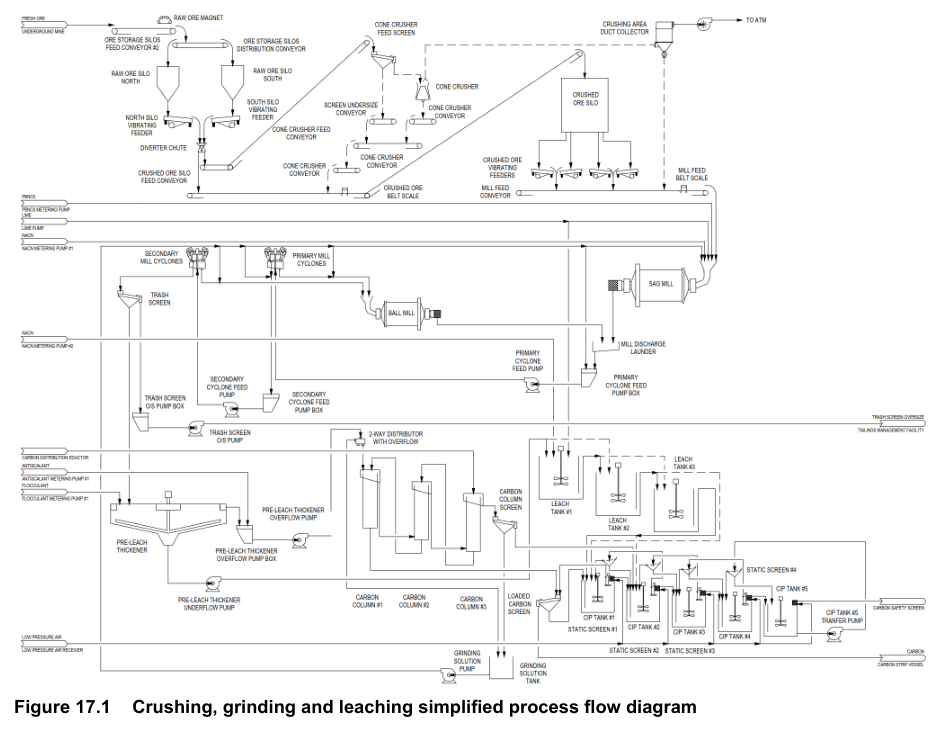
The crushing circuit includes a cone crusher and a screen. The objective of the crushing circuit was to increase throughput above the original nameplate capacity. As the planned throughput is below the original design capacity, crushing is not expected to be required. The operation of the existing surface crushing circuit will not be required.
The grinding circuit consists of an open-circuit SAG mill followed by a ball mill operating in closed circuit with two stages of cyclones. The main equipment includes one SAG mill 3.35 m diameter by 5.48 m long with a 1,000 hp motor, and one ball mill 3.20 m diameter by 3.66 m long with a 900 hp motor. The ground ore is thickened in a pre-leach thickener and sent to the leaching circuit.
The leaching circuit consists of three leach tanks, each 10 m diameter by 10.6 m high with 809 m³ effective volume. Cyanide, milk of lime, and lead nitrate are added to the leach feed. Air is introduced through the agitator shafts. The leach tanks operate in series. The CIP circuit consists of five CIP tanks, each 4.3 m diameter by 4.6 m high with 62.4 m³ volume. Slurry is fed to CIP tank #1, while unloaded carbon is fed to CIP tank #5.
The loaded carbon is sent to the carbon stripping circuit. Gold desorption occurs using the Zadra process in the elution vessel. The electrowinning cell is fed with pregnant solution, and gold is recovered by plating onto stainless steel wool cathodes. Gold-rich sludge is dried and mixed with flux, then sent to the gold melting furnace. The smelted product is poured into doré moulds.
CIP tails undergo cyanide destruction in one tank using SMBS, copper sulfate, and air to achieve a target of less than 1 ppm CNWAD. The tailings thickener increases pulp density before the slurry is transferred to the tailings management facility. When the paste backfill plant is operating, cyanide destruction tails are pumped to the paste backfill plant.
The water management circuit includes a fresh water tank, process water tank, mine water surface tank, and truck silo. Fresh water is supplied from De Montigny Lake. Process water will be used for most applications, supplied primarily by reclaim water from the TMF. Approximately 85 m³/d of fresh water is expected to be used in the process.
Additional Interesting Data and Summary
The process plant operating schedule will need to vary over time to operate efficiently and align with the mine production schedule. Because mine throughput will not be sufficient to maintain continuous operation at 1,000 tpd, regular process plant shutdowns will be scheduled. Critical equipment, such as the water and tailings systems, will remain in operation during these shutdowns.
The average electrical energy requirements for the process plant were determined from the equipment list and bulk sample processing data. The total installed power is 3,790 kW. Daily power consumption in operation is 53,800 kWh/d. In shutdown, daily power consumption drops to 13,700 kWh/d.
The available power in the grinding circuit exceeds the calculated requirement. Although grinding efficiency is lower than expected from testwork, the circuit can achieve the targeted size reduction. Most water requirements will be met by recycling process water.
Key Processes
- Crushing: bypassed; not required at planned throughput.
- Grinding: open-circuit SAG mill followed by closed-circuit ball mill with two stages of cyclones.
- Leaching: three leach tanks in series with cyanide, lime, and lead nitrate addition.
- Carbon-in-Pulp: five CIP tanks in series for gold adsorption onto activated carbon.
- Carbon Stripping: Zadra process for gold desorption from loaded carbon.
- Electrowinning: gold recovery onto stainless steel wool cathodes.
- Cyanide Destruction: SMBS, copper sulfate, and air in a single tank.
- Tailings Management: thickening followed by TMF or paste backfill plant.
- Water Management: reclaim water from TMF; fresh water from De Montigny Lake.
Source: NI 43-101 Technical Report and Feasibility Study for the Kiena Mine Complex, Val-d’Or, Québec, Canada, June 24, 2026. Project website: Kiena Mine Complex
