

Overview
Nestled in the resource-rich region of Jutiapa, Guatemala, the Era Dorada Gold Project represents a significant and strategic venture for mid-tier producer Aura Minerals Inc. This ambitious project, currently in the advanced development and permitting phase, is poised to become a cornerstone of the company’s portfolio, leveraging modern mineral processing technology to unlock the value of a substantial gold-silver deposit. The project’s effective date for its Preliminary Economic Assessment (PEA) is December 31, 2024, with the comprehensive NI 43-101 technical report prepared by GE21 Consultoria Mineral Ltda. and issued in June 2025. The envisioned processing facility is designed for a nominal throughput of 1,000 tonnes per day (tpd), or approximately 0.34 million tonnes per annum (Mtpa), focusing on high recoveries through a sophisticated flowsheet that includes gravity concentration, intensive leaching, and carbon-in-pulp (CIP) extraction. The Era Dorada project is not just an economic endeavor; it is a critical development for the local economy and a test case for implementing advanced, efficient processing technologies in the region, aiming for high overall gold and silver recoveries of 96% and 85%, respectively.
Key Process Stages
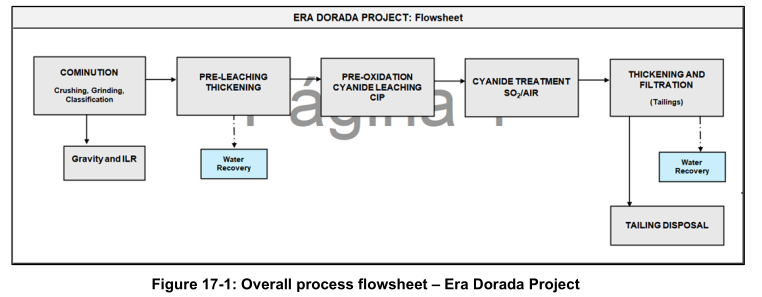
The mineral processing circuit at the Era Dorada Gold Project is a comprehensive and integrated system designed for efficiency and high recovery. It transforms run-of-mine (ROM) ore into gold-silver doré bars through a series of meticulously planned stages.
- Stage 1: Multi-Staged Crushing Underground ROM ore is first directed to an industrial crushing plant. The circuit is designed with an operational performance (availability x utilization) of 65%. The crushed product is then conveyed to a dedicated storage bin with a 24-hour live capacity, ensuring a consistent feed for the grinding circuit.
- Stage 2: Two-Staged Grinding & Classification The grinding circuit, with a 92% operational performance, is designed to reduce the ore to a very fine target grind size of P80 53 microns (0.053 mm). It utilizes ball mills in closed circuit with hydrocyclones for classification. The design is based on a Bond Ball Mill Work Index of 19.9 kWh/t, ensuring the energy requirements are accurately calculated for efficient comminution.
- Stage 3: Gravity Concentration & Intensive Leaching (ILR) A key feature for maximizing recovery, a semi-continuous batch centrifugal concentrator processes a fraction of the cyclone underflow. The high-grade gravity concentrate is not smelted directly but is instead leached in a dedicated Intensive Leach Reactor (ILR). This aggressive cyanidation step rapidly dissolves the liberated gold and silver, with the pregnant solution sent directly to the refinery.
- Stage 4: Pre-Oxidation, Leaching, and Carbon Adsorption (CIP) The main slurry stream undergoes pre-oxidation for 2 hours with oxygen sparging to oxidize sulphide minerals, reducing cyanide consumption and improving recovery. It then enters a 36-hour cyanide leach circuit. Dissolved gold and silver are subsequently adsorbed onto activated carbon in a six-stage Carbon-In-Pulp (CIP) circuit with a total residence time of 6 hours. The carbon moves counter-current to the slurry flow to maximize loading.
- Stage 5: Carbon Processing, Electrowinning, and Refining Loaded carbon is acid-washed with hydrochloric acid to remove inorganic foulants. Gold and silver are then stripped (eluted) from the carbon at high temperature (140°C) and pressure (350-500 kPa). The resulting pregnant solution is processed through electrowinning cells where gold and silver sludge is plated onto cathodes. This sludge is filtered, dried, and refined in an electric induction furnace to produce final doré bars.
- Stage 6: Cyanide Destruction and Tailings Management Tailings from the CIP circuit undergo cyanide destruction using the SO2/Air (INCO) process to reduce cyanide levels (CNwad) to below 1.0 mg/L. The detoxified slurry is then thickened and filtered to a very low moisture content of 18.6%, making it suitable for environmentally managed dry stack storage or potential use as paste backfill underground.
Critical Data
The following table summarizes the key technical and operational parameters that define the Era Dorada processing plant’s design and expected performance.
| Parameter | Value | Unit | Notes |
|---|---|---|---|
| Nominal Throughput | 1,000 | tpd | Fresh feed rate |
| Annual Processing Capacity | 0.34 | Mtpa | Based on 92% OP |
| Grinding Circuit OP | 92 | % | Operational Performance |
| Target Grind Size (P80) | 53 | μm | Final product size from hydrocyclones |
| Overall Gold Recovery | 96 | % | Design target |
| Overall Silver Recovery | 85 | % | Design target |
| Leach Residence Time | 36 | hours | In agitated tanks |
| CIP Residence Time | 6 | hours | Across 6 adsorption tanks |
| Sodium Cyanide Consumption | 0.30 | kg/t | Estimated daily usage: 520 kg |
| Lime Consumption | 1.71 | kg/t | Estimated daily usage: 2.6 t |
| Final Tailings Moisture | 18.6 | % | After filtration, suitable for dry stack |
Additional Interesting Data and Summary
Beyond the core process stages, the Era Dorada project incorporates several sophisticated elements that highlight its modern design and commitment to operational excellence and environmental stewardship. The reagent consumption profile is a critical aspect of operating cost. The plant is designed to use a suite of reagents, including sodium cyanide, lime, lead nitrate, and sodium metabisulphite (for cyanide destruction), with daily consumption meticulously calculated and storage facilities designed for safe handling. The estimated daily usage of activated carbon is 120 kg, which will be managed through a closed-loop system of loading, elution, and thermal regeneration in a horizontal electric kiln to reactivate the carbon and maintain its adsorption efficiency.
Water management is a cornerstone of the project’s sustainability initiatives. The circuit is designed for high water recirculation, minimizing fresh water make-up requirements. Overflow water from the pre-leach and tailings thickeners, along with filtrate from the tailings filters, is recirculated back to the grinding circuit. This closed-loop approach significantly reduces the project’s environmental footprint and aligns with global best practices for water conservation in mining. The final tailings disposal method is a key environmental consideration. By filtering the tailings to a low moisture content of 18.6%, the project enables dry stack tailings management. This method is generally considered safer and more environmentally stable than conventional slurry tailings dams, as it reduces the risk of seepage and catastrophic dam failures. The option for underground paste backfill is also being evaluated, which could further enhance sustainability by using tailings to provide ground support in mined-out areas.
The economic impact of the Era Dorada project on the Jutiapa region and Guatemala is expected to be substantial. During the construction and operational phases, the project will generate significant local employment and provide opportunities for local businesses. For Aura Minerals, the project represents a high-impact, dividend-friendly asset that is expected to contribute meaningfully to its production profile and bottom line. The use of proven, yet advanced processing technologies like intensive leaching and highly efficient filtration ensures the project is built on a foundation of technical robustness, aiming to deliver strong returns while maintaining a focus on safety and environmental responsibility. The successful implementation of this circuit will serve as a notable example of modern, efficient, and responsible gold processing.
Source: NI 43-101 Technical Report | Preliminary Economic | Prepared by REPORT CO | Project: Era Dorada Gold Project | Date: December 2025
Further Reading
- Era Dorada (Cerro Blanco) Project
- Operations
- The Era Dorada gold project in Guatemala is entering an important phase
- Aura Minerals’ Era Dorada: A High-Impact Dividend-Friendly Gold Asset
Technical report and processing history
The following archived source profiles have been consolidated here to preserve the project’s processing history and study context.
Era Dorada Gold Project — 2025 Technical Report
Era Dorada Gold Project — 2025 Technical Report
| Company | Aura Minerals Inc. |
| Date | 2025 |
| Region | Not Specified |
| Commodities | Gold, Silver |
| Mine Type | Underground |
| Throughput | 1,000 tpd |
| Annual Production | 0.34 Mtpa |
| Status | Development |
Executive Summary
The Era Dorada Gold Project, owned by Aura Minerals Inc., is presented in this 2025 Preliminary Economic Assessment. The project focuses on the industrial processing of underground run-of-mine ore to recover gold and silver. The design criteria establish a nominal processing rate of 1,000 tpd, with an overall gold recovery target of 96% and silver recovery of 85%.
The processing plant utilizes a multi-staged crushing circuit followed by a two-staged grinding circuit incorporating ball mills and hydrocyclones. A gravity concentration circuit with a centrifugal concentrator and Intensive Leaching Reactor (ILR) is integrated to enhance recovery. The primary extraction method involves cyanide leaching in agitated tanks followed by Carbon in Pulp (CIP) adsorption.
Tailings management includes neutralization of residual cyanide using the SO2/Air method, followed by dewatering to 18.6% moisture for dry stacking or paste backfill. The carbon processing circuit includes acid wash, elution, and regeneration, with final refining via electrowinning and electric induction furnaces to produce doré bars.
Website: http://www.auraminerals.com/en/operations/
Report Date: 2025
Region: Not Specified
Project Status: Development
Commodity: Gold, Silver
Throughput: 1,000 tpd
Mine Life:
Mine Type: Underground
Ore type:
