

The Fortnum Gold Operations (FGO) in Western Australia's Bryah Goldfields is an operating gold project owned by Aragon Resources Pty Ltd, a wholly owned subsidiary of Westgold Resources Limited. Located approximately 150 km north of Meekatharra, the operation centres on the Fortnum Mill, which has processed ore since 1989. Westgold acquired the operation in July 2015. The mill has been fed from the Starlight underground mine and local open pits, with active underground mining at Starlight as of the report date. A Preliminary Economic Assessment published 20 November 2024 examined expanding the mill from 0.9 Mtpa to 1.5 Mtpa, though the expansion has not been approved. Between May 2017 and June 2026, the mill processed 7.78 Mt at 2.60 g/t with an average recovery of 94.9%. The operation employs approximately 243 people, mostly fly-in/fly-out workers from Perth.
Critical Data
| Parameter | Value | Unit | Notes |
|---|---|---|---|
| Mill capacity | 0.9 | Mtpa | Design capacity |
| Crusher closed side setting | 90 | mm | Nominal |
| SAG mill diameter | 5.49 | m | Hardinge Allis Chalmers |
| SAG mill effective grinding length | 1.83 | m | |
| SAG mill power | 620 | kW | |
| Trommel aperture | 19 | mm | |
| Pebble crusher CSS | 10 | mm | Nominal |
| Ball mill diameter | 3.81 | m | Allis Chalmers |
| Ball mill EGL | 6.71 | m | |
| Ball mill power | 1,200 | kW | |
| Hydrocyclones | 8 | units | Weir 250 CVX |
| Trash screen aperture | 0.63 | mm | Linatex, 1.2 m x 3.6 m |
| Gravity feed screen aperture | 2.00 | mm | Oreflow, 1.2 m x 3.0 m |
| Leach tank volume | 282 | m3 | Two tanks |
| CIL tank volume | 282 | m3 | Six tanks |
| CIL tank effective working volume | 265 | m3 | Average per tank |
| Combined residence time | 15 | hours | Normally, including leach tanks |
| Agitator drive power | 15 | kW | Dual, down-pumping |
| Cyanide strength | 30 | % by weight | Dosed at Leach Tank 1 |
| Target leach pH | 10.4 | ||
| Target cyanide concentration | 180 | ppm | Up to |
| Elution capacity | 2.5 | t | Pressure Zadra |
| Carbon regeneration temperature | 700 | °C | Approximate, LNG-fired kiln |
| Tailings screen aperture | 0.8 | mm | Oreflow, 1.2 m x 3.0 m |
| Raw water dam | 5,000 | m3 | |
| Plant air pressure | 650 | kPa | Nominal |
| Power station capacity | 9.2 | MW | Hybrid, 5 CAT gas gensets, 2 dual fuel gensets |
| Solar array | 5.527 | MW | |
| BESS | 2.212 | MW | |
| Average recovery (Jan 2022 onward) | 94.7 | % | Test result |
| Recovery range (Jan 2022 onward) | 91.3 to 97.0 | % | May 2025 to February 2023 |
| Average reconciled head grade | 2.47 | g/t Au | Since 2022 |
| Tails grade range | 0.06 to 0.21 | g/t Au | Same period |
| Average tails grade | 0.13 | g/t Au | Same period |
| Historical processing (May 2017 to June 2026) | 7.78 | Mt | At 2.60 g/t, 94.9% recovery |
Overview
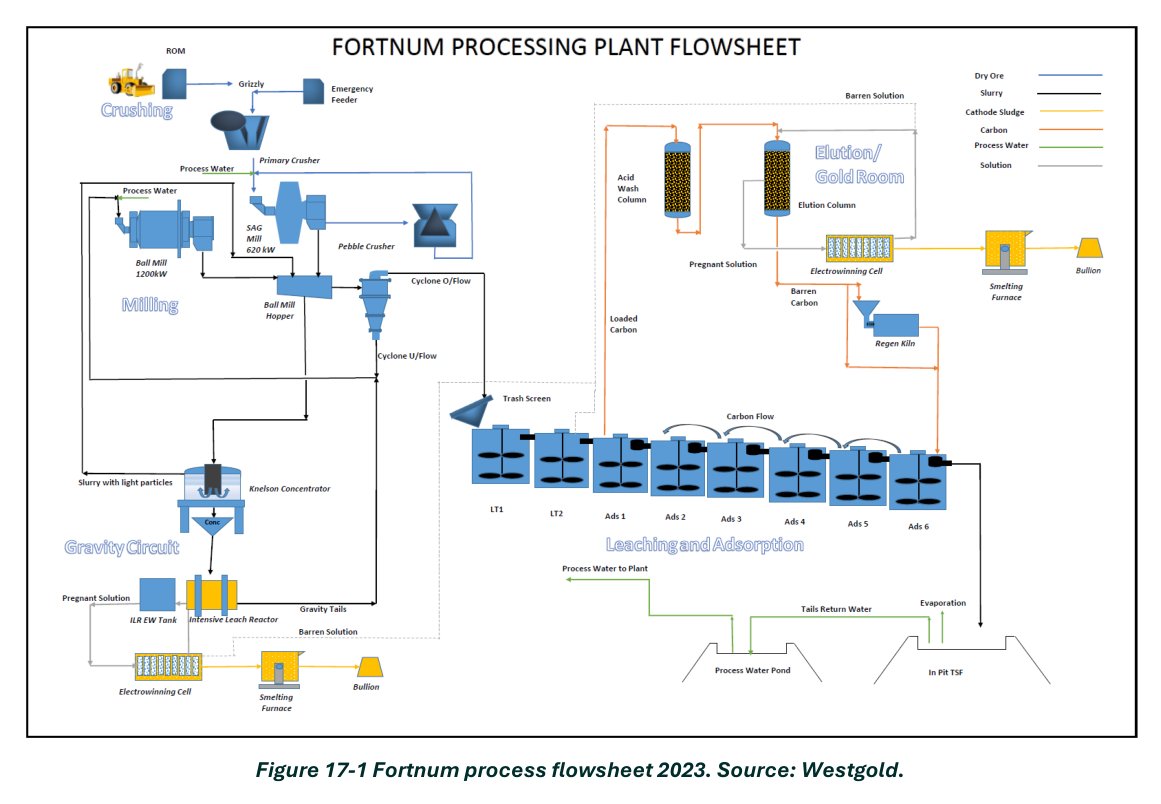
The Fortnum Mill is a conventional carbon-in-leach (CIL) plant originally built by Minproc Engineering and relocated to its current site by Homestake Australia in 1989. The plant comprises an open circuit jaw crusher, a SABC comminution circuit, a gravity separation circuit, two leach tanks, and six carbon adsorption tanks. The primary operating sections are crushing and conveying, grinding and pebble crushing, gravity recovery, leaching and carbon adsorption, carbon stripping, electrowinning, refining and carbon regeneration, tailings deposition and storage, reagent mixing and handling, and plant services.
Mill feed comes from the nearby Starlight underground operation and open pits in the Fortnum area. The feed is trucked to the run-of-mine pad, where it is classified and stockpiled according to gold grade and hardness to create an optimal feed blend. Oversize material is sorted from the stockpiles and broken using a front-end loader and a rock breaker on the ROM pad. Any oversize that cannot pass through the primary crusher grizzly is broken with the rock breaker.
Key Process Stages
The crushing circuit uses a Jaques 6 m by 1.6 m plate feeder, a Kemco C160 double toggle jaw crusher with a 48 inch by 42 inch throat, and a 3.5 m by 1.2 m emergency plate feeder. Material exits the jaw crusher at a nominal closed side setting of 90 mm and feeds directly into the SAG mill.
The SAG mill is a Hardinge Allis Chalmers unit with a 5.49 m diameter and 1.83 m effective grinding length, powered by a 620 kW motor. Discharge passes through a 19 mm trommel. Slurry undersize flows to the mill discharge hopper, while pebble oversize goes to a 3 foot Symons Cone Crusher set at a nominal 10 mm CSS. The pebble crusher product returns to the SAG mill feed. SAG undersize slurry combines with ball mill discharge and pumps to a hydrocyclone cluster of eight Weir 250 CVX units. Hydrocyclone underflow feeds an Allis Chalmers ball mill, 3.81 m diameter by 6.71 m EGL, with a 1,200 kW motor, operating in closed circuit with the hydrocyclones.
Slurry from grinding and classification passes over a trash screen to prevent oversize particles from entering the leach circuit and to remove plastic and other contaminants. The trash screen is a Linatex horizontal vibrating screen, 1.2 m wide by 3.6 m long, with an aperture size of 0.63 mm. Undersize goes to the first leach tank.
The gravity circuit was included in the plant design because the ore contains a high proportion of coarse gold. A bleed of the hydrocyclone feed stream reports to a gravity feed screen, an Oreflow horizontal vibrating screen 1.2 m wide by 3.0 m long with a 2.00 mm aperture. Oversize from this screen combines with Knelson tails and returns to the ball mill discharge hopper feed chute. Undersize feeds a KCDX30 Knelson Concentrator. The concentrate undergoes intensive cyanidation in a Gekko ILR1000 leach module, and the pregnant solution pumps to the gold room for electrowinning.
The leach and adsorption circuit has two 282 m3 leach tanks and six 282 m3 CIL tanks. All tanks use dual, open, down-pumping agitators powered by 15 kW drives. Oxygen injection is available for both leach tanks. Leach Tank 1 is the initial dosing point for cyanide, added at 30% strength by weight through a control valve. Discharge from the leach tanks overflows into the first CIL tank. Each CIL tank has an average effective working volume of 265 m3. The combined residence time through leach and CIL tanks is normally around 15 hours. Carbon advances counter-current to the slurry flow, with new and regenerated carbon added to the last tank and advanced toward the first. Loaded carbon is periodically pumped from Adsorption Tank 1 to the gold room elution circuit. The target leach pH is 10.4 and target cyanide concentration reaches up to 180 ppm.
Gold recovery from loaded carbon uses a 2.5 t Pressure Zadra elution circuit. The stripped gold electrowons onto stainless steel wool cathodes. The cathodes are washed to remove the gold concentrate, then dried and smelted in the gold room furnace to produce gold bullion. Gravity circuit gold is leached in the Gekko ILR before the solution transfers to the gold room, where it electrowons onto stainless steel wool cathodes and is smelted similarly. Barren carbon regenerates in a liquified natural gas fired horizontal Ansac HK510LP kiln at around 700°C and returns to the adsorption circuit.
Slurry from the last CIL tank flows by gravity to the tailings screen feed box. The tailings screen is an Oreflow horizontal vibrating screen, 1.2 m wide by 3.0 m long, with a 0.8 mm aperture. Undersize flows to the tailings pump hopper and pumps through a polyethylene line to the Tailings Storage Facility. Oversize, which includes trash and carbon fines, collects in a self-draining carbon fines bin at ground level.
Additional Interesting Data and Summary
Raw water is sourced from disused open pits and water bores near the plant, stored in a 5,000 m3 raw water dam. Overflow from the raw water dam flows into the adjacent process water dam. Process water combines raw water with tailings return water. Potable water comes from a good quality bore and is treated on site for use in the plant, administration building, and workshop and stores.
High pressure air is supplied at a nominal 650 kPa by plant air compressors. Power is generated on site through a hybrid 9.2 MW power station consisting of five CAT 3512H gas gensets, two dual fuel Cummins KTA50 gensets, a 5.527 MW solar array, and a 2.212 MW battery energy storage system.
The Fortnum Mill has operated intermittently since 1989 and continuously by Westgold since 2017. Recoveries from January 2022 have ranged from 91.3% in May 2025 to 97.0% in February 2023, with an average recovery of 94.7%. The lower recovery in May 2025 resulted from regeneration kiln performance that increased tails solution losses, an issue that has since been resolved. The ore is free milling and very fast leaching, with no correlation between throughput and recovery. In late 2024, the grind size was relaxed to increase throughput at a slight cost to recovery.
Processing recoveries remain consistent regardless of head grade. The reconciled head grade has averaged 2.47 g/t Au since 2022. The tails grade has ranged from 0.06 g/t Au to 0.21 g/t Au over the same period, with an average of 0.13 g/t Au.
Key Processes
- Crushing: Open circuit jaw crusher with a nominal 90 mm CSS, preceded by a plate feeder and with an emergency plate feeder available.
- Grinding: SABC circuit with a 620 kW SAG mill, 19 mm trommel, 3 foot pebble cone crusher, and a 1,200 kW ball mill in closed circuit with eight hydrocyclones.
- Classification and screening: Trash screen at 0.63 mm removes oversize and contaminants before leaching.
- Gravity recovery: Hydrocyclone feed bleed classified at 2.00 mm, concentrated in a KCDX30 Knelson Concentrator, with intensive cyanidation in a Gekko ILR1000 module.
- Leaching and adsorption: Two 282 m3 leach tanks and six 282 m3 CIL tanks with 15 kW dual agitators, oxygen injection available, target pH 10.4, target cyanide up to 180 ppm.
- Elution and refining: 2.5 t Pressure Zadra elution, electrowinning onto stainless steel wool cathodes, smelting in the gold room furnace.
- Carbon regeneration: LNG fired Ansac HK510LP kiln at approximately 700°C.
- Tailings: Oreflow screen at 0.8 mm separates trash and carbon fines, with undersize pumped to the Tailings Storage Facility.
- Plant services: Raw and process water dams, treated potable water, 650 kPa plant air, and a 9.2 MW hybrid power station with solar and battery storage.
Source: NI 43-101 Technical Report Fortnum Gold Operations Bryah Goldfields, Western Australia, October 1, 2026. Project website: Fortnum Gold Operations
