

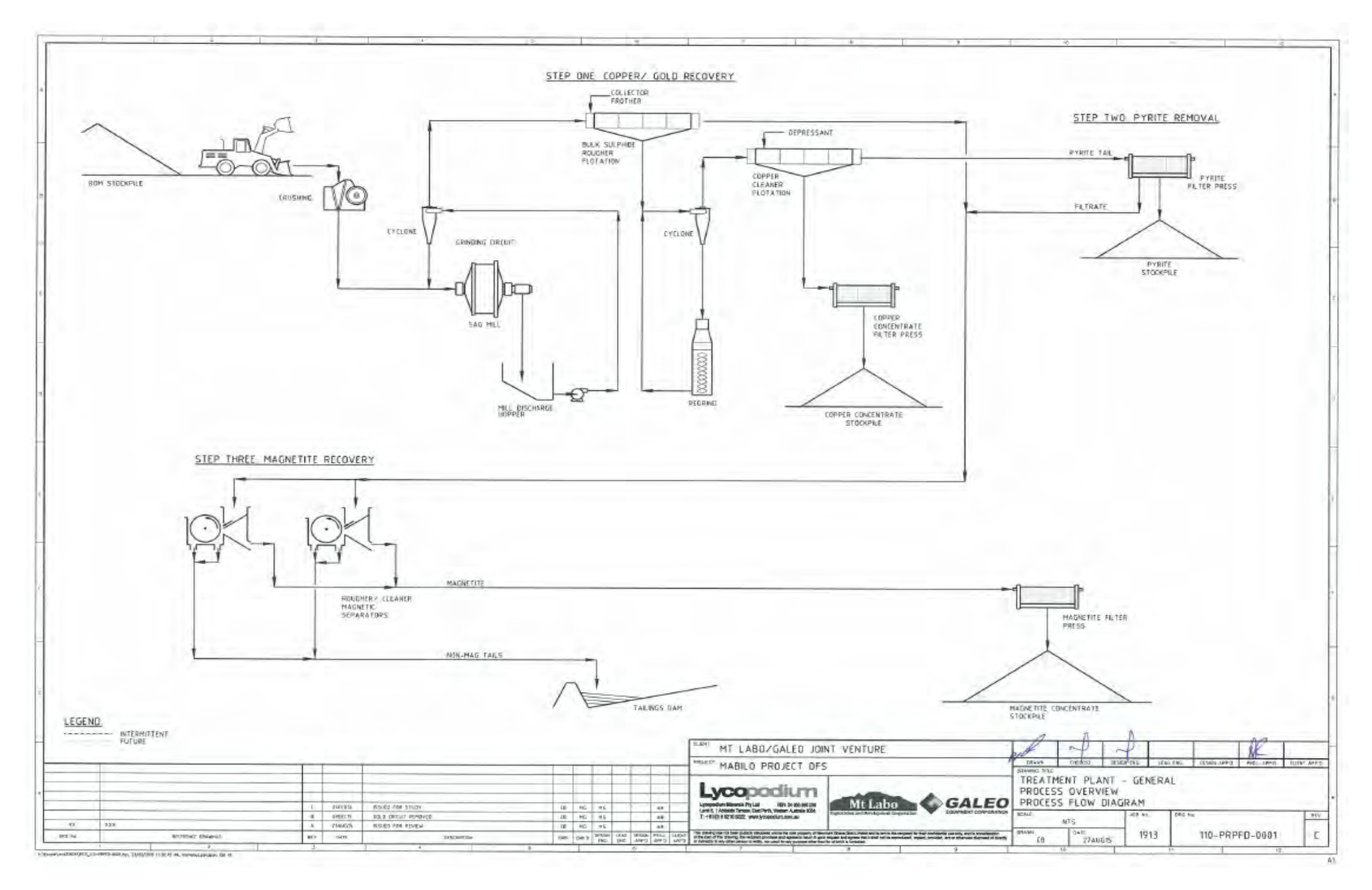
RTG Mining's May 2016 NI 43-101 report on the Mabilo project in Camarines Norte describes a single-stage SAG mill, 8-cell bulk flotation, a vertical regrind mill, two cleaner stages and low-intensity magnetic separation, with three filtered products.
The Mabilo Project lies in the Municipality of Labo, Camarines Norte Province, in the Bicol Peninsula of southern Luzon, Philippines. Lycopodium Minerals prepared the process section of the National Instrument 43-101 Technical Report for RTG Mining Inc. on a Feasibility Study, which has a date of 2 May 2016. The gold cap, supergene chalcocite and oxide skarn ores are shipped off site, and the primary ore is treated in a conventional flotation and magnetic separation plant to recover copper sulphides, pyrite in concentrate and magnetite. The plant is designed for 1,000,000 t/y of primary ore, with 80% crushing availability and 91.3% availability for the rest of the plant, supported by crushed ore storage and standby equipment in critical areas.
Critical Data
| Parameter | Value | Unit | Notes |
|---|---|---|---|
| Primary ore throughput | 1.0 | Mt/y | 125 t/h, 8,000 mill hours |
| Upside throughput | 1.35 | Mt/y | 169 t/h, no contingency |
| Crusher product | 120 | mm P80 | Single-stage open circuit |
| Grind | 90 | µm P80 | SAG mill with cyclones |
| Regrind | 38 | µm P80 | Vertical mill, variable speed |
| Mill size | 5.5 m x 6.0 m | Not applicable | 3,400 kW design, grate discharge |
| Specific energy | 17.9 | kWh/t | At P80 of 90 µm |
| Bond ball / rod work index | 15.8 / 18.5 | kWh/t | Crushing 15.0 kWh/t |
| Abrasion index | 0.33 | Not applicable | Axb 62 |
| Bulk flotation | 8 x 30 | m3 cells | 48 minutes plant residence time |
| Cleaner 1 / Cleaner 2 | 8 x 16 / 5 x 4 | m3 cells | Trough cells |
| Flotation density | 34 to 16 | % w/w | Rougher to cleaner |
| Surge bin / dead stockpile | 120 / 20,000 | t | Front-end loader reclaim |
| Magnetite skarn in design blend | 69.2 | % | Garnet skarn 14.4% |
Overview
The Mabilo plant processes a range of ore types with variable copper, magnetite and pyrite levels. A crushed ore surge bin feeds a SAG mill in closed circuit with hydrocyclones. A bulk sulphide flotation circuit floats copper sulphides and gold-bearing pyrite, and two stages of cleaner flotation separate a copper concentrate from a pyrite product for sale. Rougher tails go to low-intensity magnetic separators for magnetite. All three concentrates are thickened and pressure filtered, and combined tailings go to the tailings storage facility (TSF).
Key Process Stages
Crushing and grinding
A single-stage open-circuit primary crusher makes an 80% passing 120 mm product from a 800 mm grizzly on the ROM bin, sized at 115% of mill throughput to achieve 80% utilization. A 120 t surge bin overflows to a 20,000 t dead stockpile, which a front-end loader reclaims to feed the mill when the crushing circuit is offline. Orway Mineral Consultants reviewed 11 rock samples and recommended a single-stage SAG mill with cyclones, and allowed for pebble crushing. The mill has a variable speed drive for 65% to 80% of critical speed, because breakage is variable and low speed with high ball charge suits weaker rock. Vendors advised a 3,400 kW mill rather than the 3,200 kW OMC minimum.
Desliming and bulk flotation
An as-needed deslime circuit downstream of classification removes fine clay particles that could stop a saleable copper grade, at the cost of some copper loss. The bulk circuit floats all sulphides and gives a barren tail. Laboratory residence time of 24 minutes was doubled for plant scale-up, giving 48 minutes in eight 30 m3 tank cells, with a minimum of six cells to avoid short circuiting. The first six cells produce a rougher concentrate for regrind and copper cleaning, and the last two recover residual gold-bearing pyrite for the cleaner tail or scavenge extra copper. Lime is added to depress pyrite as the pyrite proportion changes, and duty and standby rougher concentrate pumps can both run when concentrate make is high.
Regrind and cleaning
A 90 µm primary grind separates sulphides from non-sulphides, but separating copper sulphides from pyrite needs a finer 38 µm grind, so a specialized vertical mill with a variable speed drive was selected over a ball mill. Cleaner flotation runs at lower density and higher froth depth, and the first cleaner uses eight 16 m3 trough cells in open circuit with 48 minutes of residence, five producing concentrate and three acting as cleaner scavengers. Cleaner 2 has five 4 m3 trough cells in a 2-3 configuration, with tails returning to Cleaner 1.
Magnetite and dewatering
The non-sulphide rougher tail contains significant magnetite, which two-stage low-intensity magnetic separation recovers, with cleaning to remove entrained gangue. Copper, pyrite and magnetite concentrates each go to a high-rate thickener and a plate and frame pressure filter, since testwork showed all three dewater well. Thickened pyrite can instead join the tailings stream to the TSF, which may require treating decant water.
Additional Interesting Data and Summary
Raw water comes from the Minaluli Laki stream through an environmental control dam, with a separate raw water tank so that solids in thickener overflow cannot contaminate it. Process water is recovered from thickeners and filters, concentrate thickener water recycles reagents to flotation, and magnetite thickener water returns to milling. A bleed stream is clarified for filter washing and gland water.
Comminution tests drove the design blend: 69.2% magnetite skarn, 14.4% garnet skarn, 5.8% mixed garnet and calcium silicate, 2.9% gold oxides, 2.9% copper oxides, 2.9% calcium silicate, 1.0% chalcocite and 1.0% fault zones. Fresh ore starts after the gold cap is shipped over 14 months and the supergene chalcocite and oxide skarn over 18 months.
Key Processes
- Single-stage primary crushing
- SAG milling with hydrocyclone classification
- Desliming of clay-rich feed
- Bulk sulphide flotation and two-stage cleaning
- Vertical mill regrind at 38 µm
- Low-intensity magnetic separation of magnetite
- Thickening and plate and frame filtration of three concentrates
Source: Mabilo Project National Instrument 43-101 Technical Report, May 2, 2016.
Project website: Mabilo Project
