

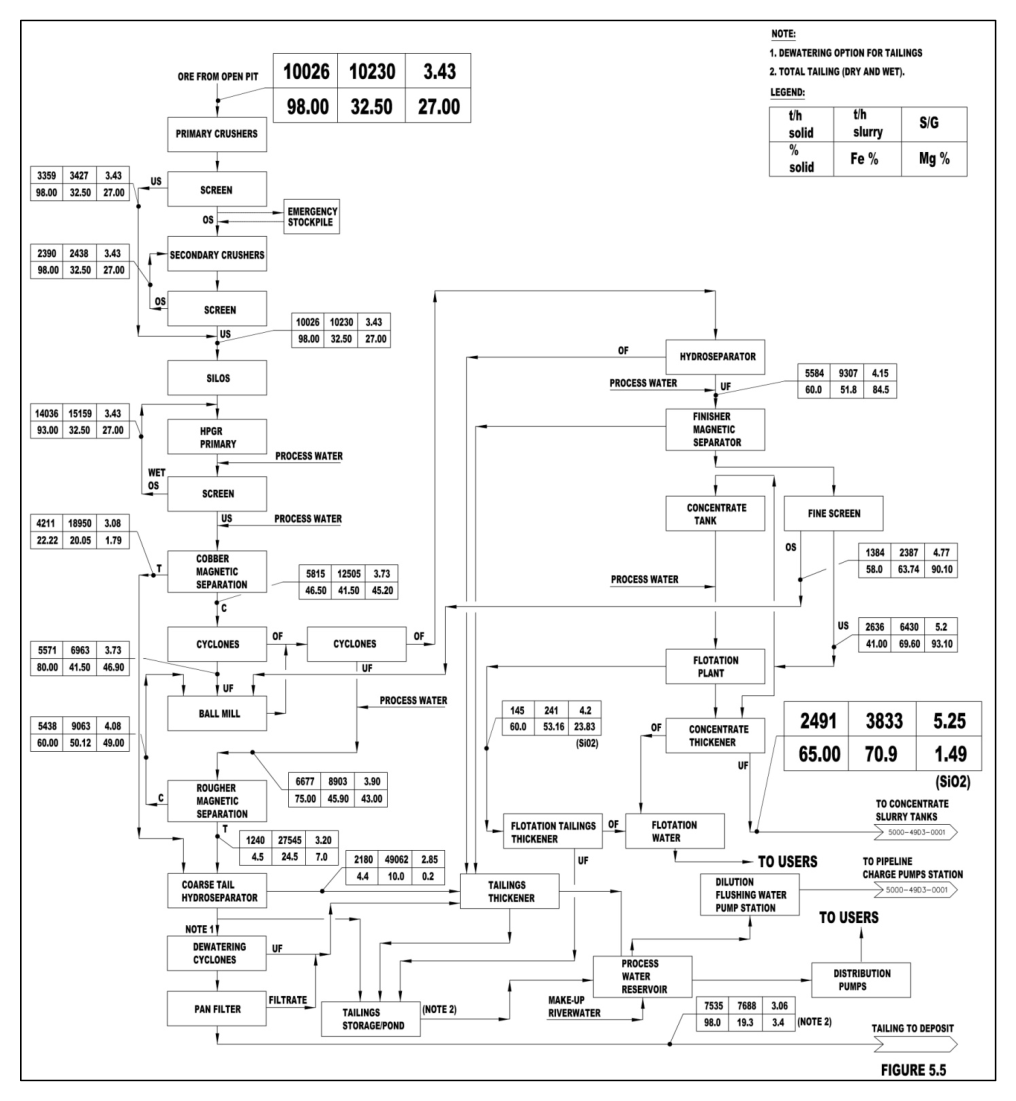
The May 2014 feasibility study for New Millennium Iron's KéMag project in the Labrador Trough pairs two 7,500 t/h gyratory crushers with HPGR dry comminution, cobber, rougher and finisher magnetic separation, and optional flotation to make DR or BF grade pellet feed.
The KéMag Taconite Project lies in the Labrador Trough in Quebec, north of Schefferville and just north of the Labrador border. New Millennium Iron Corp. prepared the NI 43-101 Technical Report on the Feasibility Study with an issue date of May 9, 2014 and an effective date of March 27, 2014. The process plant extracts magnetite from the taconite reserves. The operation mills approximately 88 Mt/y of iron-bearing mineralization to produce 22 Mt/y of magnetite concentrate, with a 22-year plant life. Silica grade can be reduced further in a flotation plant to make a high grade, low-SiO2 iron concentrate for direct reduction (DR) pellets or for sale as pellet feed. The design was based on testwork on samples from the LabMag and KéMag deposits, tested in pilot plants from 2005 to 2013.
Critical Data
| Parameter | Value | Unit | Notes |
|---|---|---|---|
| Concentrate production target | 22,000,000 | t/y | Dry |
| Design run-of-mine feed | 86,140,000 | t/y | 2% moisture |
| Weight recovery including flotation | 25.54 | % | Davis tube weight recovery about 27% |
| Feed grade | About 30 | % Fe | 32.5% Fe in mass balance feed |
| Concentrate silica | 2.1 to 2.2 | % | Not applicable |
| Operating time | 358 | days/y | 8,592 scheduled hours |
| Primary / secondary crushing availability | 66 / 85 | % | Not applicable |
| Grinding, concentration and flotation availability | 92 and 95 | % | Process plant and flotation |
| Primary crushers | 2 | gyratory | 7,500 t/h each |
| HPGR | 8 | roller presses | Fed from four 8,000 t silos |
| HPGR screening | 3 | mm | Sixteen single deck screens |
| Ore density | 3.41 | g/mL | Abrasion index 0.81 g |
| Bond ball mill work index | 13.92 | kWh/t | At 75 µm; 16.0 kWh/t at 150 µm |
| Primary stockpile | 346,000 | t | 71,000 t live |
Overview
The basic flowsheet consists of primary and secondary crushing and screening circuits feeding high pressure grinding rolls (HPGRs) for dry comminution. After cobbing, liberation of the iron-bearing magnetite is completed in a wet grinding circuit, and concentration stages include cobbing, roughing and finishing with low intensity magnetic separators (LIMS). Depending on the silica level required at the pellet plant, part or all of the final concentrate goes to flotation. Final concentrate is thickened and pumped to slurry storage tanks for transport through the concentrate slurry transportation system.
Key Process Stages
Primary crushing and screening
Fixed primary crushing units sit centrally on the edge of the resource, avoiding unnecessary haulage. Two gyratory crushers, such as a Metso 60-110E or FLS 60 x 113VD, are rated at 7,500 t/h each and process a nominal 10,026 t/h of ROM. Each has two opposing dump positions, and a common service and control area sits between the dump pockets. Four double-deck banana screens with 100 mm and 55 mm apertures screen the crushed ore. Undersize goes to the secondary ore silos ahead of the HPGR, while oversize goes to a 10,000 t cone crusher feed bin or to the primary stockpile. Taking the fines out at this stage lets one third of the ROM bypass secondary crushers and makes the stockpile less prone to freezing.
Primary stockpile and secondary crushing
The uncovered primary stockpile holds 346,000 t, of which 71,000 t is live, to continue operation during major maintenance or winter storms. Dozers push dead zone ore to the reclaim tunnel, where two apron feeders feed two conveyors. Cone crushers continue the size reduction until the material passes the 55 mm screens and goes to four 8,000 t silos.
HPGR grinding and cobbing
Eight roller presses are fed from the silos, and sixteen single-deck vibrating screens limit the product to a maximum of 3 mm before the wet magnetic cobbers. The objective of dry comminution is to reduce particle size as efficiently as possible in terms of energy, capital and operating cost. Most hematite is eliminated in the cobber tails.
Wet grinding and magnetic separation
Ball mill regrinding with rougher and finisher LIMS concentration and screening completes the liberation. The flowsheet is divided into dry plant comminution, the wet comminution and magnetic separation plant, and the flotation plant. Magnetite weight recovery is critical, because the concentration process does not recover hematite.
Flotation and tailings
Flotation reduces silica for low-silica BF and DR grade pellet feed. All tailings size fractions are pumped together to the tailings storage facility (TSF), where the heavier coarse fraction that settles first on the beaches is reclaimed to raise the dams. Decanted water is recycled to the process plant.
Additional Interesting Data and Summary
The process plant sits west of the pit in a rocky area on a slope of 10% or less. A natural valley about 4 km away is the preferred site for the TSF, which holds 22 years of tailings at a conservative settled density. A water storage pond about 4 km west of the plant collects water from Lake Harris, the mine and waste dumps, and acts as a safeguard for dry years.
The LabMag and KéMag ore characteristics are similar though not identical, and the same flowsheet and plant design can serve either orebody and still meet concentrate quality and quantity criteria. Blending provides constant feed quality. Dominant iron mineral magnetite makes up about 96% of the concentrate by mass. The feasibility study began in November 2011 and relied on pilot-scale flowsheet and mass balance work from 2006 to 2009.
Key Processes
- Gyratory crushing with banana screen scalping
- Cone crushing and silo storage
- Dry HPGR grinding with screening
- Wet cobber, rougher and finisher magnetic separation
- Ball mill regrinding and fine screening
- Flotation for silica reduction
- Concentrate thickening and slurry pumping
- Tailings storage with coarse fraction dyke raising
Source: NI 43-101 Technical Report on the Feasibility Study on KéMag Taconite Project, May 9, 2014.
