

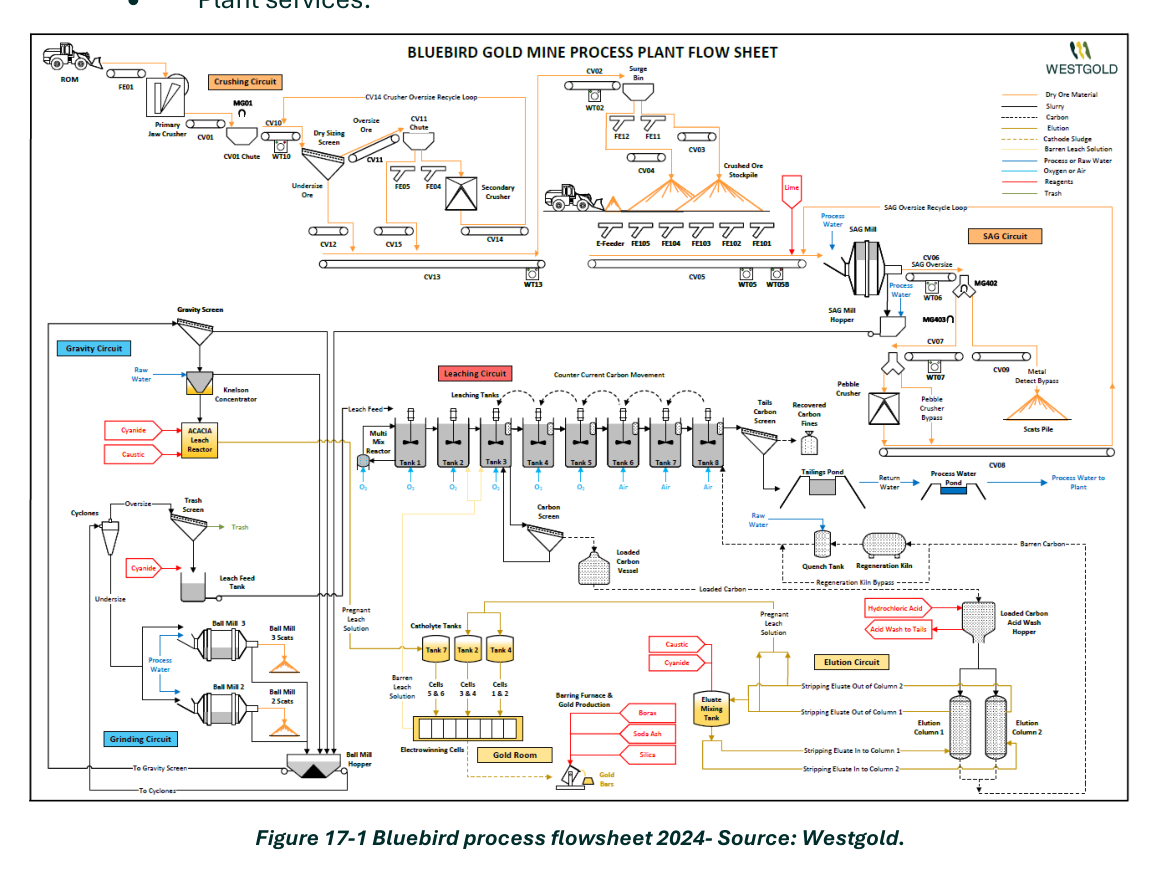
Westgold treats gold mineralisation through the Bluebird Mill at its Meekatharra Gold Operations in Western Australia. The plant uses a conventional SABC grinding circuit and carbon-in-leach recovery. Mill feed has historically blended ore from several mineral fields, and recent performance has been influenced by ore type.
The Meekatharra Gold Operations are owned by Big Bell Gold Operations Pty Ltd, a wholly owned subsidiary of Westgold Resources Limited. They sit in the Archaean Murchison Province of Western Australia, roughly 15 km south-southwest of the town of Meekatharra. The site includes four mineral fields, an accommodation village, the Bluebird Mill, 165 mineral leases as of June 30, 2026, and the Bluebird underground mine. Westgold has operated the mill since September 2015, and from that restart through June 2026 it has processed 16.44 Mt at an average grade of 2.32 g/t gold. Mining is currently active at the Bluebird South Junction underground mine. The mill treats gold ore through a conventional carbon-in-leach (CIL) processing plant with a nominal capacity of 1.8 Mtpa.
Critical Data
| Parameter | Value | Unit | Notes |
|---|---|---|---|
| Plant type | SABC grinding, conventional CIL | Not applicable | Semi-Autogenous Ball Mill Crusher circuit |
| Nominal plant capacity | 1.8 | Mtpa | Design value |
| Crushing stages | 2 | Not applicable | Jaw crusher plus secondary cone crusher |
| SAG mill | 6.5 x 4.5 | m | EGL, metal lined, 1.2 MW, Allis Chalmers |
| Ball mills | 4.0 x 5 | m | EGL, 1.2 MW, Babcock, two units |
| Hydrocyclones | 16 | Not applicable | Weir 250CVX |
| Leach tanks | 2 | Not applicable | 1,700 m³ each |
| CIL adsorption tanks | 6 | Not applicable | 1,700 m³ each |
| Combined leach residence time | 32 | h | Nominal |
| Target leach pH | 10.5 | Not applicable | Control target |
| Target cyanide concentration | Up to 220 | ppm | Control target |
| Cyanide solution strength | 30 | % by weight | Added to leach feed |
| Gravity concentrator | XD30 Knelson | Not applicable | Centrifugal concentrator |
| Intensive cyanidation | CS1000DM ConSep Acacia | Not applicable | Dissolution module |
| Elution circuits | 2 | Not applicable | 2.5 t split AARL |
| Carbon regeneration | ANSAC HK640LP | Not applicable | LNG fired horizontal kiln, ~700°C |
| Tailings screen | Oreflow HS304801 | Not applicable | 3.0 m x 4.88 m, 1.00 mm aperture |
| Trash screen | Oreflow HS304801 | Not applicable | 3.0 m x 4.88 m, 0.80 mm aperture |
| Gravity feed screen | Oreflow HS 12/24-34 | Not applicable | 1.2 m x 2.4 m, 2.5 mm aperture |
| Process water storage | 24,800 | m³ | Process water dam |
| Potable water source | Bore field | Not applicable | Approximately 7 km east of plant |
| Plant air pressure | 650 | kPa | Nominal |
| Power station | 10.7 | MW | Hybrid: 7 gas gensets, 2 dual fuel gensets |
| Solar array | 13.050 | MW | On site |
| BESS | 4.959 | MW | Battery Energy Storage System |
| Average recovery (Jan 2022 to present) | 91.1 | % | Test result, range 82.6% to 96.3% |
| Average reconciled head grade | 2.39 | g/t | Range 1.50 to 3.46 g/t |
| Average tails grade | 0.21 | g/t Au | Range 0.09 to 0.38 g/t Au |
| Workforce | Approximately 718 | people | Primarily FIFO from Perth |
Overview
The Bluebird Mill is a 1.8 Mtpa SABC grinding circuit feeding a conventional CIL gold processing plant. The flowsheet includes an open circuit jaw crusher, a primary screen and secondary crusher, coarse ore stockpiles, a grinding circuit, a gravity separation circuit, two leach tanks, six carbon adsorption tanks, and a gold recovery section. The main sections currently in use are crushing and conveying, ore storage and reclaim, SABC grinding, leaching and carbon adsorption, carbon stripping, electrowinning, refining and carbon regeneration, tailings deposition and storage, reagent mixing and handling, and plant services.
Feed arrives by truck at the run-of-mine pad directly from the adjacent Bluebird underground mine and from other scheduled ore sources. The feed is classified and stockpiled by source, gold grade, and metallurgical recovery so the mill can blend an optimal mix. Oversize material is handled on the pad with a front-end loader and rock breaker.
The plant has been operated by Westgold since 2015. Throughput versus recovery data has been tracked since January 2022. Plant recovery depends heavily on the ore types being treated.
Key Process Stages
Crushing
The crushing circuit has two stages. A 9 m x 2 MA400N000 apron feeder delivers ore to a Nordberg C125 950 mm x 1,250 mm single toggle jaw crusher. A 1.68 m Weir Trio Turbocone TC66 secondary cone crusher in standard configuration follows, with a Weir TIO8242 double deck screen. Screen undersize passing through the bottom deck apertures of 46 x 68 mm, along with some jaw crushed lump ore, is conveyed to two open coarse ore stockpiles for feed to the comminution circuit.
Grinding
Coarse feed is drawn from the stockpiles through one of five belt feeders onto the SAG mill feed conveyor. An emergency feeder can also discharge onto the same conveyor. The SABC circuit consists of an Allis Chalmers 6.5 m x 4.5 m EGL metal lined 1.2 MW SAG mill in closed circuit with a Weir Trio TC51 SHM cone crusher for pebble crushing, a hydrocyclone cluster classifier, and a gravity recovery circuit. The ball mill is a 4.90 m diameter by 6.77 m EGL LMMP / CITIC-HMC overflow ball mill.
SAG discharge is pumped to the ball mill discharge hopper, combined with ball mill discharge, and classified by a cluster of sixteen Weir 250CVX hydrocyclones. Cyclone underflow returns to two Babcock 4.0 m diameter x 5 m EGL 1.2 MW ball mills operating in closed circuit with the cyclones. A 16 mm aperture trommel screen on the mill discharge trunnions removes oversize ore particles and reject grinding balls. This mill scats material is rejected to a bin and removed by wheel loader to protect the cyclone feed pumps and reduce wear.
Slurry from the grinding and classification circuit passes over a trash screen, an Oreflow HS304801 3.0 m wide by 4.88 m long horizontal vibrating screen with 0.80 mm apertures. This removes oversize particles, plastic, and other contaminants. Undersize gravitates to leach tank feed pumps. Cyanide solution at 30% strength by weight is added to the pump hopper through a flow meter and automatic control valve.
Gravity and Intensive Cyanidation
A gravity separation circuit improves coarse gold recovery from the grinding circuit. Slurry is pumped from an internal hopper in the mill discharge hopper by 32 kW Curve C100 WEK centrifugal slurry pumps to a gravity feed screen, an Oreflow HS 12/24-34 1.2 m wide by 2.4 m long step deck vibrating screen with 2.5 mm apertures. Screen oversize is combined with Knelson concentrator tailings and returned to the ball mill discharge hopper. Undersize flows to an XD30 Knelson Concentrator to recover coarse gold.
The collected concentrate undergoes intensive cyanidation in a CS1000DM ConSep Acacia dissolution module. Pregnant solution from this process is pumped to the gold room for electrowinning.
Leaching and Adsorption
The leach and adsorption circuit has two 1,700 m³ leach tanks and six 1,700 m³ CIL carbon adsorption tanks. All tanks are mechanically agitated with dual, open, down-pumping agitator systems powered by 75 kW drives. Oxygen can be injected into Tanks 1, 2, and 3, with a high shear oxygen injector pump recirculating into Tank 1. Air sparging is available on Tank 4.
Liquid oxygen is stored on site in a 50,000 L vacuum insulated vessel. Leach Tank 1 is the initial oxygen addition point. Cyanide strength in the first leach tank is monitored by a Cynoprobe online analyser and adjusted automatically. Combined residence time is nominally thirty-two hours.
Dissolved gold is recovered from solution by adsorption onto activated carbon. Carbon advances counter-current to slurry flow, with new and regenerated carbon added to the last tank and advanced toward the first. Slurry flows from Tank 3 to Tank 8. Loaded carbon is periodically pumped from Adsorption Tank 3 to the gold room elution circuit.
The target pH is 10.5, and target cyanide concentration is up to 220 ppm. An on-line free cyanide analyser controls cyanide addition into the leach feed hopper. Dissolved oxygen is measured manually through the circuit.
Carbon Stripping, Electrowinning, Refining, and Carbon Regeneration
Gold is recovered from loaded carbon using two 2.5 t split AARL stripping circuits. Gold deposits onto steel wool cathodes in the electrowinning cells. The cathodes are washed to remove the gold concentrate, which is then dried and smelted in the gold room furnace to produce gold bullion for shipment.
Gold from the gravity circuit is leached in the Acacia reactor and electroplated onto stainless steel wool cathodes by the Acacia electrowinning circuit, then recovered and smelted in a similar manner.
Barren carbon is reactivated in an LNG fired ANSAC HK640LP horizontal kiln at around 700°C and returned to the adsorption circuit.
Tailings Disposal
Slurry from the last CIL tank flows by gravity to the feed box of a tailings screen, an Oreflow HS304801 3.0 m wide by 4.88 m long horizontal vibrating screen with 1.00 mm apertures. Undersize flows by gravity to the tailings pump hopper and is pumped through a polyethylene pipeline to the tailings storage facility. Screen oversize, consisting of trash and carbon fines, is collected in a self-draining bin at ground level.
Plant Services
Raw water is sourced from disused open pits north of the plant, where regular rain inflow provides an essentially permanent supply. Process water is stored in a 24,800 m³ dam and is made up of raw water, tailings return water, and underground dewatering from the vicinity of the plant. Potable water comes from a bore field approximately 7 km east, treated at a small treatment plant and used across the process plant, administration building, workshop, stores, main camp, and mining offices.
Plant air compressors supply high pressure air at a nominal 650 kPa. Power is generated on site with a hybrid 10.7 MW power station consisting of 7 CAT 3512H gas gensets, 2 dual fuel Cummins KTA50 gensets, a 13.050 MW solar array, and a 4.959 MW Battery Energy Storage System.
Additional Interesting Data and Summary
The Bluebird Mill has been operated by Westgold since 2015, and local mill feed variability is well understood. Since acquisition, the mill has processed ore from all the mineral fields surrounding Meekatharra. Paddy's Flat and Yaloginda have provided the majority of the ore, with some deposits from Reedy's and Nannine also processed. Ore from the CGO region has been treated at various times.
Recoveries have ranged from 82.6% to 96.3% since January 2022, with an average of 91.1%. Plant recovery depends on ore type. Some of the Paddy's Flat ores are semi-refractory, with arsenopyrite affecting gold recovery. High arsenic ores have low recoveries, and months with higher percentages of these ores result in lower plant recoveries. More free milling ores like Bluebird underground improve plant recovery when present in higher amounts in the blend. Ore recoveries in FY26 were improved by the free milling Ore Purchase Agreement from New Murchison Gold.
Reconciled head grades have ranged between 1.50 g/t and 3.46 g/t, averaging 2.39 g/t over the period. Tails grades ranged from 0.09 g/t Au to 0.38 g/t Au, with an average of 0.21 g/t Au. Improved head grades from free milling Bluebird underground ore correspond with improved plant recovery.
Throughput is generally higher when softer oxide material is treated, though the plant handles harder underground ores easily. Low throughput around October 2023 was the result of a full reline on the SAG mill, rotation of one ball mill girth gear, and maintenance on the coarse ore stockpile reclaim feeders. Campaign milling reduced throughputs from October 2024 through February 2025. Throughputs increased in FY26 with the addition of pre-crushed softer oxide material from the Ore Purchase Agreement to the blend.
Key Processes
- Two stage crushing: Nordberg C125 jaw crusher, Weir Trio TC66 secondary cone crusher, Weir TIO8242 double deck screen
- SABC grinding: Allis Chalmers SAG mill, Weir Trio TC51 pebble crusher, two Babcock ball mills, sixteen Weir 250CVX hydrocyclones
- Gravity recovery: XD30 Knelson Concentrator, screen oversize returned to ball mill discharge
- Intensive cyanidation: CS1000DM ConSep Acacia dissolution module
- Leaching and adsorption: two leach tanks and six CIL tanks, 1,700 m³ each, nominal 32 hour residence
- Carbon recovery: two 2.5 t split AARL stripping circuits, electrowinning onto steel wool cathodes
- Carbon regeneration: ANSAC HK640LP LNG fired kiln at ~700°C
- Tailings: Oreflow HS304801 screen, polyethylene pipeline to TSF
- Power: hybrid 10.7 MW station with gas gensets, solar, and BESS
Source: NI 43-101 Technical Report Meekatharra Gold Operations Murchison Goldfields, Western Australia, October 1, 2026. Project website: Meekatharra Gold Operations
