

The Tuckabianna Mill has been the processing heart of Westgold Resources' Cue Gold Operations since 2018. This article breaks down the crushing, grinding, leaching, and recovery circuits that turn ore from the Big Bell, Fender, and Great Fingall underground mines into gold bullion.
# Article Body
The Cue Gold Operations are owned by Big Bell Gold Operations Pty Ltd, a wholly owned subsidiary of Westgold Resources Limited. The project sits in the Archean Murchison Province of Western Australia, within a granite-greenstone terrane in the northwest of the Yilgarn Craton. The Tuckabianna Mill is located at Tuckabianna, approximately 25 km east of the township of Cue. The mill has been operating since March 2018, processing gold ore from the Big Bell, Cuddingwarra, Day Dawn, and Tuckabianna mineral fields. Mining is currently active at the Big Bell, Fender, and Great Fingall underground operations. From restart in March 2018 until June 30, 2026, the mill has processed 10.5 Mt at 2.1 g/t gold.
Critical Data
| Parameter | Value | Unit | Notes |
|---|---|---|---|
| Nominal plant capacity | 1.4 | Mtpa | Design value |
| Crushed product size | 12 | mm | P80, design value |
| Fine ore bin live capacity | 5,500 | t | Design value |
| Ball mill power | 2.9 | MW | Design value |
| Ball mill dimensions | 5.49 x 8.70 | m | Diameter by effective grinding length |
| Hydrocyclone diameter | 250 | mm | Weir hydrocyclones |
| Trommel screen aperture | 16 | mm | Removes oversize and reject grinding balls |
| Trash screen aperture | 0.80 | mm | Before leach circuit |
| Gravity feed screen aperture | 2.5 | mm | On hydrocyclone underflow bleed |
| Leach tanks | 3 | tanks | 2,100 m³ each, design value |
| Leach residence time | 24 | hours | Design value |
| Adsorption tanks | 6 | tanks | Four at 1,300 m³, two at 600 m³ |
| Adsorption residence time | 24 | hours | Combined, design value |
| Target leach pH | 9.8 | , | Target value |
| Target cyanide concentration | up to 350 | ppm | Target value |
| Elution circuit | 8 | t | Pressure Zadra, design value |
| Carbon regeneration temperature | ~700 | °C | LNG fired kiln |
| Process water dam capacity | 7,500 | m³ | Design value |
| Potable water RO unit | 26.5 | m³/day | Novatron unit |
| High pressure air | 650 | kPa | Nominal |
| Power station capacity | 9.2 | MW | Hybrid: gas gensets, solar, BESS |
| Average plant recovery | 86.8 | % | Test result, 2022 to report date |
| Recovery range | 82.1 to 90.3 | % | Test result |
| Average tailings grade | 0.28 | g/t Au | Test result |
| Tails grade range | 0.19 to 0.39 | g/t Au | Test result |
| Average reconciled head grade | 2.10 | g/t Au | Test result |
| Oxygen storage | 50,000 | L | Liquid oxygen, vacuum insulated |
| ROM to Big Bell mine | ~70 | km | By road |
Overview
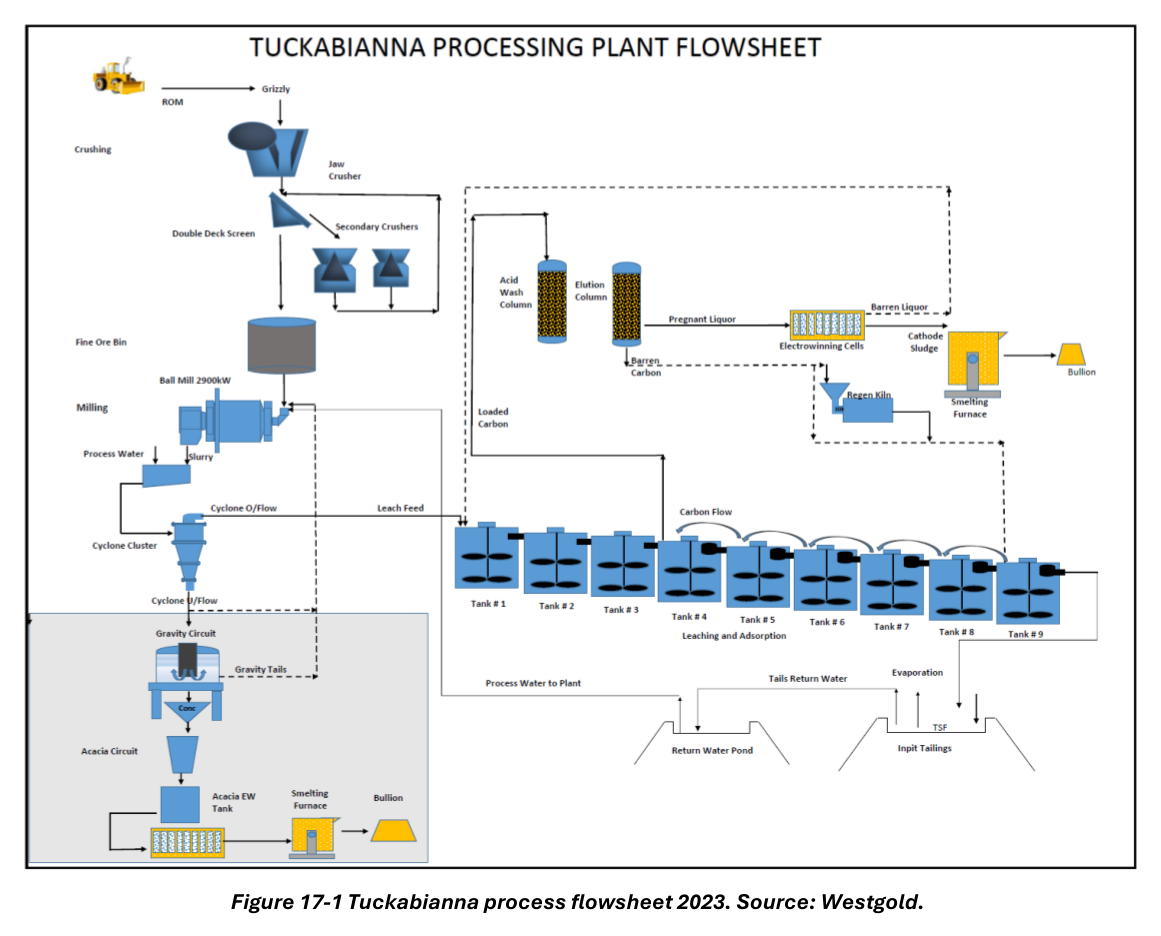
The Tuckabianna Mill is a conventional carbon-in-leach gold processing plant originally constructed for Silverlake Resources in 2012 and commissioned in 2013. Westgold acquired the mill in June 2017 and has operated it since. The plant includes an open circuit jaw crusher, closed circuit secondary crushers, a fine ore bin, a ball mill, a gravity separation circuit, three leach tanks, and six carbon adsorption tanks. The processing sections currently in use cover crushing and conveying, ore storage and reclaim, grinding, leaching and carbon adsorption, carbon stripping, electrowinning, refining, carbon regeneration, tailings deposition and storage, reagent mixing and handling, and plant services.
Mill feed comes primarily from the Big Bell mine, about 70 km by road to the west. Additional open pit and other underground ore sources are used where available. Feed is classified and stockpiled by gold grade so the mill can blend an optimal mix.
Key Process Stages
The crushing circuit runs two stages. A C160 Nordberg primary single-toggle jaw crusher starts the process. Secondary crushing uses an HP500 SX Metso cone crusher and a TP450 Trio cone crusher. The crushers work in closed circuit with a 3.0 m wide by 7.3 m long Metso MF double deck vibrating Banana screen. Crushed material exits the product screen at a P80 of 12 mm and goes into the fine ore bin, which has a live capacity of 5,500 t. Oversize material is sorted from stockpiles and broken on the ROM pad using a front end loader and a rock breaker.
Grinding takes place in a 2.9 MW ANI overflow ball mill, 5.49 m in diameter with an 8.70 m effective grinding length. The mill operates in closed circuit with a cluster of Weir 250 mm hydrocyclones. Crushed feed from the fine ore bin is conveyed to the ball mill feed chute and combined with process water and recirculating cyclone underflow slurry. A 16 mm aperture trommel screen on the mill discharge trunnion removes oversize ore particles and reject grinding balls. These mill scats pass under a belt magnet to remove reject grinding balls, then go to a Trio TC 51 pebble crusher before returning to the ball mill. Slurry from the grinding and classification circuit flows over a trash screen with an 0.80 mm aperture to stop oversize particles, plastic, and other contaminants from entering the leach circuit.
A gravity separation circuit improves gold recovery from the hydrocyclone underflow stream. A bleed from that stream goes to a gravity feed screen with a 2.5 mm aperture. Oversize returns to the ball mill feed chute. Undersize reports to a KCMD30 Knelson centrifugal concentrator. The concentrate moves to a CS1000DM ConSep Acacia dissolution module for intensive cyanidation. Pregnant solution from that process is pumped to the gold room for electrowinning.
The leach and adsorption circuit has three 2,100 m³ leach tanks and six carbon adsorption tanks. The leach tanks use dual, open, up and down-pumping Mixtec agitator systems with 75 kW drives. The adsorption tanks use dual open down pumping Lightnin agitator systems with 55 kW drives. Oxygen can be injected into Leach Tanks 1, 2, and 3, with high shear oxygen injector recirculating pumps on Tanks 1 and 2. Liquid oxygen is stored on site in a 50,000 L vacuum insulated vessel. All adsorption tanks have air injection through side entry sparging or down the agitator shaft. Cyanide solution at 30% strength is added to the first leach tank through a flow meter and automatic control valve. Lead nitrate solution at 40% w/v can be added to either the milling circuit or Leach Tank 1. Leaching residence time is 24 hours. Target pH is 9.8. Target cyanide concentration is up to 350 ppm.
Slurry flows from the leach tanks into the carbon adsorption circuit. Dissolved gold is recovered by adsorption onto activated carbon. The six CIL tanks have four with an average effective working volume of 1,210 m³ and two at 585 m³ each. Combined adsorption residence time is 24 hours. Carbon advances counter-current to slurry flow. New and regenerated carbon enters the last tank and advances toward the first. Loaded carbon is pumped from Adsorption Tank 1 to the gold room elution circuit.
An 8 t Pressure Zadra elution circuit strips gold from loaded carbon. Gold is electrowon onto stainless steel wool cathodes. The cathodes are washed to collect the gold concentrate, which is dried and smelted in the gold room furnace to produce gold bullion. Gravity circuit gold leached in the Acacia reactor is also electrowon and smelted the same way. Barren carbon is reactivated in a liquified natural gas fired vertical kiln at around 700°C and returned to the adsorption circuit.
Tailings slurry from the last CIL tank flows by gravity to a tailings screen with an 0.8 mm aperture. Undersize goes to a tailings pump hopper and is pumped through a polyethylene line to the Tailings Storage Facility. Screen oversize, which includes trash and carbon fines, is collected in a self-draining carbon fines bin.
Raw water comes from disused open pits and water bores near the plant. Process water is stored in a 7,500 m³ dam and is made up of raw water and tailings return water. A Novatron 26.5 m³/day reverse osmosis unit produces potable water from raw water for the process plant, administration building, and workshop. High pressure air is supplied at a nominal 650 kPa. Power is generated on site by a hybrid 9.2 MW station with five CAT 3512H gas gensets, two dual fuel Cummins KTA50 gensets, a 6.115 MW solar array, and a 2.448 MW battery energy storage system.
Additional Interesting Data and Summary
The Tuckabianna Mill has been operated by Westgold since 2017. Plant recoveries from 2022 have ranged from 90.3% to 82.1%, with an average of 86.8%. Recovery has declined over that period as higher recovery ore sources were depleted and more Big Bell ore entered the blend. Throughput has stayed consistent, with lower months tied to plant maintenance or weather restricting ore cartage. Throughput rate has been capped to maintain grinds because Big Bell ore shows sensitivity to grind.
Recovery from Big Bell ore displays sensitivity to alkalinity due to the presence of stibnite in the ore, along with sensitivity to grind. The variance between reconciled and assayed head grades has been small, with an average reconciled head grade of 2.10 g/t Au. There is little relationship between head grade and tailings grade. pH and grind have more significant effects on recovery. Tailings grade has ranged from 0.19 g/t Au to 0.39 g/t Au, averaging 0.28 g/t Au.
Key Processes
- Two stage crushing: C160 Nordberg jaw crusher, HP500 SX Metso cone crusher, TP450 Trio cone crusher.
- Closed circuit screening with a 3.0 m by 7.3 m Metso MF double deck Banana screen.
- Ball mill grinding in closed circuit with Weir 250 mm hydrocyclones.
- Pebble crushing of mill scats with a Trio TC 51 crusher after belt magnet removal of grinding balls.
- Gravity concentration with a KCMD30 Knelson Concentrator followed by intensive cyanidation in a CS1000DM ConSep Acacia module.
- Carbon-in-leach with three 2,100 m³ leach tanks and six adsorption tanks.
- Gold recovery by 8 t Pressure Zadra elution, electrowinning, and smelting.
- Carbon regeneration in an LNG fired vertical kiln at about 700°C.
- Tailings deposition via polyethylene pipeline to the Tailings Storage Facility.
- On site power from a hybrid 9.2 MW station with gas gensets, solar, and battery storage.
Source: NI 43-101 Technical Report Cue Gold Operations Murchison Goldfields, Western Australia, October 1, 2026. Project website: Cue Gold Operations
