

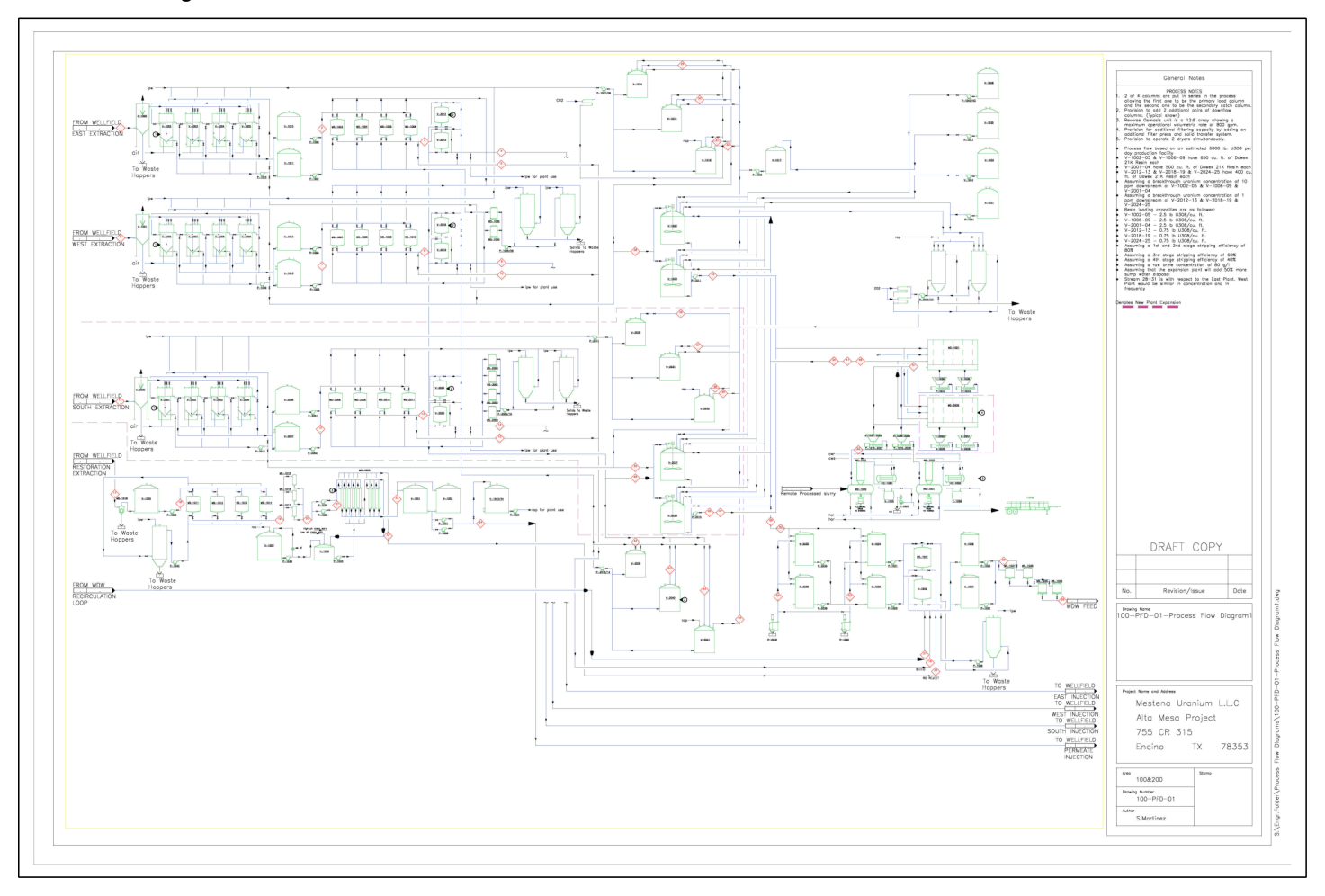
enCore Energy brought the Alta Mesa central processing plant back into service in 2024, with three ion exchange trains being returned to a combined 7,500 gpm in phases.
Alta Mesa is an operating in-situ recovery (ISR) uranium project in Brooks County, south Texas, on private land within the Jones Ranch. enCore Energy Corporation bought the project from Energy Fuels in February 2023 and decided a month later to resume production. Between March 2023 and the second quarter of 2024, enCore refurbished the central processing plant (CPP), and mining started in production area PAA-7 in June 2024. The technical report prepared by SOLA Project Services, with an effective date of December 31, 2024, describes Alta Mesa as an operating mine. enCore made the production decision without a feasibility study or declared mineral reserves, and the report notes the economic risk that comes with that choice.
Critical Data
| Parameter | Value | Unit | Notes |
|---|---|---|---|
| CPP flow capacity | 7,500 | gpm | Three IX circuits at 2,500 gpm each |
| Flow capacity after Phase II | 5,000 | gpm | Second IX circuit, expected Q1 2025 |
| IX columns per circuit | 4 | Not applicable | Up-flow, operated in series |
| Resin per column | 500 | cubic feet | Anionic ion exchange resin |
| Barren lixiviant uranium | Less than 2 | ppm | Returned to wellfield |
| Production bleed | 1 | % | Hydraulic control of mine units |
| Yellowcake drying temperature | 176 to 212 | °F | Rotary low temperature vacuum dryers |
| Drying time per batch | 9 to 14 | hours | Two dryers |
| Electrical consumption | 8.95 | kW per lb U3O8 | enCore studies |
| Measured and indicated resources | 2,585.9 | thousand lb U3O8 | 894.0 thousand tons at 0.145% |
| Inferred resources | 5,200.5 | thousand lb U3O8 | 2,223.4 thousand tons at 0.112% |
| Capital cost estimate | 25.9 | US$ million | Includes US$2.5 million for CPP refurbishment |
| Operating cost estimate | 27.44 | US$ per lb U3O8 | Plant, wellfield, restoration and other costs |
Overview
The uranium at Alta Mesa sits in stacked roll-front deposits in the Goliad Formation. Chevron discovered them in the 1970s, and Mesteña Uranium LLC first built and ran the project. Several members of enCore's team worked on that early operation, and the report says this familiarity drove the restart decision.
In an ISR operation the plant never handles ore. Lixiviant carrying oxygen and carbon dioxide is injected into the wellfield, dissolves uranium in place, and comes back to the surface as pregnant solution. The CPP strips the uranium from that solution and turns it into dried yellowcake. Its circuits cover ion exchange, elution, precipitation, dewatering, drying and packaging.
enCore is bringing the CPP back in phases to match a gradual ramp-up. Phase 1 refurbished the first IX train together with the elution and yellowcake circuits and ran alongside the development of PAA-7. Phase II upgrades the second IX circuit. Phase III upgrades the third, taking the plant to its full 7,500 gpm in 2025.
Key Process Stages
Ion exchange
The CPP holds three identical IX circuits, the South, West and North Plants. Each has four up-flow columns operated in series, and each column holds a 500 cubic foot batch of anionic resin. A stainless steel manifold inside each vessel spreads the lixiviant evenly across the resin bed, and the dissolved uranium adsorbs onto the resin. A secondary down-flow IX circuit downstream catches any uranium left in the up-flow effluent. Booster pumps sit upstream and downstream of the trains for production and injection.
The barren lixiviant leaves the columns with less than 2 ppm uranium. It goes back to the wellfield, where oxygen and carbon dioxide are added before reinjection. Before that, a bleed is drawn from the injection stream to keep hydraulic control of the production zone, and the bleed joins the liquid waste stream.
Elution
Loaded resin is eluted in place in the up-flow columns. A brine solution strips the uranium and forms a uranium rich eluate, which overflows from the columns and is pumped to eluant tanks. The plant has three sets of eluant tanks.
Precipitation
Sulfuric acid takes the eluate to pH 2 to 3. At that pH the uranyl carbonate breaks down, releasing carbon dioxide and leaving free uranyl ions. Caustic soda then raises the pH to 4 to 5, and hydrogen peroxide is added in batches to form insoluble uranyl peroxide. Once precipitation is complete the pH goes up to about 7 and the slurry is pumped to a filter press. The barren solution is disposed of down a deep injection well.
Filtering, drying and packaging
Yellowcake handling sits in a separate building. The filter press cake is washed to remove chlorides and other soluble contaminants, then moved by progressive cavity pump to a hopper and into the dryer. Two rotary low temperature vacuum dryers heat the cake to between 176 and 212 °F using propane-heated oil in an external jacket, and a batch takes 9 to 14 hours. Off-gas, mostly water vapor, passes through a baghouse and a condenser. The report states that these dryers have no significant airborne particulate emissions compared with high temperature multi-hearth drying.
The dried product goes into 55-gallon drums, which wait on a curbed concrete pad before trucking to a conversion facility. The drying and packing stations are kept apart for worker safety and have dust abatement and filtration equipment.
Additional Interesting Data and Summary
The water balance assumes a maximum production flow of 7,500 gpm and a 1% bleed. The CPP takes about 12 gpm of fresh water for make-up and washdown. Restoration sends 250 gpm to reverse osmosis, which returns 175 gpm to the wellfield and sends 75 gpm to an effluent system with six 44,000-gallon tanks and Class I injection wells. Alta Mesa has two permitted disposal wells. Fresh water comes from two Goliad formation wells. One dryer running 12 hours a day burns about 1 MBTUH of propane.
In February 2024, enCore applied to amend its Texas licence so it could build remote ion exchange (RIX) units within the licence area and process resin from other sources at the CPP. A RIX unit is a standalone IX circuit with a resin transfer system. Loaded resin from a RIX would be trucked to the CPP for elution and yellowcake production.
Radiologically contaminated solid waste that cannot be cleaned is classed as 11.e.(2) byproduct material and shipped periodically to a licensed facility.
The economic analysis assumes that 80% of the mineral resources can be recovered, at an average life-of-mine price of US$83.43 per pound. The report recommends a 200-hole drilling program to convert inferred resources.
Key Processes
- In-situ leaching with oxygen and carbon dioxide in lixiviant
- Up-flow anionic ion exchange in three parallel circuits
- Secondary down-flow ion exchange polishing
- In-place brine elution of loaded resin
- Acid, caustic and hydrogen peroxide precipitation of uranyl peroxide
- Filter press dewatering and washing
- Low temperature vacuum drying and drum packaging
- Deep well injection of liquid waste
Source: Alta Mesa Uranium Project, Brooks County, Texas, USA, National Instrument 43-101 Technical Report, December 31, 2024.
Project website: Alta Mesa Uranium Project
