

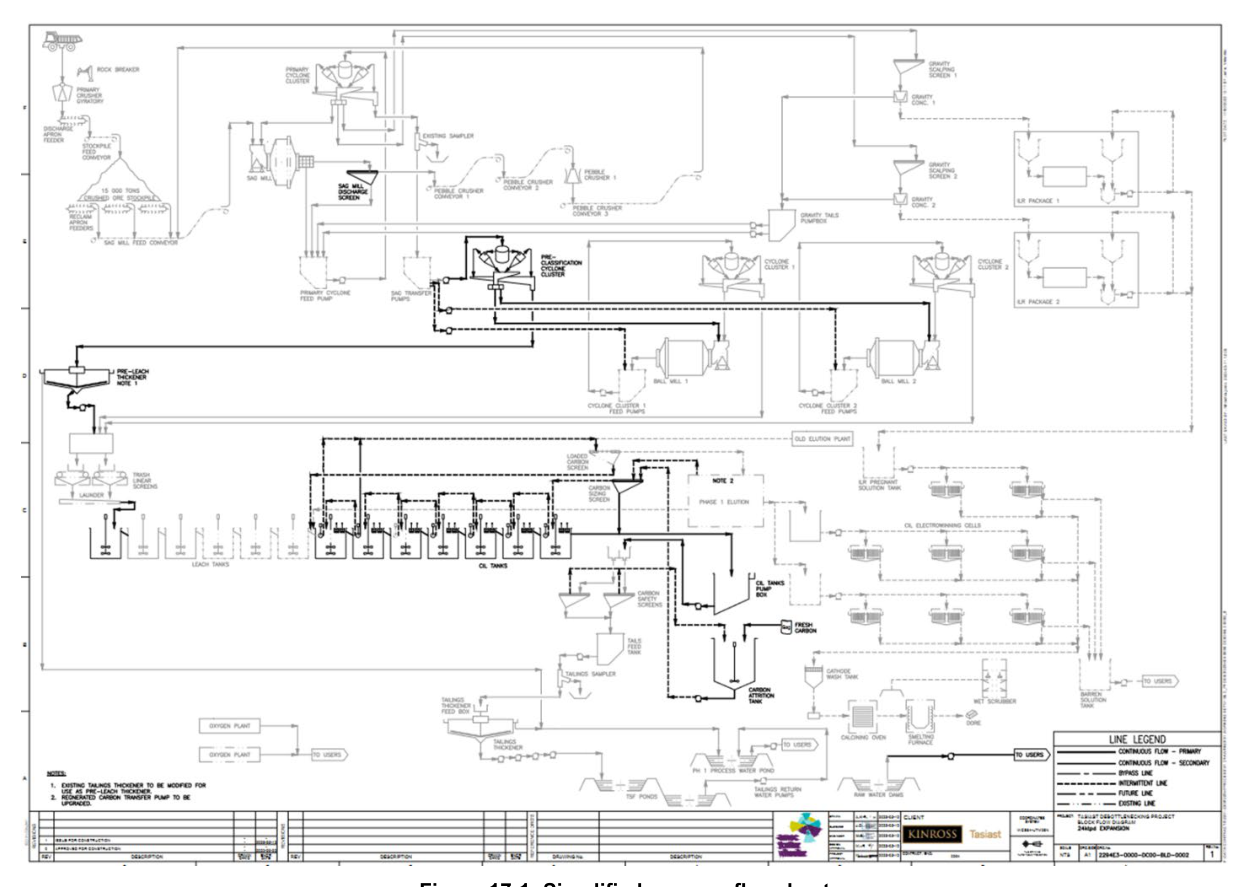
Kinross's 2025 technical report on Tasiast describes a single-stage gyratory crusher, a 40 ft SAG mill with pebble crushing, slimes pre-classification ahead of the ball mills, gravity recovery and an oxygenated leach-CIL train with AARL elution.
Tasiast is an operating open pit gold mine in Mauritania, wholly owned by Kinross Gold Corporation through Tasiast Mauritanie Limited S.A. Kinross acquired it with Red Back Mining in September 2010. The technical report, effective December 31, 2024 and signed March 27, 2025, supports resources and reserves for the West Branch, Piment, Prolongation and Fennec deposits. After a 2019 feasibility study, the carbon-in-leach (CIL) plant was expanded in steps from about 15,000 t/d to 21,000 t/d and then to 24,000 t/d, a rate reached in 2023. In 2024 the '24K New CIL' project replaced the old adsorption tanks with seven new ones. A 34 MW solar plant with an 18 MW battery, completed in late 2023, provides about 20% of the site's power.
Critical Data
| Parameter | Value | Unit | Notes |
|---|---|---|---|
| Daily throughput | 24,000 | t/d | Design, reached in 2023 |
| Plant availability | 92 | % | Crushing at 70% |
| Gold feed grade | 1 to 3 | g/t | Design range |
| Crusher work index | 14.6 | kWh/t | Design criteria |
| Primary crusher product | 125 | mm P80 target | Single gyratory, below 210 mm |
| Coarse ore stockpile | 15,000 | t live | About 15 hours |
| SAG mill feed | 1,087 | t/h | Nominal fresh feed |
| Bond ball mill work index | 13.3 | kWh/t | Axb 31.4 |
| Final grind | 90 | µm P80 | Ball mills and pre-classification |
| Leach and CIL residence | 18 | h | Total at nominal flow |
| Free cyanide target | About 250 | ppm | pH 10.5 |
| Elution batch | 7.5 | t carbon | AARL, 140 °C and 450 kPa |
| Tailings thickener | 40 | m | Underflow 60% solids |
| Q4 2024 recovery | 94.3 | % | At 23,968 t/d |
| Doré gold content | About 94 or higher | % | Minor silver |
Overview
The Tasiast plant crushes ore in one stage and grinds it in a SAG mill with a pebble crusher and primary cyclones. A pre-classification cyclone cluster sends the fine slimes straight to a pre-leach thickener and the coarse fraction to two ball mills in parallel. Two Knelson concentrators on the primary cyclone underflow recover coarse gold for intensive leaching. Leaching runs in six oxygen-sparged tanks, followed by seven tanks that work in carbon-in-pulp mode but keep the CIL name. Loaded carbon is acid washed and stripped by the AARL method, and gold is electrowon and smelted to doré. Tailings are thickened, detoxified with ferrous sulphate and pumped to the tailings facility.
A dump leach with its own adsorption-desorption-recovery plant once added to production but has been shut down, so the CIL plant now produces all of Tasiast's gold. Recovery estimates draw on test work and plant history and follow a head grade equation.
Key Process Stages
Primary crushing
Trucks bring ore above the plant feed cut-off from the pits to the ROM pad or tip it straight into the gyratory crusher, and ore can be blended by grade and competency. The crusher reduces rock below 210 mm with a target P80 of 125 mm, while the design criteria table lists 150 mm. A conveyor carries the product to the coarse ore stockpile, and three apron feeders reclaim it to the 40 ft SAG mill.
Grinding and pre-classification
The SAG mill runs in closed circuit with a pebble crusher and the primary cyclones, with a discharge screen added during the 24K project. Pebble circulating load runs from 5% to 20% and cyclone circulating load from 150% to 250%. Primary cyclone overflow at about 200 µm goes to the pre-classification cyclones. Their overflow of slimes at 90 µm goes to the pre-leach thickener, formerly the 12K tailings thickener. Their underflow feeds the ball mills, which run in closed circuit with their own cyclones and deliver 90 µm product to trash screens ahead of leaching.
Gravity recovery
Two to six primary cyclone underflows feed two scalping screens and two Knelson concentrators. Gravity concentrate is leached in batches in intensive leach reactors, and the pregnant solution goes to the gold room. The text puts gravity recovery at 10% to 15% of fresh feed, while the design criteria give 20% to 25% of the gold in feed.
Leaching and adsorption
Feed enters the leach tanks at 50% solids. The first tank can run as a pre-aeration stage without cyanide at the natural pH of 8 to 8.5. Lime raises the pH to 10.5, and cyanide is held at about 250 ppm free. High-pressure oxygen from four vacuum swing adsorption units and a containerised pressure swing unit is injected at the tank bases through SlamJet spargers. Of the six leach tanks, three date from the 12K project, two from 21K and one from 24K. The text gives 12 hours of leach time and the design table 9 hours. The seven new adsorption tanks add 9 hours. Carbon loaded to 3,000 to 5,000 g/t is pulled daily, and the rest advances counter-current.
Elution and refining
Loaded carbon is water washed, acid washed in hydrochloric acid and neutralized. Two elution vessels strip 7.5 t batches by the AARL process with hot caustic and cyanide under pressure, at 140 °C and 450 kPa. A kiln reactivates the barren carbon, which returns to the last tank. Gold is plated onto stainless steel wool cathodes, with two extra cells added in the 21K project. The sludge is pressure washed off, dried, fluxed and melted in a diesel-fired crucible furnace into doré, which a security firm carries to a commercial refinery.
Tailings
Carbon safety screens catch fine carbon ahead of the 40 m tailings thickener, which takes the slurry from 50% to 60% solids and returns water to the plant. Ferrous sulphate treats the underflow for residual cyanide before a pipeline and a booster station carry it to the tailings facility. Reclaim water returns from a collection area in the basin. The pipelines run in a trench linked to five emergency ponds.
Additional Interesting Data and Summary
Quarterly throughput in 2024 rose from 22,782 t/d to 23,968 t/d. Recovery ran at 91.2% to 91.8% for three quarters and rose to 94.3% in Q4, when the new tanks and recovery projects took effect. The plant design life is 15 years.
Raw water comes from the brackish Sondage bore field through a 400DN PVC pipeline with added pump stations, and reverse osmosis plants make potable water. Thickener overflows, tailings reclaim and camp grey water cut raw water demand. The plant is run to International Cyanide Management Code standards. Wet areas are bunded to 110% of the largest tank or 25% of total tank volume for hazardous materials.
Key Processes
- Single-stage gyratory crushing to a coarse ore stockpile
- SAG milling with pebble crushing and primary cyclones
- Pre-classification cyclones sending slimes to a pre-leach thickener
- Parallel ball milling to 90 µm
- Knelson gravity recovery with intensive leach reactors
- Oxygen-sparged cyanide leaching and seven-tank carbon adsorption
- AARL elution, electrowinning and crucible furnace smelting
- Tailings thickening and ferrous sulphate cyanide treatment
Source: Tasiast Mine, Mauritania, National Instrument 43-101 Technical Report, December 31, 2024.
Project website: Tasiast Mine
