

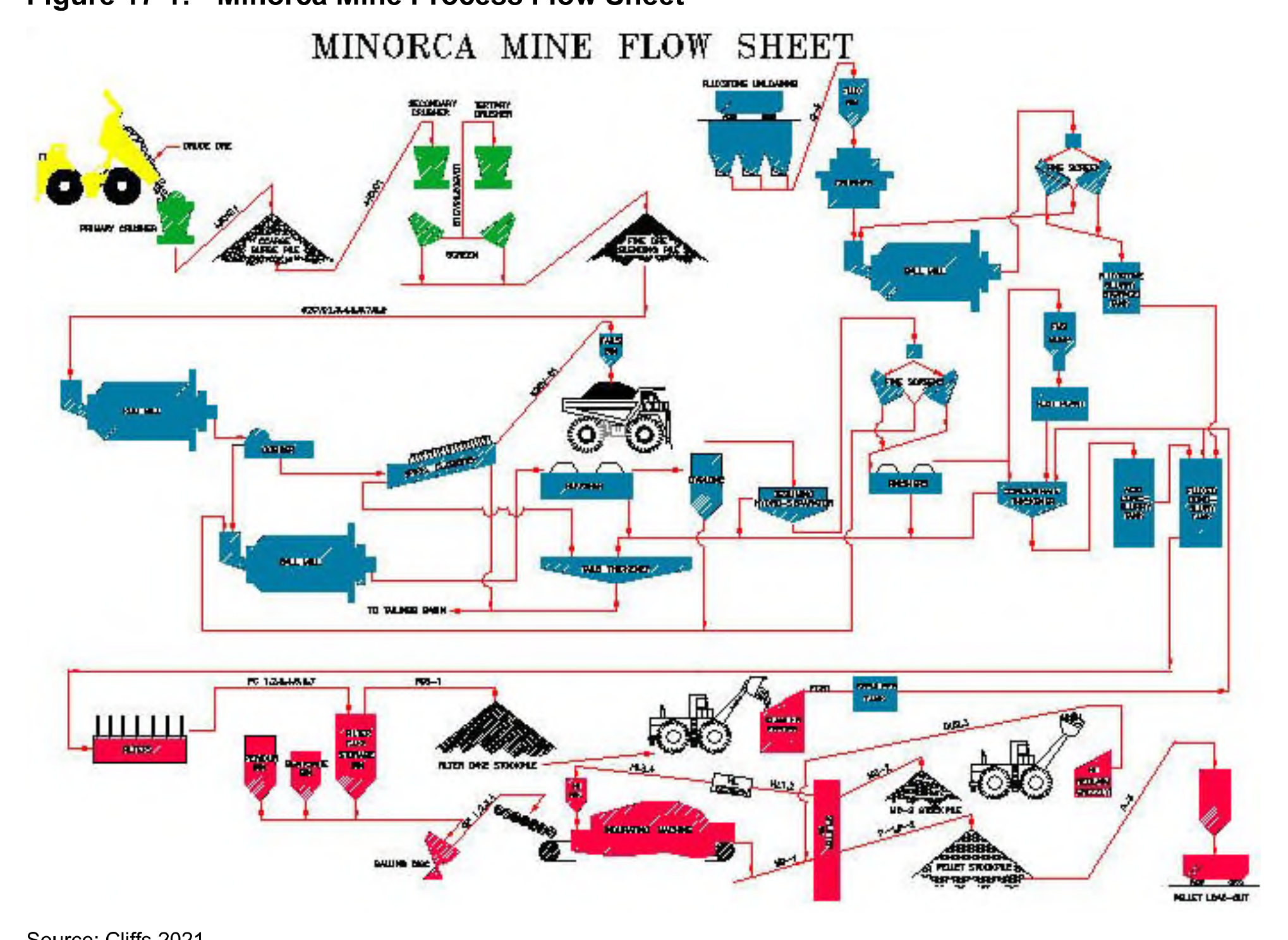
The 2024 technical report on Cleveland-Cliffs' Minorca mine in Minnesota describes rod and ball milling, staged magnetic separation, silica flotation for Laurentian pit ore, and a straight grate pellet furnace that makes flux pellets.
Minorca is an iron ore mine and pellet plant near Virginia, Minnesota, owned directly by Cleveland-Cliffs Inc. through its wholly owned subsidiary. The NI 43-101 technical report by SLR, effective December 31, 2021 and signed August 16, 2024. From 2015 to 2020 the concentrator processed an average of 8,782,900 long tons (LT) of ore a year at 22.7% magnetic iron. It made an average of 2,789,200 LT of flux pellets and 42,200 LT of lump product a year at 62.6% iron and 4.2% silica. The report notes that the property was idled once before, for six months, and Cliffs' own site page now lists the mine as in full idle, so the figures describe the operation as it ran to 2020.
Critical Data
| Parameter | Value | Unit | Notes |
|---|---|---|---|
| Average ore processed, 2015 to 2020 | 8,782,900 | LT/y | 22.7% magnetic iron |
| Mass recovery to concentrate | 32.5 | % | 2015 to 2020 average |
| Magnetic iron recovery | 95.4 | % | 2015 to 2020 average |
| Flux pellets | 2,789,200 | LT/y | 62.6% Fe, 4.2% SiO2 |
| Lump product | 42,200 | LT/y | 2015 to 2020 average |
| Primary crusher | 54 x 84 | in | Gyratory, product minus 6 in |
| Reclaim design rate | 1,396 | LT/h | Fine ore stockpile |
| Concentrator lines | 3 | Not applicable | 365 LT/h each |
| Rod mills | 3 | Not applicable | 15 ft x 20 ft, 2,500 hp |
| Ball grind target | 78 to 83 | % passing 325 mesh | 44 µm |
| Cyclone overflow | About 90 | % passing 325 mesh | Twenty inch cyclones |
| Flotation regrind | 25 | µm P80 | 500 mesh |
| Concentrate quality | 67.5 | % magnetite | 88% passing 44 µm |
| Filter cake moisture | About 9.3 | % | Disc filters |
| Bentonite | 20 | lb/LT | Of filter cake |
| Target calcium to silica ratio | 1.10 | Not applicable | Pellet chemistry |
Overview
Minorca's flowsheet is a magnetite concentrator with a pellet plant. Ore is crushed in three stages to minus 3/8 inch. Three concentrator lines each grind it in a rod mill and strip rock with cobber magnetic separators. The magnetic material is ball milled, cleaned in rougher magnetic separators, classified in cyclones, passed through a hydroseparator and cleaned again in finisher separators. Concentrate that exceeds the silica specification goes to reverse flotation, a circuit added to handle Laurentian pit ore. Concentrate is thickened and mixed with flux slurry, filtered, balled with bentonite and fired on a Dravo straight grate furnace.
Key Process Stages
Crushing
A 54 inch by 84 inch gyratory crusher breaks run-of-mine ore to minus 6 inches, and a conveyor stacks it on a coarse ore stockpile. Vibrating feeders send it to a bank of 7 ft Symons standard cone crushers working with double deck screens. Screen oversize goes to 7 ft short head cone crushers, and their screens recycle oversize. The minus 3/8 inch product is stacked on the fine ore stockpile. Twenty vibrating feeders in two reclaim tunnels, with any six running, supply the 1,396 LT/h design rate to the rod mill feed bin. Two baghouses control dust.
Rod milling and cobbing
Each line has a 15 ft by 20 ft rod mill with a 2,500 hp drive, designed for 365 LT/h. Rod mill discharge goes to three counter-rotation wet drum cobber separators in parallel. Cobber tailings pass a spiral classifier. The coarse fraction, minus 6 mesh plus 65 mesh, is dewatered and trucked to tailings, and the fines go to the tailings thickener.
Ball milling and rougher separation
The magnetic cobber product is pumped to a 15 ft by 20 ft ball mill, ground to 78% to 83% passing 325 mesh. Eight double-drum rougher separators take the discharge, with counter-current wash water to remove weakly magnetic particles. Rougher concentrate goes to the cyclones, and rougher tailings go to the tailings thickener.
Classification and finishing
Twenty inch cyclones with rubber linings, five of six running, return underflow to the ball mill. Overflow, at about 90% passing 325 mesh, passes a permanent magnet that flocculates the magnetite and flows to a hydroseparator. The settled magnetic flocs go through a demagnetizing coil to four two-drum finisher separators per line, and silica-rich fines overflow to tailings. Finisher concentrate goes to the concentrate thickener, or to flotation if its silica is above the pellet feed specification.
Reverse flotation
The flotation plant treats concentrate from the Laurentian pit, which carries more silica. An amine collector and frother are sprayed into the feed, and silica floats off in the rougher cells while magnetic iron leaves in the underflow. Rougher overflow passes magnetic separators to recover remaining iron. This iron is thickened, reground to 25 µm in a flotation regrind ball mill with cyclones, and cleaned in scavenger flotation cells. Scavenger concentrate returns to the rougher feed and scavenger overflow goes to tailings.
Flux plant
A flux plant adds calcium and magnesium to the pellets at Minorca, ahead of steelmaking. Rail cars unload flux stone through three Syntron feeders and four conveyors to a storage pile. A crusher reduces it below 5/8 inch, and a ball mill with 2 inch balls grinds it. Six vibrating screens, one on standby, return oversize to the mill, and the slurry is blended into the concentrate to reach a calcium to silica ratio of 1.10.
Pellet plant
Concentrate slurry is stored at about 65% solids and filtered on disc filters to about 9.3% moisture. An on-belt Pekay mixer adds bentonite at 20 lb per long ton of cake, supplied by an H.B. Fuller system. Six 20 ft balling discs, at 4 to 8 rpm and fitted with ceramic-coated plows, make green balls, with at least 90% in the target size range. A natural gas Dravo straight grate furnace dries, preheats, fires and cools the balls in six zones. Magnetite converts to hematite in the firing. A splitter chute separates the hearth and side layer for recycling, and the pellets go to storage piles and rail cars.
Additional Interesting Data and Summary
Mass yield ran between 30.5% and 33.2% from 2013 to 2020, and magnetic iron recovery between 93.9% and 97.4%. Crusher feed stayed near 8.6 to 9.0 million LT a year. In 2016 to 2020, most of the feed came from the East and Laurentian pits.
The concentrator major equipment list includes nine 36 inch by 120 inch cobbers, nineteen rougher separators, twelve finisher separators and three 43 ft primary hydroseparators. The report says primary crusher and mill performance depend mainly on preventive maintenance, and credits maintenance for recent gains in pellet plant output.
Key Processes
- Gyratory crushing and two stages of cone crushing to minus 3/8 inch
- Rod milling with cobber magnetic separation
- Ball milling with rougher magnetic separation
- Cyclone classification and hydroseparation
- Finisher magnetic separation
- Reverse flotation of silica with an amine collector
- Flux stone crushing and milling for slurry blending
- Disc filtration, bentonite balling and straight grate induration
Source: NI 43-101 Technical Report, Minorca Property, Minnesota, USA, December 31, 2021.
Project website: Minorca Mine
