

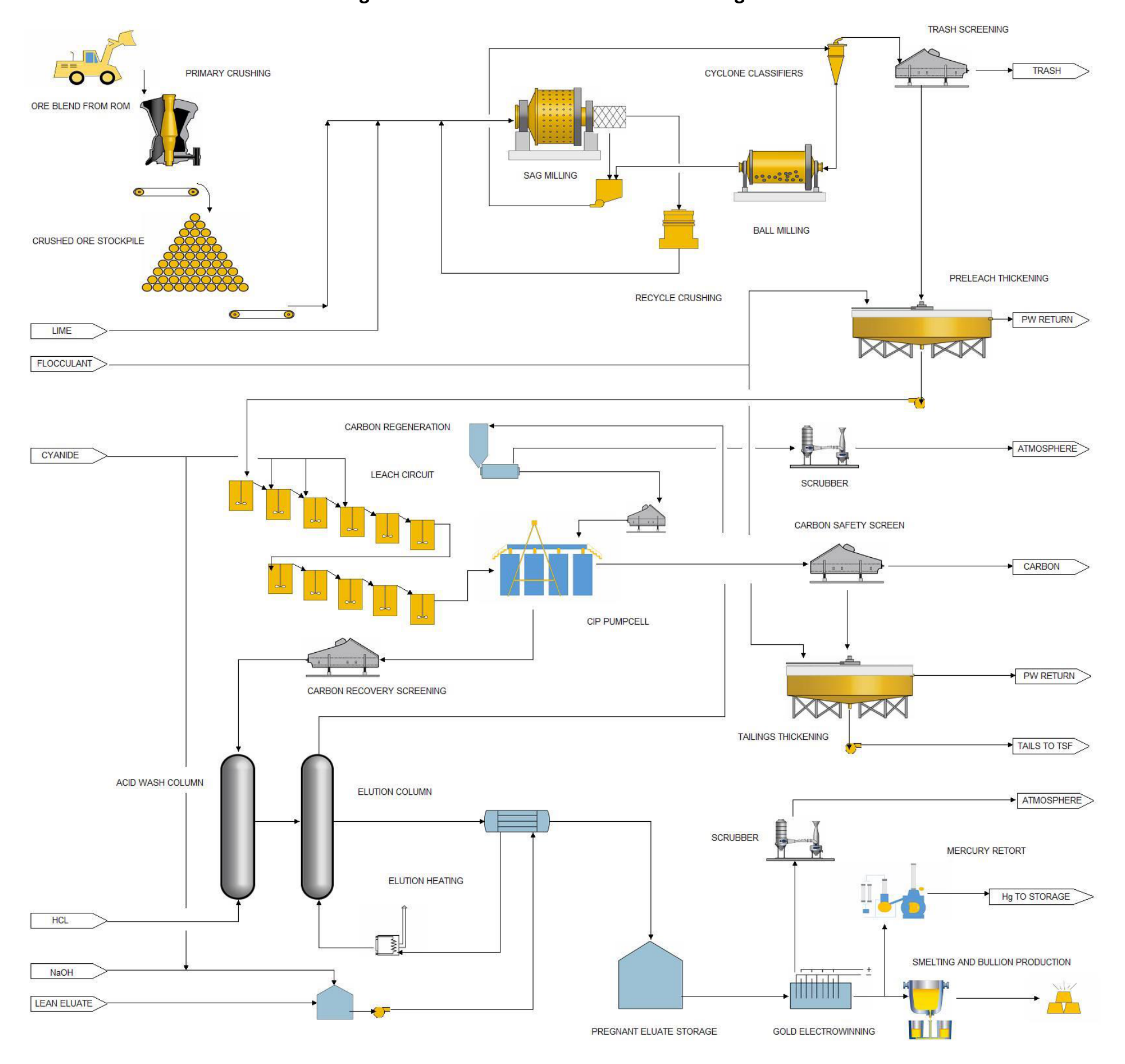
The September 2020 feasibility study for Orca Gold's Block 14 project in Sudan describes a gyratory crusher, grinding at 53 to 90 µm depending on ore type, a 45 hour leach and an elution circuit that removes mercury, for 86% gold recovery.
Block 14 is a gold project in the Republic of the Sudan. Orca Gold Inc. is the issuer of the NI 43-101 feasibility study, which carries a report date of 14 September 2020 and an effective date of 31 August 2020. The process plant design draws on the 2017 and 2018 metallurgical test work by SGS Vancouver and Lakefield, which confirmed that the GSS and Wadi Doum (WD) material is amenable to gold and silver recovery by conventional cyanidation and carbon adsorption across a wide range of ore domains and lithologies. A pre-aeration stage was found to save significant cyanide for Main Transition, Main Fresh and East Fresh ores. The design is based on a nominal 6.0 million tonnes a year of ore, a head grade of 1.84 g/t gold and 4.33 g/t silver, and overall recoveries of 86% for gold and 45% for silver.
Critical Data
| Parameter | Value | Unit | Notes |
|---|---|---|---|
| Nominal throughput | 6.0 | Mt/y | Design |
| Head grade | 1.84 / 4.33 | g/t Au / g/t Ag | Design |
| Overall recovery | 86 / 45 | % Au / % Ag | Design |
| Plant availability | 91.3 | % | On-site LNG power |
| Crusher product | About 110 | mm P80 | Gyratory, 140 mm open side setting |
| Crushed ore stockpile | 10,000 | wet t live | Three apron feeders |
| Grind size, oxide and Wadi Doum | 53 | µm P80 | SAG mill and ball mill |
| Grind size, transition | About 75 | µm P80 | Design |
| Grind size, fresh | 90 | µm P80 | Design |
| Cyclone diameter | 500 | mm | Up to 310% circulating load |
| Pre-leach thickener density | 55 | % w/w solids | High rate thickener |
| Leach tanks | 10 | x 4,000 m3 | 45 hour residence time |
| Pre-aeration | 4 | hours | Dedicated tank |
| Design carbon loading | 6,133 | g/t Au + Ag | For CIP and elution sizing |
| Elution batch size | 12.5 | t | Split AARL, seven cycles per week |
| Electrowinning cells | 3 | Not applicable | 33 cathodes each |
Overview
The flowsheet is a conventional cyanide leach and carbon adsorption plant built around single-stage gyratory crushing and a SAG and ball mill (SAB) grinding circuit. Slurry is thickened ahead of leaching to cut tankage and reagent use. A dedicated pre-aeration tank passivates cyanide-consuming minerals, ten tanks leach the slurry in series and a Kemix Pumpcell carbon-in-pulp (CIP) circuit recovers gold and silver onto carbon. Elution, electrowinning, mercury retorting and smelting make doré. The design also provides for removal of deleterious elements such as mercury. A trade-off compared hybrid carbon-in-leach (CIL), leach CIP and leach pumpcell circuits. The hybrid CIL had the lowest capital cost, but over the life of mine the leach pumpcell circuit had the lowest operating costs and the best economics, so it was adopted.
Key Process Stages
Crushing and stockpile
The ROM pad buffers the mine from the plant, and separate stockpiles allow a front-end loader to blend ore types for consistent grade and hardness. Because some fresh ores are abrasive and competent, a vibrating grizzly jaw crusher installation was judged high risk, so a primary gyratory crusher with an open side setting of 140 mm was selected. An apron feeder draws from the discharge pocket to the stockpile feed conveyor, and a metal detector flags magnetic tramp material. The crushed ore stockpile has a live capacity of 10,000 wet tonnes.
Grinding and classification
A SAG mill and a closed circuit ball mill reduce the ore to the P80 sizes in the table, which means the grind coarsens over the mine life as fresh ore replaces oxide. From year 7 the ore becomes more competent, and pebble crushing will be required, with provision made in the design. Cyclones of 500 mm diameter were chosen to minimize wear and spigot blockages, and they will need spigot and vortex finder changes over the life of mine. The pre-leach thickener lets the cyclones run at feed densities that improve classification efficiency and cut circulating load and power.
Trash screening and pre-leach thickening
Vibrating trash screens protect the leach and adsorption circuit from oversize particles and rubbish, which matters for carbon management. A high rate thickener lifts the screen undersize to the 55% w/w solids leach feed density. Rheology test work confirmed this is achievable even for oxide blends, which contain only trace clay.
Leach and CIP
Head assays and test work showed that Block 14 ores are not preg-robbing, so leach CIP could be considered. Leaching is generally complete within 32 hours for fresh and transition ores, but oxide and Wadi Doum ores benefit from longer, so the design uses 45 hours in ten 4,000 m3 tanks at 55% solids. Test work on a fresh blend showed no recovery benefit from oxygen over air, so air is delivered down the agitator shaft. Four hours of pre-aeration reduced cyanide consumption for several ore types.
Elution, electrowinning and refining
A split AARL elution circuit strips gold and silver from the carbon in about eight hours, with an optional cold cyanide wash to remove copper first. Three electrowinning cells with 33 cathodes each give a high pass efficiency. The high silver content means the electrowinning capacity is relatively large for the throughput, since silver, lead and mercury reduction consume most of the current early in the cycle. A sludging cell design with in-tank cathode washing simplifies handling. Off-gases pass an activated carbon filter for mercury removal, sludge is pressure filtered and retorted to remove mercury before smelting to doré, and barren carbon is regenerated in a horizontal rotating kiln with off-gas scrubbing.
Tailings
A high rate thickener recovers process water from CIP tailings and returns residual free cyanide to the leach. Underflow is pumped to the tailings storage facility.
Additional Interesting Data and Summary
The design criteria came from SGS test work, Orca advice, comminution modelling by Orway Mineral Consultants, CIP modelling by SGS and Kemix, and Lycopodium calculations. Equipment was selected for suitability, reliability and ease of maintenance, and the plant layout is arranged so that construction can progress in several areas at once. The plant uses standby equipment in critical areas and reputable western vendor equipment to support its 91.3% availability.
Key Processes
- Single-stage gyratory crushing and blended ROM stockpiles
- SAG mill and closed circuit ball mill grinding with 500 mm cyclones
- Trash screening and high rate pre-leach thickening
- Pre-aeration and 45 hour cyanide leaching in ten tanks
- Kemix Pumpcell carbon in pulp
- Split AARL elution, electrowinning and mercury retorting
- Tailings thickening and cyanide recycle
Source: Feasibility Study NI 43-101 Technical Report, Block 14 Gold Project, Republic of the Sudan, September 14, 2020.
