

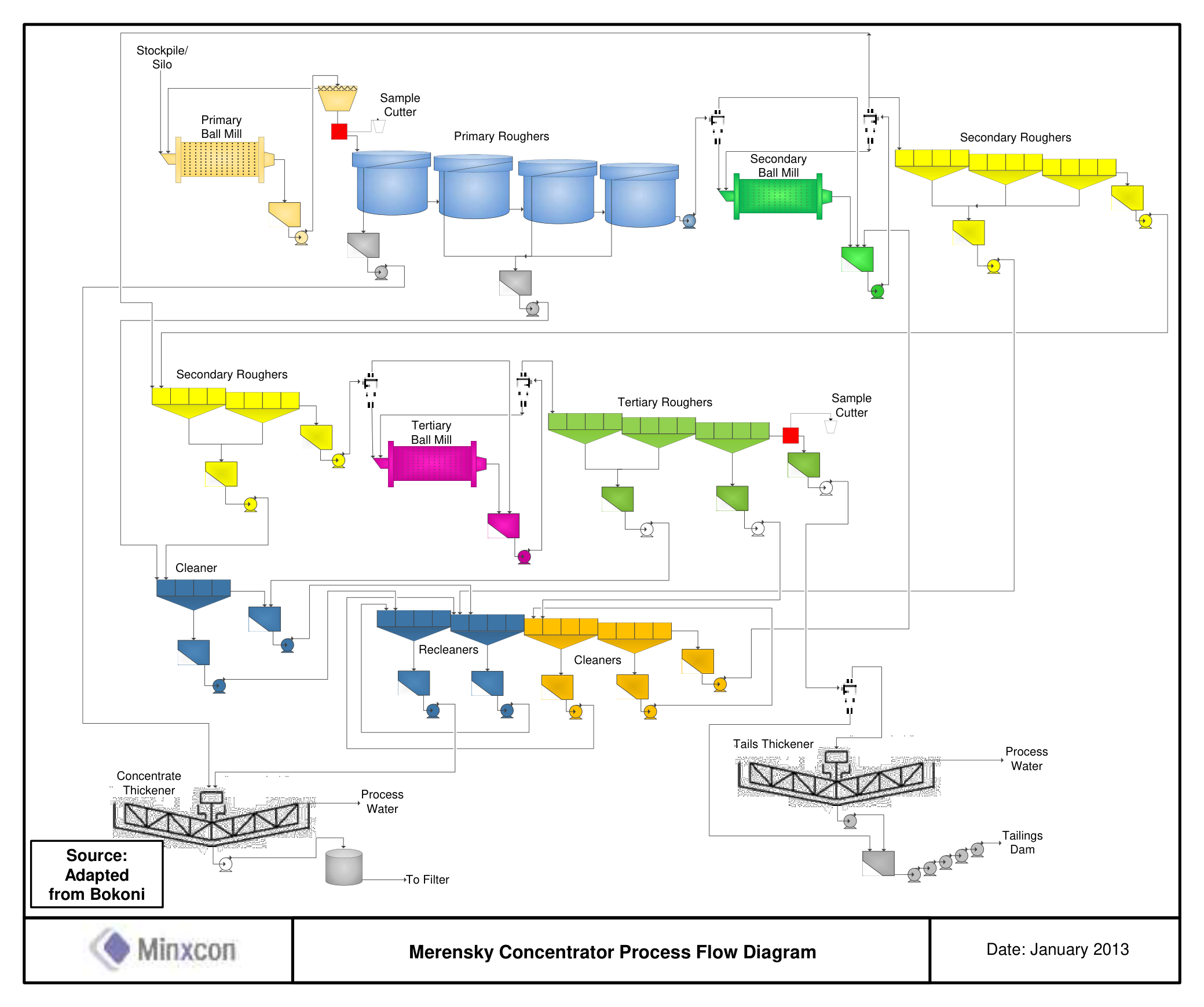
The 2013 independent report on the Bokoni platinum mine in Mpumalanga, South Africa describes a shared crushing circuit, a Merensky plant with an autogenous mill and three stages of milling, and a UG2 plant with a ball mill and column flotation, with recoveries near 90% for four elements.
Bokoni is a platinum mine in Mpumalanga Province, South Africa. Minxcon (Pty) Ltd prepared the independent qualified persons' report for the operator, Atlatsa Resources Corporation, with an effective date of 28 November 2012 and an issue date of 24 April 2013, under reference M12-159. Bokoni treats Merensky and UG2 ore separately in two concentrators, with no blending of the two ores. Both plants float a platinum group metal concentrate that goes to smelting. Bokoni employs about 150 people at the concentrator plants, including management, administrative staff, operators, foremen, engineering staff and labour hire.
Critical Data
| Parameter | Value | Unit | Notes |
|---|---|---|---|
| Static grizzly | 300 | mm | Ahead of the surge bin |
| Jaw crusher setting | 80 | mm | Closed side |
| Cone crusher settings | 25 / 15 | mm | Primary / secondary, closed side |
| Merensky silo | 4,200 | t | Ahead of milling |
| Merensky mill feed rate | About 125 | t/h | Primary autogenous mill |
| UG2 primary ball mill feed | Usually 85 | t/h | 70 mm balls |
| Classifier screen aperture | 0.85 | mm | Both plants |
| UG2 grind | 80 | % passing 75 µm | After secondary milling, 40 mm balls |
| Merensky head grade | 3.72 | g/t 4E | January to September 2012 average |
| Merensky 4E recovery | About 90 | % | January to September 2012 |
| Merensky tails | 0.41 | g/t | Average |
| Merensky concentrate | 185 | g/t PGM and Au | Typical |
| Concentrate filter cake | Under 14 | % moisture | Larox filter |
| Merensky tailings dam | About 70 | ha | Consolidated Tailings Dam |
| UG2 tailings dam | About 63 | ha | Dam No. 6, commissioned 2003 |
Overview
Both Bokoni plants use staged flotation after milling. Ore passes a common crushing circuit, then goes to the Merensky or UG2 plant. The Merensky concentrator uses a primary autogenous mill followed by secondary and tertiary ball mills with primary, secondary and tertiary rougher banks, and a cleaner and recleaner circuit. The UG2 plant uses a primary ball mill, a secondary mill with cyclones, roughers, cleaners, recleaners and a flotation column. Concentrates are thickened and filtered, and tailings go to conventional upstream spigot dams. The four elements counted in the report are platinum, palladium, rhodium and gold (4E).
Key Process Stages
Crushing circuit
Mined ore passes over a 300 mm static grizzly, and undersize falls into a surge bin. Brute force feeders reclaim it to an 80 mm vibrating grizzly after an electromagnet removes tramp iron, and oversize is crushed in a jaw crusher set at 80 mm. Ore then goes to a 100 t surge bin and a single-deck primary screen with a 25 mm aperture, with oversize sent to a primary cone crusher set at 25 mm. A double-deck secondary screen of 20 mm and 15 mm sends oversize to a secondary cone crusher set at 15 mm, which runs in closed loop with the screen. The final product goes to the stockpile.
Merensky plant
Crushed ore is held in a 4,200 t silo, then conveyed to a 60 t mill feed bin, with an electromagnetic belt sorter removing tramp iron on the way. A primary autogenous Metso mill takes feed at about 125 t/h, controlled by a PLC, and water is added by ratio control. A trommel and 0.85 mm classifier screens return oversize to the mill. Four Wemco 5 primary rougher cells use SIBX collector, Senkol N65 and Senfroth 6005 frother. Rougher tailings go to a dewatering cyclone, and the underflow is reground in a secondary ball mill using 30 mm balls. Secondary roughers have two stages of Wemco 120 and 144 cells, tails are reground in a tertiary ball mill and tertiary roughers use three banks of Wemco 144 cells. Cleaners and recleaners use OK cells in five banks of four, with Gempolym M47 depressant. Concentrate is thickened to an SG above 1.6 and filtered in a Larox filter to below 14% moisture, and is trucked to the Amplats smelters.
UG2 plant
UG2 ore is crushed and stored on the UG2 tip and flows to a mill surge bin. A primary ball mill, usually fed at 85 t/h, uses 70 mm balls. Oversize on a 0.85 mm screen returns to the mill. Six OK 30 cells make up the rougher section, with SIBX, Senkol N65, Gempolym M47 and Senfroth 6005 added at the feed box. Concentrate from cells 1 and 2 goes straight to the final concentrate thickener, while cells 3 to 6 go to final cleaners. A regrind mill with primary and secondary cyclones, and 40 mm balls, makes a product of 80% passing 75 microns.
Tailings and stockpile handling
The Merensky tailings dam covers about 70 ha and is known as the Consolidated Tailings Dam, formed from five earlier dams. The UG2 tailings dam, Dam No. 6, was commissioned in 2003 and covers about 63 ha. Both are conventional upstream spigot dams with underdrains and catchment paddocks that collect run-off and evaporate water.
Additional Interesting Data and Summary
Plant performance data cover January to December 2012. Merensky 4E recovery was about 90% from January to September, at head grades between 3.16 and 4.16 g/t. Labour strikes in October and November meant the plant was emptied in October, which produced a recorded recovery of 99.07% and an accountability of 874%. The report expects a negative impact on recovery and accountability once the plant is recommissioned and precious metal lock-up builds again.
The reagent dosage tables show M47 depressant added at 40, 20 and 30 g/t in the three Merensky cleaner stages and SIBX added at the primary mill and secondary and tertiary stages.
Key Processes
- Grizzly screening, jaw crushing and two stages of cone crushing
- Autogenous milling and staged ball milling in the Merensky plant
- Primary ball milling and cyclone regrinding in the UG2 plant
- Staged rougher flotation with SIBX collector
- Cleaner and recleaner flotation with depressant
- Concentrate thickening and Larox filtration
- Cyclone dewatering of tailings to upstream spigot dams
Source: An Independent Qualified Persons' Report on the Bokoni Platinum Mine, in the Mpumalanga Province, South Africa, April 24, 2013.
