

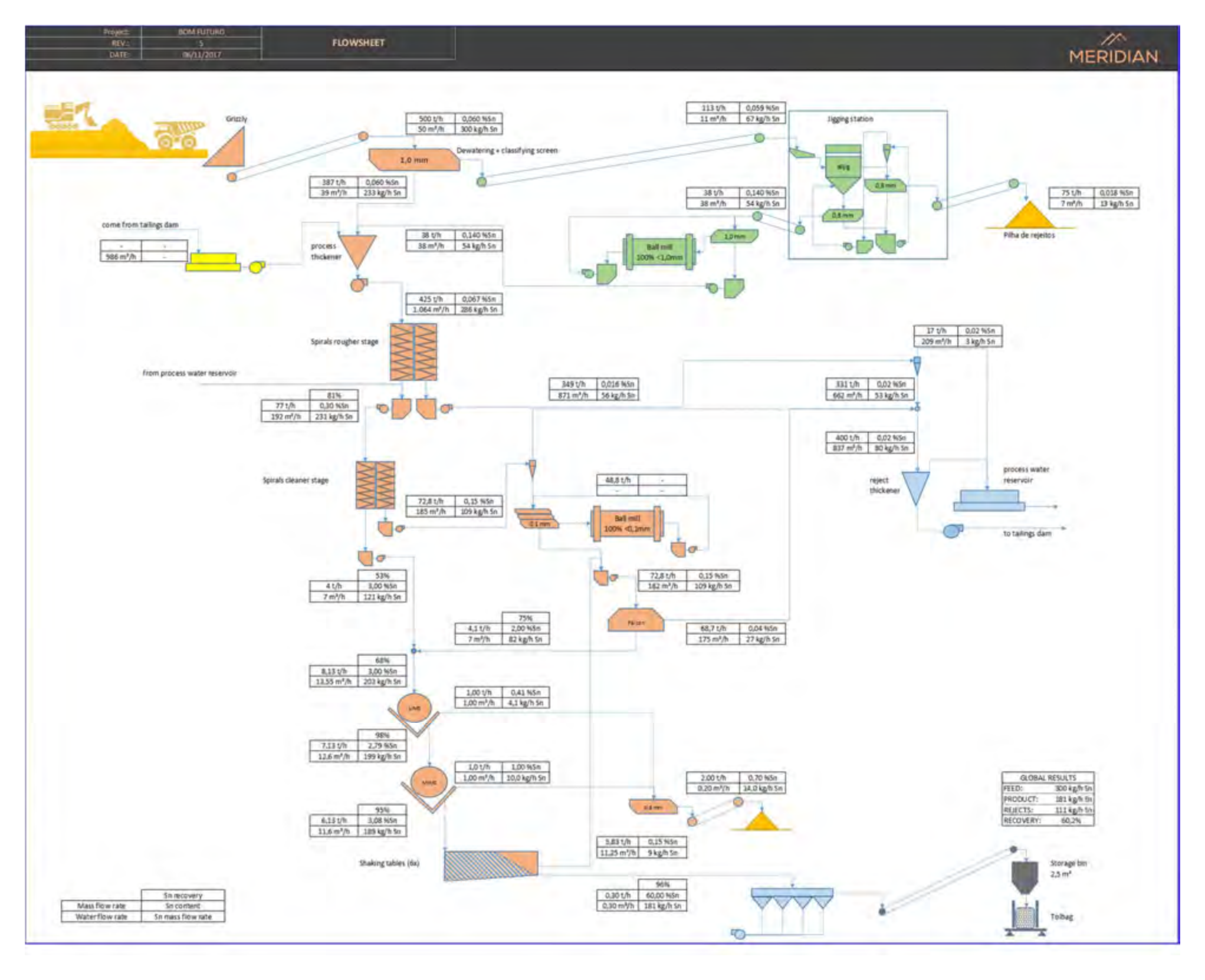
The December 2017 preliminary economic assessment for Meridian Mining's Bom Futuro project in Rondônia, Brazil describes a 500 t/h plant that reclaims old cassiterite tailings by truck and dredge and upgrades them by gravity and magnetic separation to a 60% tin concentrate.
Bom Futuro is a tin project in Rondônia, in north-western Brazil, where the plan is to treat tin tailings. Meridian Mining S.E. commissioned the NI 43-101 technical report, a preliminary economic assessment (PEA) prepared by H&S Consultants Pty Ltd, with an effective date of December 7, 2017. The processing flowsheets and design criteria for treating the Bom Futuro tailings were developed from recent metallurgical test work. The test data show it is technically feasible to treat the tailings with conventional mineral processing, particularly gravity concentration and magnetic separation, to obtain tin concentrates at relatively high recovery and grade. The calculated mass balance sets a nominal plant throughput of 500 t/h of solids.
Critical Data
| Parameter | Value | Unit | Notes |
|---|---|---|---|
| Plant throughput | 500 | t/h solids | Nominal |
| Primary screen aperture | 1.0 | mm | Oversize 23% (113 t/h) to the jig |
| Screen undersize | 77 | % (387 t/h) | To a dedicated thickener |
| Dredge pumps | 3 | Not applicable | In series, 40% solids slurry |
| Dredge pumping rate | 2,200 | m3/h | 1,000 m distance, 50 m lift |
| Jig stage | 34 / 80 | % mass / % Sn recovery | Alljig, two cells |
| Ball mill circulating load | 200 | % | Grinds jig concentrate to 1% retained on 1.0 mm |
| Rougher spirals | 72 | MG-12 units | Six lines of 12 |
| Rougher spiral stage | 18 / 81 | % mass / % Sn recovery | Design |
| Cleaner spirals | 16 | MG-12 units | Two lines of 8 |
| Regrind product | 100 | % passing 0.1 mm | Spiral cleaner tailings |
| Centrifugal concentrators | 2 | Falcon C1000 | Treat reground cleaner tailings |
| LIMS / MIMS field | 2,500 / 6,000 | Gauss | Sn recovery 98% / 95% |
| Shaking tables | 6 | Not applicable | 1.5 t/h each, 82% Sn recovery |
| Final concentrate | 60 | % Sn | About 0.3 t/h |
| Filter cake moisture | 10 to 15 | % | Horizontal vacuum belt filter |
Overview
The Bom Futuro plant is a gravity and magnetic circuit with no flotation or chemical leach. Reclaimed tailings are screened at 1.0 mm. Oversize goes to a jig and ball mill, and undersize joins the ground jig concentrate in a thickener that feeds spiral concentrators. Cleaner spiral tailings are reground and treated in Falcon centrifugal concentrators. Spiral and Falcon concentrates go to wet low and medium intensity magnetic separation, and shaking tables make the final tin concentrate. The concentrate is filtered, bagged in 2,500 kg big bags and trucked to the customer.
Key Process Stages
Tailings reclaim
Bulldozers and trucks reclaim tailings inside the Jacaré Leste perimeter during the first five years, since the distance between stockpiles and the plant and the terrain make hydraulic transport more expensive in capital and operating cost. Trucks dump onto a 70 mm grizzly, and undersize flows to a hopper and a conveyor to the plant. After the Jacaré Leste area and adjacent regions are depleted, a floating dredge reclaims tailings and pumps them to the plant, with a return pipeline carrying water back to the pond. The system uses three dredge pumps in series at 40% solids and 2,200 m3/h over about 1,000 m and 50 m of height, and two return pumps at 1,000 m3/h and 5% solids.
Screening and jigging
A vibrating screen with 1.0 mm mesh splits the feed. Oversize, 23% by mass or 113 t/h, goes to the jigging circuit, and undersize goes to a thickener. The jig is a laterally pulsed Allmineral Alljig with two cells and separate air pulsation chambers, with a "fish" measuring the heavy layer height. Test work gives 34% mass recovery and 80% tin recovery, so relatively little solid needs grinding. Jig tailings are dewatered, conveyed and piled.
Grinding, spirals and Falcon concentrators
Jig concentrate is ground in a ball mill at 200% circulating load and pumped to the primary thickener, which stabilizes the flow that the spiral circuit requires. Underflow is distributed to six lines of twelve Mineral Technologies MG-12 spirals in the rougher stage, and rougher tailings go to a tailings thickener and the tailings dam. The cleaner stage has two lines of eight MG-12 spirals. Cleaner tailings are reground in a reverse closed circuit with high frequency screens and treated in two SEPRO Falcon C1000 centrifugal concentrators.
Magnetic separation and shaking tables
Cleaner spiral and Falcon concentrates go to a low intensity magnetic separator (LIMS) drum at 2,500 Gauss, then a medium intensity magnetic separator (MIMS) drum at 6,000 Gauss, to remove contaminants such as hematite and ilmenite. Magnetic tailings are dewatered on a screen and stockpiled. The magnetic concentrate carries about 3.0% tin with minimal iron and titanium contamination, so a final gravity stage is included. Six wet shaking tables at 1.5 t/h each make a concentrate of 60% tin at 82% recovery and 0.5% mass recovery, or about 0.3 t/h. Table tailings return to the Falcon feed.
Filtering and bagging
Table concentrate is filtered on a 0.5 m2 horizontal vacuum belt filter to 10% to 15% moisture, with filtrate returned to magnetic separation. The concentrate goes to a 10 m3 bin with weighing and bagging, and 2,500 kg big bags are sealed and forklifted to storage before trucking.
Additional Interesting Data and Summary
The plant areas include the feeding plant with the dredge and reclaim system, pre-concentration with jigging and grinding, rougher and cleaner stages, magnetic separation, re-cleaning on shaking tables, a water recovery system of cyclones and a slimes thickener, product handling and operational and administrative facilities. The dredge is a floating hull with a suction depth of 5,000 mm, built in three modules, with two slurry pumps of 450 kW each. The whole plant is controlled by a general programmable logic controller panel and a supervisory system in a control room.
Key Processes
- Truck and dredge reclaim of tin tailings
- Screening at 1.0 mm with Alljig jigging of oversize
- Ball milling of jig concentrate
- Rougher and cleaner spiral concentration
- Falcon centrifugal concentration of reground cleaner tailings
- LIMS and MIMS wet magnetic separation
- Shaking table upgrading and vacuum belt filtration
Source: NI 43-101 Technical Report, Preliminary Economic Assessment, Bom Futuro Tin Project, Rondônia, NW Brazil, December 7, 2017.
