

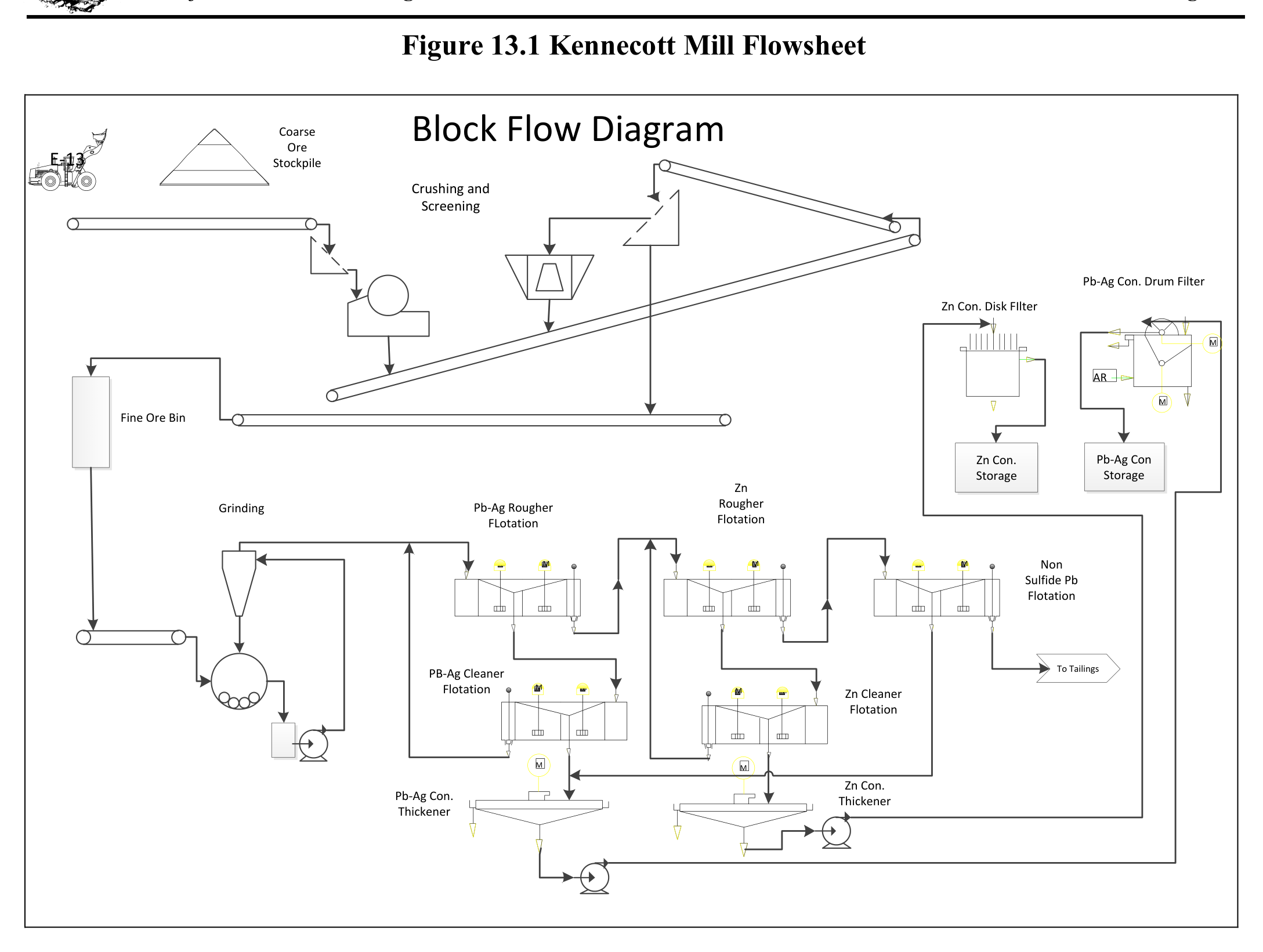
The 2011 preliminary economic assessment for the Burgin extension deposit in the East Tintic district describes refurbishing a 1968 mill, installing new lead-silver, zinc and non-sulfide lead flotation circuits, and filtering all tailings for backfill and a lined stack.
Burgin is a lead-silver-zinc project in the East Tintic Mining District of Utah County, Utah. Mine Development Associates prepared the Technical Report on the Burgin Extension Deposit, a preliminary economic assessment (PEA) for Andover Ventures Inc. and Chief Consolidated Mining Co., with an effective date of November 17, 2011 and a report date of December 2, 2011. The Burgin mill was a 500 tons per day plant built by the Tintic Mines Division of Kennecott Copper Company in 1968 and commissioned on December 26 of that year. Kennecott ran it until 1978, after which the property was optioned to Sunshine Mining Company, which never operated the mill. The PEA proposes restarting it at an 800 tpd production rate.
Critical Data
| Parameter | Value | Unit | Notes |
|---|---|---|---|
| Original mill capacity | 500 | tpd | Built 1968 by Kennecott |
| Proposed production rate | 800 | tpd | 280,000 tons per year |
| Grinding circuit | Ball mill | Not applicable | Closed with hydrocyclones |
| Flotation circuits | 3 | Not applicable | Lead-silver, zinc, non-sulfide lead |
| Lead-silver cleaners | 2 | stages | Primary and secondary |
| Zinc cleaners | 2 | stages | Primary and secondary |
| Concentrate filters | 2 | types | Belt filter for Pb-Ag, disk filter for Zn |
| Tailings filtration | Drum filter | Not applicable | All tailings |
| Tailings to backfill | 50 to 60 | % | Remainder to lined storage |
| Lined storage footprint | About 350,000 | sq ft | Near the plant |
| Mill salaried staff | 4 | people | Proposed |
| Mill hourly staff | 29 | people | Proposed |
Overview
The proposed flowsheet includes crushing, grinding, flotation, thickening and filtration. It is based on the original flotation circuit installed by Kennecott, because there is no current metallurgical test work using modern flotation chemistry. The report expects that using the original flowsheet and equipment layout will ease reconstruction and commissioning. During 1999 the existing flotation circuit was removed from the mill building, so essentially the only flotation equipment left on site is a set of Denver 60 cubic foot cells. The crushing and grinding equipment needs refurbishing and some minor replacements but is expected to sustain 800 tpd. The flotation equipment must be purchased and installed, and the thickeners and filters need repair.
Key Process Stages
Crushing
Underground ore is delivered to a coarse ore stockpile and fed into the circuit by front-end loader and a vibratory feeder. A primary screen sends undersize to the crusher product conveyor and oversize to the primary jaw crusher. A secondary screen deck passes oversize to a secondary cone crusher in closed circuit, and its undersize goes to the fine ore bins.
Grinding
Two belt feeders, one per fine ore bin, feed a ball mill that runs in closed circuit with hydrocyclones. Cyclone underflow returns to the ball mill, and overflow goes to the lead circuit conditioning tank. Milk of lime is added directly to the ball mill for initial pH control.
Flotation
Initial reagents are added in the lead circuit conditioning tank, and the slurry goes to lead-silver rougher cells. Rougher concentrate is cleaned in primary and secondary cleaner cells, with cleaner tails returned to the roughers. Rougher tailings go to the zinc conditioning tanks and then to zinc rougher cells, whose concentrate is cleaned in primary and secondary zinc cleaners, with the cleaner tailings recycled to the roughers. Zinc circuit tailings go to non-sulfide lead rougher cells. Their tailings go straight to the tailings pond, and their concentrate is cleaned, with non-sulfide cleaner tailings recycled. The non-sulfide cleaner concentrate joins the lead-silver concentrate thickener. The report notes that an oxide lead circuit in the original Kennecott flowsheet was never operational.
Concentrate thickening and filtration
The final lead-silver concentrate is thickened and pumped to a belt filter, which discharges to a storage bunker directly below. The final zinc concentrate is thickened, pumped to a disk filter and discharged to a bunker. The concentrates are loaded into trucks for shipment to a smelter. The report says filtration test work is needed to confirm the filters can make concentrates low enough in moisture for shipping, and new filter media may not meet the moisture thresholds, so pressure filters may be required.
Tailings disposal
All tailings are filtered with a drum filter. About 50% to 60% will be used as mine backfill, and the rest placed in a lined storage facility with a footprint of about 350,000 square feet near the plant. The plant is to be a zero discharge facility, so mill water must be recycled, and the water balance would be set by testing and modeling. Permits for the facility would have to be obtained.
Additional Interesting Data and Summary
In 2001, Chief converted the lead-zinc flotation circuit to make a bulk concentrate from Trixie gold-silver ore, which it tried to process with a Merrill-Crowe circuit on the lower floor of the mill. It could not produce a satisfactory doré because the concentrate had too much copper, so the bulk concentrate was shipped to the Peñoles smelter in Torreón, Mexico. The mill operated only in the first three months of 2002 and has not run since.
Laboratory work by Dawson Metallurgical Laboratories in 1997 indicated that selective lead and zinc concentrates can be produced, and that grades and recoveries could be improved by more test work. The report recommends testing with current flotation reagents and equipment, and expects that both recoveries and concentrate grades would increase while net operating costs decrease. Process water for the mill originally came from fresh water springs above the Trixie mine, about two miles southwest of the mill.
Key Processes
- Jaw and cone crushing with screening
- Ball milling in closed circuit with hydrocyclones
- Lead-silver rougher and two-stage cleaner flotation
- Zinc rougher and two-stage cleaner flotation
- Non-sulfide lead flotation
- Thickening and belt or disk filtration of concentrates
- Drum filtration of tailings for backfill and lined storage
Source: Technical Report on the Burgin Extension Deposit, Preliminary Economic Assessment, Burgin Project, East Tintic Mining District, Utah County, Utah, USA, December 2, 2011.
