

New Gold's March 2012 technical report on the El Morro project in Chile describes a gyratory crusher, a 20 MW SAG mill, two 18 MW ball mills, rougher and three-stage cleaner flotation, and a 156 mm concentrate pipeline to a coastal filter plant.
El Morro is a copper and gold project in Region III of Chile, described in New Gold Inc.'s Technical Report on the El Morro Project, an NI 43-101 report dated March 23, 2012 and prepared with Hatch's process flow diagrams. The operating plan mines the resource over an 18-year mine life plus a period of preproduction stripping, and the mine plant feeds 32.85 million tonnes a year to the mill facilities. An overall plant utilization of 92% was used to set instantaneous capacities for the metallurgical design criteria. Process plant areas at the plant site include primary crushing, a coarse ore stockpile and reclaim system, primary and secondary grinding, flotation, concentrate regrinding, dewatering, a concentrate pipeline, tailings water reclaim and water treatment. At Punta Cachos on the coast, the plan includes concentrate dewatering and storage, port facilities and a seawater desalination plant.
Critical Data
| Parameter | Value | Unit | Notes |
|---|---|---|---|
| Mill feed | 32.85 | million tpa | 90,000 tpd nominal |
| Copper feed grade | 0.700 | % Cu | Nominal |
| Gold feed grade | 0.460 | g/t Au | Nominal |
| Bond ball mill work index | 11.8 | kWh/t | Hardness |
| Primary crusher | 1.52 x 2.79 | m | 750 kW gyratory; P80 78 mm |
| Primary crushing utilization | 70 | % | 5,357 tph |
| Coarse ore stockpile | 72,000 | t live | 305,000 t total, enclosed |
| SAG mill | 11.6 x 6.4 | m diameter x EGL | 20 MW gearless drive |
| Ball mills | 2 | x 8.2 m x 13 m EGL | 18 MW gearless drives each |
| Grinding circuit product | 130 | µm P80 | 350% circulating load |
| Rougher flotation | 4 lines x 8 | x 300 m3 cells | 30 minutes retention |
| Regrind product | 25 | µm P80 | One 3,000 hp vertical mill |
| First cleaner concentrate | 13.2 | % Cu | Three 300 m3 cells |
| Final copper concentrate | About 30 | % Cu | Third cleaner |
| Global copper recovery | 85.9 | % | Design |
| Global gold recovery | 68.7 | % | Design |
| Concentrate pipeline | 156 | mm | 6 inch steel, 120 tph |
| Desalinated water | 521 | L/s | 202 km, 30 inch pipeline |
Overview
Ore is trucked to a gyratory crusher and conveyed to an enclosed coarse ore stockpile. A SAG mill and two parallel ball mill circuits grind it, rougher flotation recovers copper-gold minerals, and a vertical stirred mill regrinds the concentrate before three stages of cleaning. The concentrate is pumped through a pipeline to a filter plant on the coast and shipped to smelters. Trade-off studies evaluated relocating the plant from its original 4,000 masl location to 3,030 m, but the cost of the extra materials handling outweighed the benefits, so the plan reverted to 4,000 masl.
Key Process Stages
Crushing and stockpile
Trucks dump into a 720 t dump pocket with a rock breaker and dust suppression, designed to let two opposing trucks dump at once. A 1.52 m by 2.79 m, 750 kW gyratory crusher makes a P80 of 78 mm at an open side setting of 152 to 203 mm. A 720 t surge bin and belt feeder feed the coarse ore stockpile conveyor. The stockpile is enclosed because of snow, high winds and other environmental issues. Its live capacity of 72,000 t allows 19.2 hours of operation with the SAG mill at 80% of nominal capacity, and total capacity gives 3.4 days of supply. Six belt feeders, four operating and two standby, reclaim ore, and the reclaim tunnel has dust collection.
Primary grinding
The SAG mill has a grate discharge followed by a trommel and vibrating screen with 12 mm openings, giving a transfer size of about 3.6 mm to the ball mills. Oversize is washed and recycled to the SAG feed. The 2008 feasibility study designed a pebble crushing circuit, but because softer ore in the initial years allows deferral, only a recycle conveying system is installed, with space left for two 800 hp cone crushers later. A ball handling system feeds 140 mm balls, and milk of lime is added to the SAG feed chute to condition the slurry and control rheology and pH.
Secondary grinding
Two parallel cyclone clusters of fourteen 840 mm cyclones each, with twelve operating and two standby, classify the SAG and ball mill discharge. The two overflow ball mills are 8.2 m by 13 m with 18 MW gearless drives, fed with 63.5 mm balls, and the circuit runs at 350% circulating load, about 11,000 m3/h, at 50% to 60% solids in the cyclone feed.
Flotation
Rougher flotation uses four lines of eight 300 m3 forced air tank cells for a 30 minute residence time. Rougher tailings and first cleaner-scavenger tailings form the final tailings. Rougher and cleaner-scavenger concentrate is reground in cyclones, with the underflow going to a single 3,000 hp vertical stirred mill, replacing four 1,119 kW vertical mills in the earlier design after a value engineering workshop, to reach 80% passing 25 µm. The first cleaner has three 300 m3 cells with about 15 minutes of retention, making a 13.2% copper concentrate, with an attached cleaner scavenger row of three cells. The second cleaner has two cells with 14 minutes, and the third cleaner is a single 300 m3 cell with 14 minutes that makes a final concentrate of about 30% copper.
Concentrate transport and water
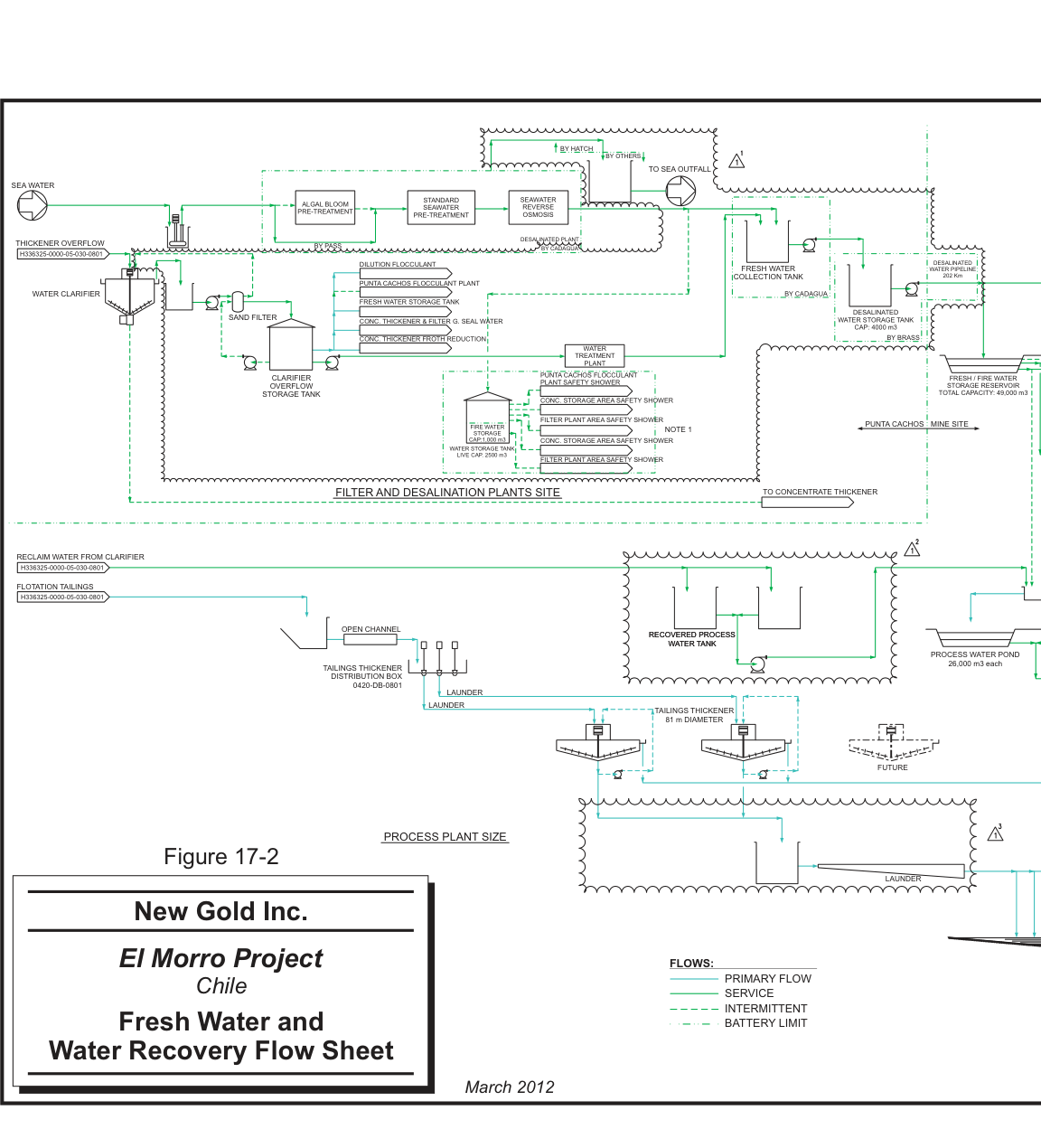
Concentrate follows the new access road in a 156 mm steel pipeline, designed for 120 tph of solids, to a filter plant on the coast, where filtered concentrate is stored next to the filter plant and loaded on ships. Water requirement is 521 L/s of desalinated water at 63% solids in the high density tailings, supplied from a desalination plant at Punta Cachos by a 202 km, 30 inch pipeline to the concentrator and the mine at 4,000 masl.
Additional Interesting Data and Summary
Plant utilization differs by area: 70% for primary crushing, 92% for grinding, flotation, thickening and pebbles crushing, 98% for the concentrate pipeline and 85% for the filter plant and concentrate handling. The flotation circuit design criteria were revised based on revised recovery algorithms.
The design includes a potable water treatment plant for safety showers, camp and administration areas.
Key Processes
- Gyratory crushing and enclosed coarse ore stockpile
- Gearless SAG mill and overflow ball mills with large cyclone clusters
- Rougher flotation in 300 m3 forced air tank cells
- Vertical stirred mill regrinding
- Three-stage copper cleaner flotation
- Concentrate pipeline to a coastal filter plant
- Seawater desalination for process water
Source: Technical Report on the El Morro Project, Region III, Chile, NI 43-101 Report, March 23, 2012.
