

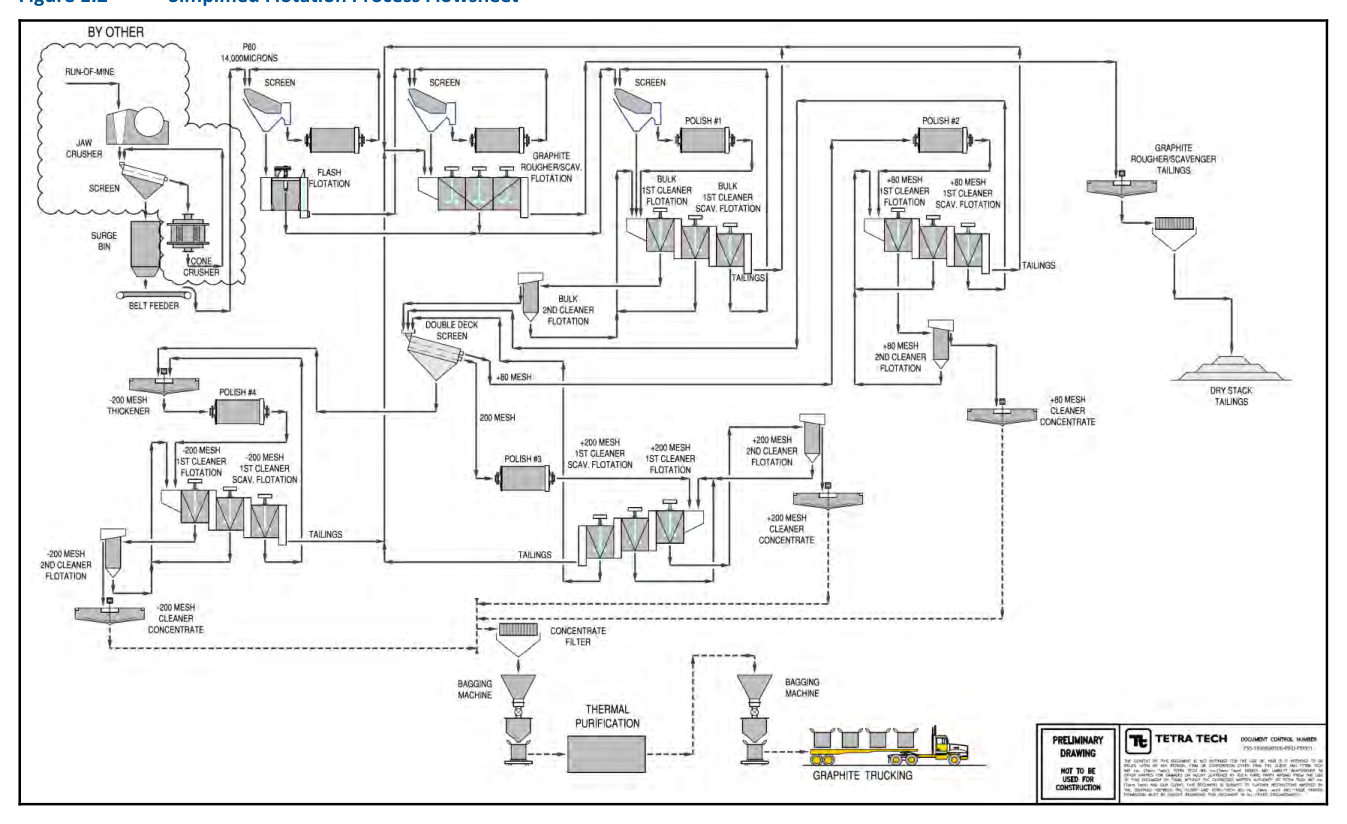
The March 2016 preliminary economic assessment for Canada Carbon's Miller graphite and marble property in Quebec describes tire-driven rod mills, bulk flotation, three size fractions that are reground and refloated, and a thermal upgrading plant 150 km away.
Miller is a graphite and marble property in Grenville Township, Quebec, Canada. The Technical Report and Preliminary Economic Assessment for the Miller Graphite and Marble Property was prepared for Canada Carbon Inc. and has an effective date of March 4, 2016. Graphite occurs as disseminations in marble, in sulphide-bearing paragneiss, in pods and in veins, mostly as well-crystallized euhedral flakes. Graphite and marble are the major economic values. The proposed concentrator at the mine site will be conventional and will process graphite mineralization at a nominal 200 t/d with equipment availability of 88% for 365 days a year, expanding to approximately 499 t/d late in the mine life. It uses conventional flotation technology to produce three graphite concentrates, each with a different particle size.
Critical Data
| Parameter | Value | Unit | Notes |
|---|---|---|---|
| Initial processing rate | 200 | t/d | Nominal |
| Maximum processing rate | 499 | t/d | Late in the mine life |
| Mill feed grade, initial years | 2.46 | % Cg | LOM average 1.10% |
| Graphite recovery | 88.0 / 86.7 | % | Initial years / life of mine |
| Flotation concentrate grade | About 95 | % Cg | Three size fractions |
| Flotation concentrate output | About 1,650 | t/a | From mill feed of 0.5 to 2.6% Cg |
| Final high-purity product | 1,500 | t/a | Over 99.99% graphitic carbon |
| Crushed product | 12 | mm P80 | By a mining contractor |
| Surge bin | 200 | t live | Rod mill feed |
| Primary rod mill | 75 | kW | Tire-driven, 1.65 mm screen, P80 850 µm |
| Secondary rod mill | 150 | kW | Tire-driven, 0.35 mm screen, P80 250 µm |
| Flotation feed rate | About 9.1 | t/h | Fresh feed |
| Rougher and scavenger cells | 5 | x 1.5 m3 | Conventional tank cells |
| Bulk cleaner cells | 3 | x 0.5 m3 | First bulk cleaner |
| Concentrate size fractions | Plus 0.18 / minus 0.18 plus 0.074 / minus 0.074 | mm | Refloated separately |
| Thermal upgrading plant | About 150 | km | Asbury site, northwest of Miller |
Overview
The process flowsheet consists of conventional multi-stage grinding and flotation. The processing plant comprises crushing by a mining contractor, crushed material storage and rehandling, a 200 t surge bin, primary grinding integrated with flash flotation, bulk rougher and scavenger flotation, concentrate regrinding, bulk cleaner flotation with classification, polishing regrinding of the cleaner concentrate, refloating of the reground concentrates, concentrate dewatering, and flotation tailings dewatering and dry stacking. The final concentrate is dewatered, bagged and trucked to the thermal upgrading plant. Tailings are thickened, filtered and stacked at the mine site, with plans to backfill excavated pits when they cease operation.
Key Process Stages
Crushing and reclaim
A mining contractor crushes material from the graphite pits to about 80% passing 12 mm and hauls it to the mill feed stockpile. A front-end loader reclaims it to a dump pocket, with dust suppression, and a conveyor takes it to the 200 t surge bin. A belt feeder supplies the rod mill at a nominal 9.5 t/h, controlled by a belt scale.
Grinding and flash flotation
Two tire-driven rod mills work in series. The 75 kW primary mill is in closed circuit with a 1.65 mm screen, and the screen undersize goes to two flash flotation cells that recover liberated or partly liberated coarse flakes with fuel oil collector and MIBC frother. Flash concentrate goes to bulk flotation and flash tails to the 150 kW secondary mill, in closed circuit with a 0.35 mm screen and giving 80% passing 250 µm. Steel rods are added manually in batches, and a particle size analyzer will monitor efficiency.
Rougher, scavenger and bulk cleaner flotation
Rougher and scavenger flotation in five 1.5 m3 conventional tank cells recovers graphite using fuel oil and MIBC. Concentrates are classified on a vibrating screen, and the coarser than 0.1 mm fraction is reground in an open-circuit rod mill for polishing before the first bulk cleaner in three 0.5 m3 cells. Cleaner tailings go to two scavenger stages, whose concentrates return to the cleaners or the polishing screen, and the first bulk cleaner concentrate is upgraded in a flotation column.
Size-fraction regrinding and refloating
The second cleaner concentrate is screened on a double deck screen into plus 0.18 mm, minus 0.18 plus 0.074 mm and minus 0.074 mm fractions. Each is polishing reground in a rod mill in open circuit where required and refloated in two stages of upgrading flotation, with a conventional cell and scavengers followed by a flotation column. The column concentrate is the final product, pumped to its own concentrate thickener. The minus 0.074 mm fraction goes first to a high-rate thickener, whose overflow returns to the process water tank, and its underflow is polishing reground in a tire-driven ball mill in open circuit before the same two-stage refloat.
Concentrate handling
The three size concentrates are separately thickened, filtered and bagged before being trucked to the Asbury site for thermal treatment. The handling area has three 1 m high-rate thickeners with flocculant added to the feed wells, thickener underflow at about 50% to 60% solids, three agitated filter feed stock tanks, one 5 m2 plate-frame press filter and a bagging system. Filtration runs on day shift only and filters each concentrate separately, cutting moisture to about 12% w/w.
Tailings and dewatering
Flotation tailings go to a thickener, then a pressure filter, before being trucked to the tailings stack storage pad. Thickener overflows recycle as process make-up water.
Additional Interesting Data and Summary
The concentrator feed comes from the Miller open pits, and the plant is designed to handle low-grade material late in the mine life, when throughput rises to about 499 t/d. The mill operates two shifts a day of 12 hours.
The estimated graphite recoveries to flotation concentrates range from 85% to 88%.
Key Processes
- Contractor crushing to 12 mm
- Two-stage tire-driven rod mill grinding
- Flash flotation of coarse flake
- Rougher, scavenger and bulk cleaner flotation
- Polishing regrinding and column refloating by size fraction
- Thickening, pressure filtration and dry stacking of tailings
- Thermal upgrading of concentrate to over 99.99% carbon
Source: Technical Report and Preliminary Economic Assessment for the Miller Graphite and Marble Property, Grenville Township, Quebec, Canada, March 4, 2016.
