

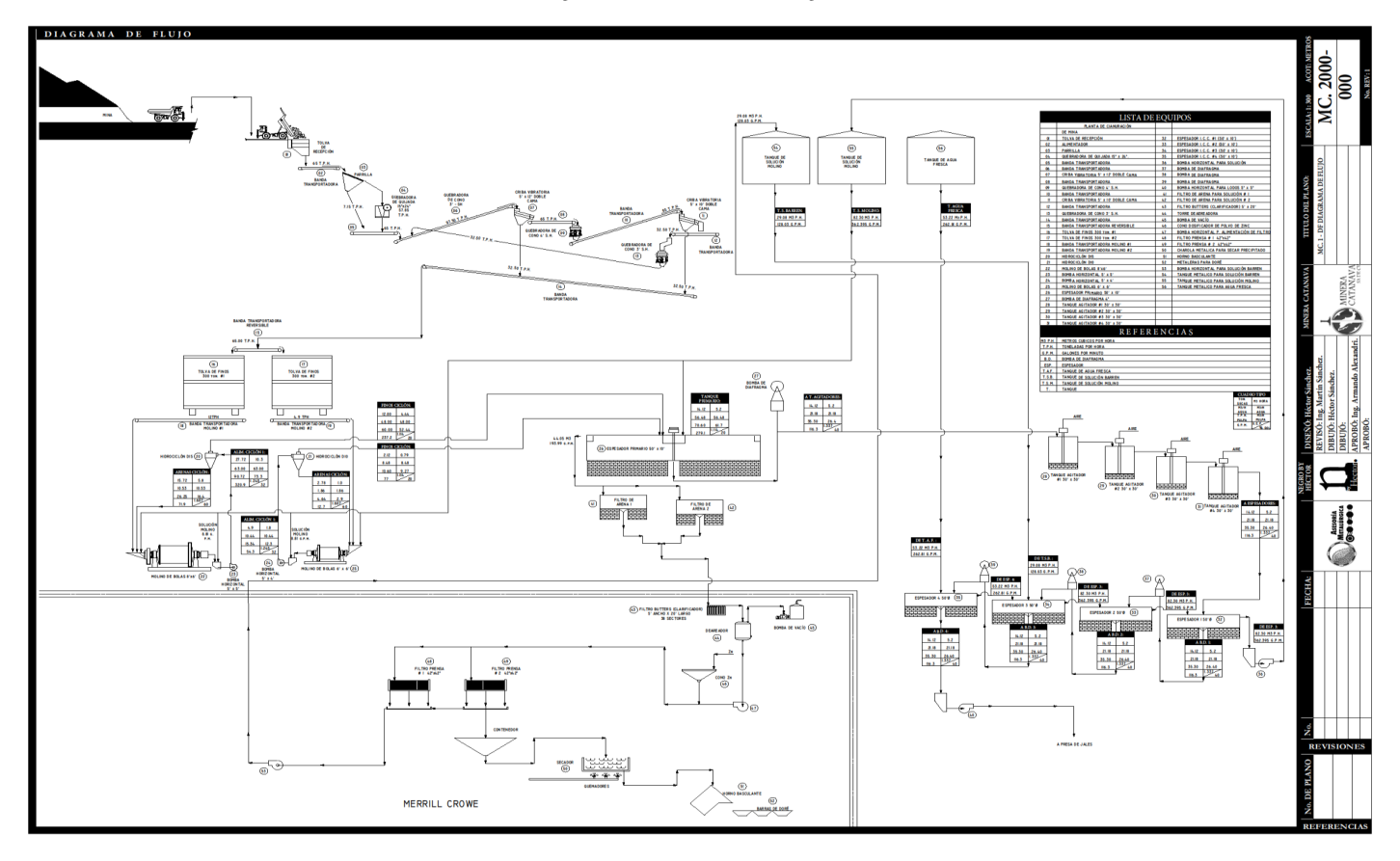
The October 2018 preliminary economic assessment for Candelaria Mining's Pinos project in Mexico describes a three-stage crushing plant, two ball mills, four air-lift leach tanks and a lined tailings pond, targeting 90% gold and 80% silver recovery.
Pinos is a gold and silver project in Zacatecas, Mexico. Candelaria Mining Corp. is the issuer of the NI 43-101 Preliminary Economic Assessment Study for the Pinos Project, with an effective date of September 13, 2018 and a signing date of October 16, 2018. The Pinos remanufactured process facility, purchased by Candelaria, will consist of a run-of-mine crushing plant, a milling circuit with two closed-circuit ball mills, a primary thickener, four cyanidation leach tanks and four countercurrent decantation (CCD) washing thickeners, and a complete Merrill-Crowe zinc precipitation circuit. The process milling rate would start at 200 mtpd in the first year, then 300 mtpd in the second and third years, and 400 mtpd from the fourth to the seventh year, with designed recoveries of 90% for gold and 80% for silver.
Critical Data
| Parameter | Value | Unit | Notes |
|---|---|---|---|
| Milling rate | 200 / 300 / 400 | mtpd | Year 1 / years 2 and 3 / years 4 to 7 |
| Designed gold recovery | 90 | % | Design |
| Designed silver recovery | 80 | % | Design |
| Specific gravity | 2.69 | g/cc | Mill parameters |
| Volumetric weight | 1,670 | kg/m3 | Mill parameters |
| Work index | 16.83 | kWh/short ton | Mill parameters |
| Ore patio | 10,000 to 15,000 | tons | Near the crushing zone |
| Crushed product | 3/8 | in | About 95 mm per the report |
| Ball mills | 2 | 8 x 7 ft and 6 x 6 ft | Two D-15 hydrocyclones each |
| Grind target | 65 to 75 | % passing 74 µm | -200 mesh |
| Primary thickener | 50 x 10 | ft | Feed at 25% to 30% solids |
| Fresh cyanide solution | 1,500 to 1,750 | ppm NaCN | If more leaching is needed |
| Leach tanks | 4 | air-lift, 30 x 30 ft | Residence time 96 hours |
| Clarified solution | Under 10 | ppm solids | Preferably 5 ppm |
| Dissolved oxygen after deaeration | 0.5 to 1.0 | mg/L | From 5 to 8 mg/L |
| Tailings embankment | 14.92 | m | Upstream method, 60 mil HDPE over clay |
| Maximum tailings discharge | 400 | tpd | 16.22 m3/h water |
Overview
Dynamic leaching consists of milling the mineral, leaching it with cyanide and precipitating the final product. The ore mineralogy is quartz, calcite, rare muscovite, hydrothermal silica and orthoclase, with silver linked to acanthite, hematite and aguilerite. Ore is crushed in a jaw crusher with closed circuit secondary and tertiary cone crushers, milled and classified, thickened, leached in four agitation tanks, washed in countercurrent decantation and the pregnant solution clarified and precipitated with zinc. The precipitate is initially sold to refiners.
Key Process Stages
Crushing
Ore is stockpiled on a large patio near the crushing zone and delivered to the primary crusher's dump hopper by trucks, excavators or directly from the San Luis shaft. A conveyor feeds a jaw crusher, and another carries crushed ore to a 5 ft by 12 ft double deck vibrating screen. Oversize goes to a 4 ft secondary cone crusher, then to a 5 ft by 10 ft screen. Because of the work index of the ore, oversize from the second screen goes to a 3 ft tertiary cone crusher and back into the crushing circuit. The final product for milling is reduced to minus 3/8 inch.
Milling and leaching
Milling tests determined an ideal pulp of 65% to 75% passing 74 µm. An 8 ft by 7 ft ball mill and a 6 ft by 6 ft ball mill each work in closed circuit with two D-15 hydrocyclones. The pulp, at 25% to 30% solids, goes to a 50 ft by 10 ft primary thickener, where recovery of rich solution starts. Four air-lift agitation tanks of 30 ft by 30 ft with lateral siphons continue leaching for 96 hours, which exceeds the time required by test work. Pulp from the fourth tank returns to the primary thickener through countercurrent washing, and final pulp goes to the tailings pond. Wash solution goes to the primary thickener and then a mill solution tank for reuse.
Clarification and Merrill-Crowe
Pregnant solution carries 200 to 300 ppm suspended solids, which harm Merrill-Crowe, so two stages of clarification, primary sand filters and a vacuum leaf clarifier, bring it under 10 ppm and preferably 5 ppm. A packed deaeration tower under high vacuum, with a liquid ring vacuum pump, cuts dissolved oxygen from 5 to 8 mg/L to 0.5 to 1.0 mg/L so the zinc is used efficiently. The process needs about 0.166 g of zinc per gram of gold and 0.300 g per gram of silver by reaction chemistry, or 0.303 and 0.606 g in the precipitation process, with a small amount of fresh cyanide, and lead nitrate as activator at 20 to 30 g/t.
Refinery and tailings
The schedule does not include doré production on site. The precipitate is sold to refiners with the best terms, though a refinery on site or in the nearest commercial city is possible. The tailings impoundment sits just below the plant on land owned by Candelaria. It has two liners, a clay liner under a welded 60 mil HDPE geomembrane, designed to NOM-141-SEMARNAT-2003, and is raised by the upstream method to 14.92 m including 1 m of free volume. It has two derivation channels, three piezometers and two monitoring wells, and the first bench has a projected life of 5.5 years.
Additional Interesting Data and Summary
The tailings pond design accounts for hills morphology, a seismic zone, dry hydrology and a 100-year maximum storm period for the desert zone, and includes both finite static and finite seismic element stability analyses. Tailings are discharged through a 4 inch HDPE conduit.
The report presents the process flow diagram and plant plans as drawings from Asesoria Metalurgica, and gives mill operating costs of US$30.77 per tonne at 200 tpd, falling to US$28.26 at 400 tpd.
Key Processes
- Jaw crushing with secondary and tertiary cone crushers
- Closed circuit ball milling with hydrocyclones
- Primary thickening and four-tank air-lift cyanide leaching
- Countercurrent decantation washing
- Two-stage clarification and vacuum deaeration
- Merrill-Crowe zinc precipitation
- Double-lined tailings impoundment
Source: NI 43-101 Preliminary Economic Assessment Study for the Pinos Project, Zacatecas, Mexico, October 16, 2018.
