

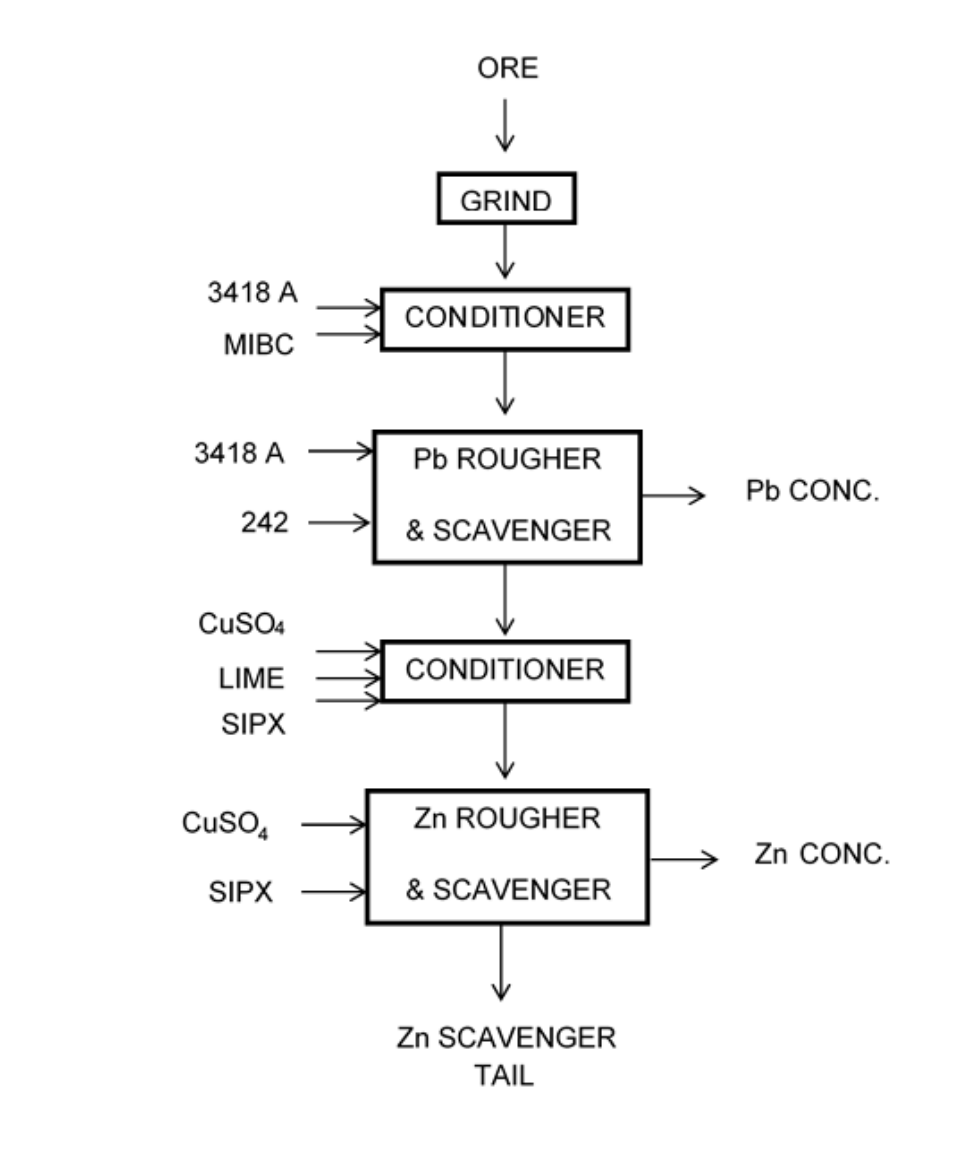
Santacruz Silver's October 2014 preliminary economic assessment for the San Felipe Project in Sonora, Mexico builds on the Rosario mill's operating costs, sizes a three-stage crushing and ball mill circuit, and assumes no copper concentrate because testing did not produce one.
The San Felipe Project lies in the Sonora River basin of Sonora, Mexico, about 110 km north-northwest of the city of Hermosillo. Santacruz Silver Mining Ltd. commissioned the 2014 Resource Estimate and Preliminary Economic Assessment, with an effective date of September 4, 2014 and a signature date of October 23, 2014. The resource estimate is supported by 55,050 m of drilling in 260 holes. The PEA is based on a conventional flotation mill that produces a zinc concentrate and a lead concentrate. Silver is recovered primarily within the lead concentrate, and silver in the zinc concentrate is too low to be payable. Copper is left out of the PEA, because testing has not produced a viable copper concentrate.
Critical Data
| Parameter | Value | Unit | Notes |
|---|---|---|---|
| Mill capacity in PEA | 1,250 | t/d | Built in the first year |
| Mill sizes costed | 750 / 1,250 / 2,000 | t/d | Order-of-magnitude |
| Capital cost, 750 t/d | About 10.8 | US$ million | 15% contingency |
| Capital cost, 1,250 t/d | About 15.3 | US$ million | Includes the 750 t/d upgrade |
| Capital cost, 2,000 t/d | About 27.8 | US$ million | Not applicable |
| Operating cost, 1,250 t/d | 19.09 | US$/t | Based on Rosario mill |
| Operating cost range | 17.77 to 20.26 | US$/t | 2,000 to 750 t/d |
| Power requirement | 25 | kWh/t | Grid power |
| Make-up water | 1,250 | m3/d | Tailings and Sonora River valley wells |
| Silver recovery | 70 / 80 | % | Oxide / sulphide |
| Lead recovery | 70 / 86 | % | Oxide / sulphide |
| Zinc recovery | 68 / 87 | % | Oxide / sulphide |
| Tailings pond | 300 | m | Southwest of the mill |
Overview
The mill would stand on the flat part of a seasonal drainage near the old Artemisa mill site, about 2 km southeast of the Ventana vein. Run-of-mine material is trucked to a hopper with a grizzly, crushed in three stages, ground in a ball mill with cyclones and floated to make lead and zinc concentrates. Both concentrates are thickened, filtered and stored for shipment. Tailings go to a conventional tailings pond, and water is reclaimed to the mill.
Key Process Stages
Crushing and grinding
The crushing circuit is a three-stage system. The 750 t/d equipment list is a coarse material bin, an apron feeder, a 24 in by 36 in jaw crusher, a magnet, a 6 ft by 16 ft double deck screen, a 4¼ ft standard cone crusher, a second 6 ft by 16 ft screen and a 4 ft short head cone crusher. Fine material goes to a bin, then to a 10.5 ft by 20 ft ball mill in closed circuit with cyclones. Raising capacity to 1,250 t/d adds a 10 ft by 9 ft ball mill and further cyclones, and the 2,000 t/d design uses a 10.5 ft by 20 ft ball mill.
Lead flotation
Cyclone overflow is pumped to the lead rougher and scavenger flotation circuit, and the scavenger concentrate returns to the rougher feed. Rougher concentrate goes through two stages of counter-current cleaner flotation. The lead concentrate is thickened on a 30 ft by 10 ft thickener, filtered and stored for shipment. Laboratory flotation work found lead recovery above 90% in most tests at concentrate grades around 30% Pb, with 50% to 87% of silver reporting to the lead concentrate.
Zinc flotation
Lead rougher tailings feed the zinc rougher and scavenger circuit, and zinc scavenger tailings go to the tailings pond. Rougher zinc concentrate gets two stages of counter-current cleaning, then the final concentrate is thickened on a 44 ft by 10 ft thickener and filtered. In earlier tests, zinc flotation was robust, with 45% to 82% of zinc going to concentrate at grades between 34% and 54% Zn.
Tailings and water
Tailings are pumped to a pond 300 m southwest of the mill and water is reclaimed to the plant. Make-up water of 1,250 m3 per day comes from precipitation on the tailings pond and from wells in the Sonora River valley. Power is supplied from the grid at an estimated 25 kWh/t. The report notes that no detailed geotechnical investigation of the mill site has been done, and that the maximum projected water level on the drainage needs investigation, with protection measures.
Additional Interesting Data and Summary
Reagent use in the operating cost model includes 100 g/t sodium cyanide, 4 kg/t of lime, 35 g/t of Aerophine, 30 g/t of promoter, 60 g/t of frother, 1,500 g/t of zinc sulphate, 1,000 g/t of copper sulphate and 500 g/t of ammonium bisulphite. Steel use is 0.2 kg/t for crushers and 1 kg/t for balls. Operating costs were taken from actual costs at the Rosario mill and judged reasonable by the report author, with energy at US$0.11 per kWh. Personnel plus indirects, at 56%, cost US$2.19 per tonne at 1,250 t/d, falling from US$3.64 at 750 t/d.
Test work began with Dawson Metallurgical Laboratories in 2008 on seventeen composites made from 51 samples of core assay rejects, representing oxide, mixed and sulphide mineralization. Santacruz added work in 2013 and 2014 on four composites, one from Ventana, two from Las Lamas and one from San Felipe. Bond work indices from the earlier testing were 13.9 kWh/t for oxide, 15.8 kWh/t for mixed and 16.1 kWh/t for sulphide mineralization.
Key Processes
- Three-stage crushing
- Ball milling with cyclone classification
- Lead rougher, scavenger and two-stage cleaner flotation
- Zinc rougher, scavenger and two-stage cleaner flotation
- Concentrate thickening and filtration
- Conventional tailings pond with water reclaim
Source: 2014 Resource Estimate and Preliminary Economic Assessment, San Felipe Project, Sonora, Mexico, October 23, 2014.
