

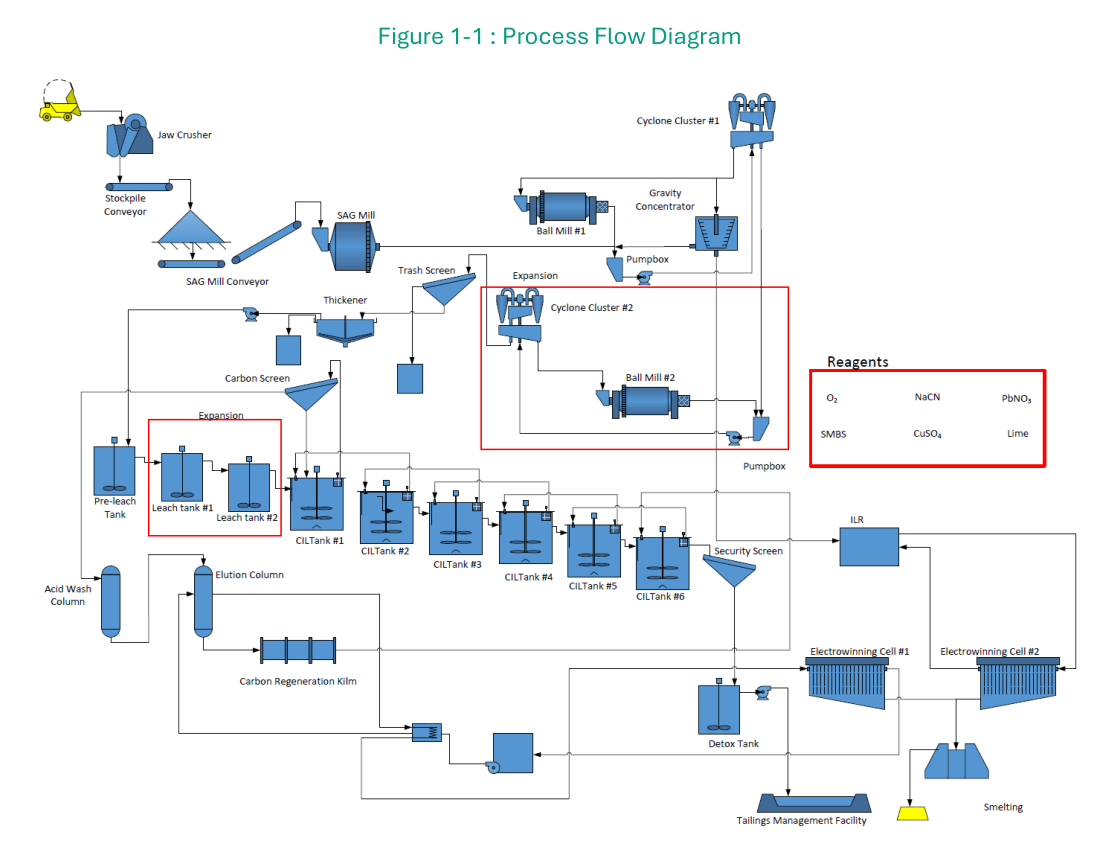
The Cadillac Project in Abitibi-Témiscamingue, Québec, is a preliminary economic assessment-stage gold project held by Cartier Resources Inc. Its recovery methods centre on conventional crushing and grinding, gravity recovery, pre-aeration, carbon-in-leach and the SO₂/air cyanide destruction process.
The Cadillac Project sits in Abitibi-Témiscamingue, Québec, Canada, roughly 35 km east-southeast of Val-d'Or and about 5 km southeast of the municipality of Louvicourt. Cartier Resources Inc. controls the property, which integrates the historic Chimo Mine and East Cadillac projects, and holds it through 281 mining titles covering 11,596 ha. The target commodity is gold, and the current study is an updated Preliminary Economic Assessment with an effective date of August 31, 2026. Several of the mining titles carry royalty obligations, ranging from 1 to 2% of Net Smelter Return and 3% Gross Metal Return.
Critical Data
| Parameter | Value | Unit | Notes |
|---|---|---|---|
| Phase 1 feed throughput | 3,000 | t/d | Design value |
| Phase 2 feed throughput | 4,300 | t/d | Design value |
| Crusher operating availability | 65 | % | Both phases |
| Mill operating availability | 92 | % | Equivalent to 8,059 operating hours per year |
| Phase 1 feed gold grade | 2.7 | g/t | Design criterion |
| Phase 2 feed gold grade | 2.0 | g/t | Design criterion |
| Feed solid specific gravity | 2.8 | Not applicable | Both phases |
| Phase 1 total gold recovery | 95.0 | % | Design value |
| Phase 2 total gold recovery | 94.8 | % | Design value |
| Gravity gold recovery | 50.0 | % | Design criterion; no recovery credit is taken |
| Phase 1 power demand | 10.1 | MW | Design value |
| Phase 2 power demand | 12.5 | MW | Design value |
| Phase 1 annual energy consumption | 63,600 | MWh/y | Design value |
| Phase 2 annual energy consumption | 79,468 | MWh/y | Section 17.6 value; the summary states 79,500 MWh/y |
| Phase 1 jaw crusher throughput | 192.3 | t/h | Nominal hourly |
| Phase 2 jaw crusher throughput | 275.6 | t/h | Nominal hourly |
| Design grind size, ball mill product | 50 | µm | P80 |
| Pre-aeration time | 6 | h | Both phases |
| Required leach time | 36 | h | Both phases |
| CIL carbon content | 10 | g/L | Both phases |
Overview
Testwork ran from December 2025 to September 2026 at ALS Metallurgy under job number KM7798, covering nine composites from the Chimo, East Chimo and West Nordeau deposits. The program established a design basis: whole-rock cyanide leaching at a P80 of 50 µm, preceded by pre-aeration and lead nitrate addition. At the design grind size, 43.9% to 61.4% of the gold reports to a gravity concentrate, and a parallel gravity circuit allows the target recovery to be reached more quickly. Cyanidation testwork showed that gold recovery is highly sensitive to grind size. Recovery fell by about 11 percentage points from the finest to the coarsest grind tested, with standard-condition results running from 90.1% to 98.0% at a K80 of 48 µm to 56 µm and dropping to 77.6% to 87.7% at a K80 above 120 µm. Lead nitrate addition combined with pre-aeration accelerated gold dissolution and, at the finest grind size, cut average cyanide consumption from 0.92 kg/t to between 0.19 kg/t and 0.32 kg/t, with gold recovery between 93.4% and 97.8%. That condition forms the conceptual design basis. Gravity-recoverable gold ran from 43.9% to 61.4% across the three deposits, though cyanidation of the gravity tailings returned an overall recovery equivalent to whole-rock leaching, so no recovery credit attaches to the gravity circuit. A recovery equation built from grind size, feed gold grade and feed sulphur grade is used to project gold recovery over the mine plan.
The plant design assumes 3,000 t/d in Phase 1 and 4,300 t/d in Phase 2, with the crushing circuit at 65% availability and the milling circuit at 92% availability. It produces doré bars. During pre-production and the first year of operation, mine production is expected to be processed at a custom mill, where recovery is expected to be lower because the mill product P80 will likely be coarser than 50 µm.
Key Process Stages
Run-of-mine mineralized material goes to a single-stage jaw crusher, with a 1,250 mm opening and a 100 mm minimum close side setting, driven by a 160 kW motor. Feed F80 is 700 mm and product P80 is 150 mm. Crushed material is conveyed to a 17,200 t stockpile, of which 25% is live, giving 34 hours of storage in Phase 1 and 24 hours in Phase 2 so that routine crusher maintenance does not interrupt mill feed. Two apron feeders operating in sequence regulate SAG mill feed.
Grinding pairs a SAG mill with a ball mill in closed circuit with hydrocyclones. The Phase 1 SAG mill takes a feed F80 of 150 mm and the ball mill delivers a product P80 of 50 µm. SAG mill slurry discharges through a trommel, with undersize flowing to the cyclone feed pump box. Part of the cyclone underflow feeds back to the ball mill and the remainder feeds the gravity circuit. Cyclone overflow passes a trash screen by gravity to the pre-leach thickener and then to the leaching circuit. A second ball mill and hydrocyclone cluster are added in Phase 2 to hold the 50 µm product at the higher throughput.
The gravity circuit handles 85 t/h in Phase 1 and 97 t/h in Phase 2. The diverted stream passes over a gravity feed screen, with oversize returning to grinding and undersize feeding a batch-operated centrifugal concentrator. Each batch yields 30 kg of concentrate, and 41 batches run per day for 1.23 t of daily concentrate at a grade of 3,389 g/t in Phase 1 and 3,591 g/t in Phase 2. Concentrate moves to an intensive leach reactor feed tank, where gold dissolves in high-strength cyanide solution. Pregnant solution flows to the gold-room electrowinning circuit and leached solids return to the grinding circuit.
A pre-aeration tank precedes six CIL tanks. Thickener underflow is targeted at 50% solids by weight, and the slurry is oxygenated for six hours in the pre-aeration tank to oxidize reactive minerals. In Phase 1, pre-aeration discharge feeds the first CIL tank. Oxygen is sparged into each tank while hydrated lime and cyanide are added as required. Lime holds pH high enough to keep cyanide in solution and to prevent toxic HCN gas from forming in the work area. Fresh and regenerated carbon enter the last CIL tank and advance counter-current to the slurry toward the first tank, adsorbing dissolved gold as it moves. Slurry from the final tank flows to detoxification. During Phase 2, two additional leach tanks go in between the pre-aeration tank and the CIL circuit to maintain the design residence time.
Cyanide is destroyed with the SO₂/air process, using oxygen, lime, copper sulphate and sodium metabisulphite. The tank carries oxygen injection points and an agitator, with a CNWAD target of 1 mg/L, a pH target of 8.5, an SO₂ dosage of 8 g SO₂ per g CN⁻, copper sulphate at 50 g Cu per tonne of mineralized material, and lime at 0.33 kg per kg SO₂. Testwork found the process effective but needing an SO₂ dosage above the 5 g/g that usually works on mill feed with less sulphide, probably because of the significant pyrrhotite content. Treated tailings flow to the Tailings Management Facility.
Loaded carbon is acid washed with weak hydrochloric acid to remove calcium, magnesium and other salt deposits before gold stripping. Elution uses the Zadra process with a solution of water, caustic soda and sodium cyanide, pre-heated and passed through a heat exchanger and heater to 140°C, then through the elution column at 2 bed volumes per hour. Solution leaving the column is cooled below 100°C and directed to electrowinning cells. Barren carbon is thermally reactivated in a kiln at 600°C and returned to the CIL circuit. Electrowon sludge is dewatered, dried, fluxed and smelted into doré bars in a secure, supervised gold room.
Additional Interesting Data and Summary
Bond ball mill work indices for the three deposits range from 13.1 kWh/t to 14.3 kWh/t, and SMC SCSE values range from 11.3 kWh/t to 13.1 kWh/t. The report describes these values as indicating moderate to high competency relative to the JKTech database, with all three deposits expected to respond comparably in a conventional crushing and grinding circuit. The Phase 1 grinding circuit calls for 2,545 kW of grinding power in the SAG mill and 1,511 kW in Ball Mill 1; the SAG mill carries a 3,000 kW motor and each ball mill a 1,850 kW motor. Phase 1 process water flows at 184 m³/h and Phase 2 at 264 m³/h. The design keeps to standard unit operations for a North American gold deposit, and the report notes that further testwork will be required to advance the project beyond the preliminary economic assessment level. Sodium cyanide consumption is set at 0.50 kg/t in both phases, an annual requirement of 548 t in Phase 1 and 785 t in Phase 2. Quick lime consumption is 1.86 kg/t, sodium metabisulphite 1.62 kg/t and oxygen 0.61 kg/t. The process plant workforce totals 88 in Phase 1 and 92 in Phase 2.
Key Processes
- Primary crushing in a single-stage jaw crusher with crushed material stockpiling
- SAG and ball mill grinding in closed circuit with hydrocyclones
- Gravity concentration with intensive cyanide leaching of concentrate
- Pre-aeration ahead of carbon-in-leach
- Carbon-in-leach adsorption, acid wash, Zadra elution and carbon regeneration
- Electrowinning and smelting to doré
- Cyanide destruction by the SO₂/air process
- Reagent preparation, storage and distribution
Source: NI 43-101 Technical Report Preliminary Economic Assessment Cadillac Project, Quebec, Canada, 2026-08-31. Project website: Cadillac Project
