

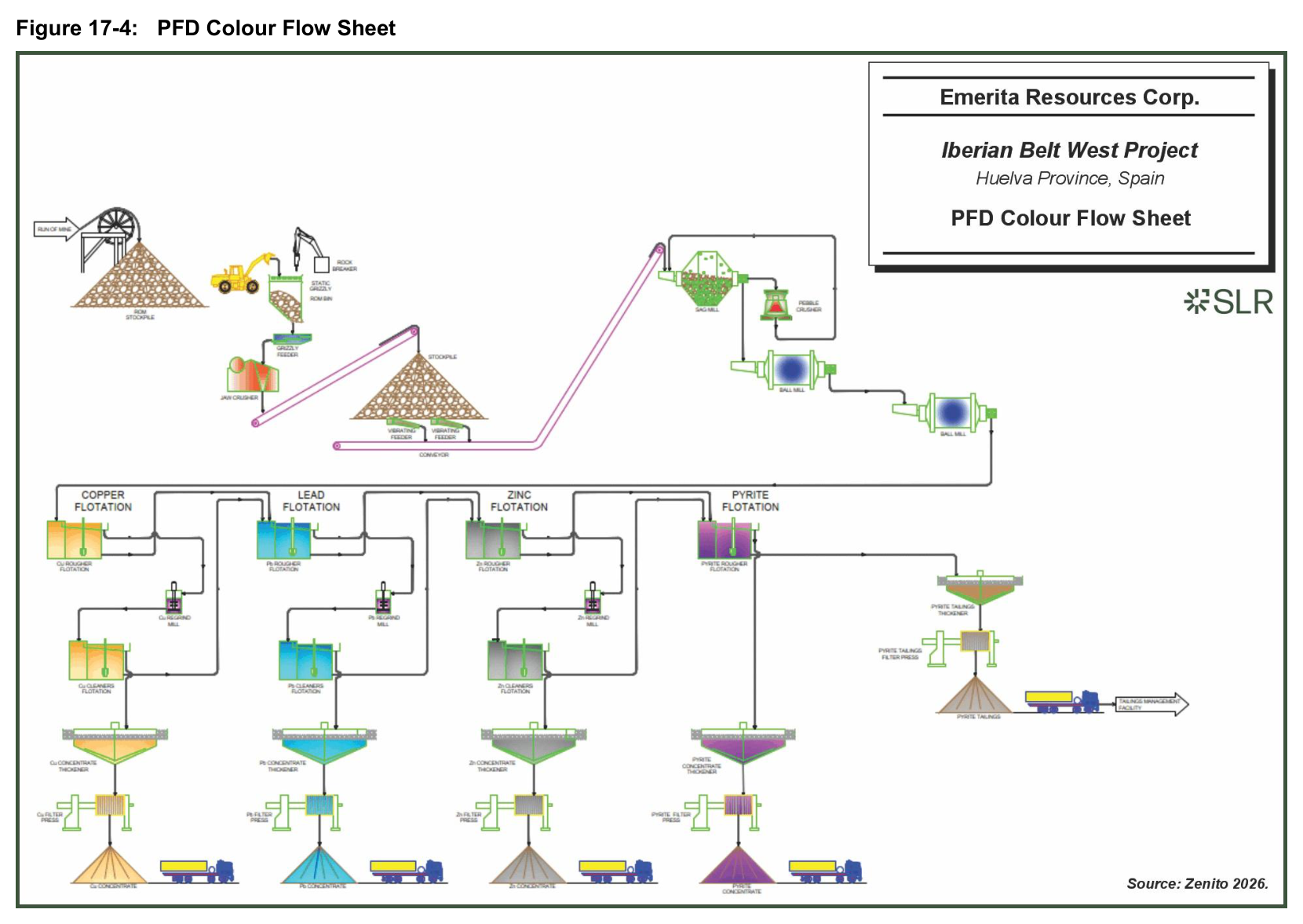
A 1.2 Mtpa flowsheet built around La Romanera feed, with copper, lead, zinc and pyrite flotation, concentrate filtration and dewatered tailings for paste backfill and dry stacking.
Emerita Resources Corp holds the Iberian Belt West Project in Spain, where the current plan treats three orebodies through a single process plant. It is a project, with process design criteria based on La Romanera average head grades and testwork. La Romanera is the main ore source at approximately 85% of the total tonnage, blended with ore from La Infanta and El Cura to even out the head grades and process requirements.
Critical Data
| Parameter | Value | Unit | Notes |
|---|---|---|---|
| Plant throughput | 1,200,000 | tpa | Nominal, design criterion |
| Mill and flotation plant operating time | 8,000 | h/a | Design criterion |
| Crushing throughput | 400 | t/h | Design criterion |
| Milling and flotation throughput | 150 | t/h | Design criterion |
| Crushing utilisation | 75 | % | Design criterion |
| Primary crusher | Jaw, 1200 x 870 | mm | Type and size |
| Run of mine top size | 500 | mm | Design criterion |
| Crushing product P80 | 87 | mm | Design criterion |
| Crushed ore stockpile live capacity | 3,600 | t | Design criterion |
| Crushed ore stockpile live capacity, both apron feeders | 3,021 | m3 | Design volume |
| Crushed ore stockpile live capacity, single apron feeder | 1,917 | m3 | Approximately |
| Crushed ore stockpile diameter | 62 | m | Approximately 24 hours milling |
| Milling circuit product P80 | 45 | µm | Design criterion |
| Bond Ball Mill Work Index | 14.37 to 14.79 | kWh/t | Test range |
| Bond abrasion index | 0.4189 to 0.6747 | Not applicable | Test range |
| Primary mill | 1 x SAG, 5.0 x 3.75, 1,400 | m, kW | Size and power |
| Secondary mill | 1 x Ball, 4.5 x 6.75, 2,300 | m, kW | Size and power |
| Tertiary mill | 1 x Vertical stirred mill, 1,600 | kW | Power |
| Tower mill product P80 | 45 | µm | Design criterion |
| Copper flotation circuit feed | 150 | t/h | Design criterion |
| Copper rougher cell size | 4 x 30 | m3 | Design criterion |
| Copper rougher design retention time | 20 | min | Design criterion |
| Copper regrind mill power | 550 | kW | Vertical stirred |
| Regrind circuit product P80, copper | 15 | µm | Design criterion |
| Lead regrind mill power | 2,500 | kW | Vertical stirred |
| Zinc regrind mill power | 1,500 | kW | Vertical stirred |
| Regrind circuit product P80, zinc | 10 | µm | Design criterion |
| Rougher lead concentrate yield | 25 | % | Design criterion |
| Rougher zinc concentrate yield | 19.2 | % | Design criterion |
| Rougher pyrite concentrate yield | 64.9 | % | Design criterion |
| Copper concentrate production | 11,320 | tpa | Design criterion |
| Lead concentrate production | 29,346 | tpa | Design criterion |
| Zinc concentrate production | 51,330 | tpa | Design criterion |
| Pyrite concentrate production | 782,720 | tpa | Design criterion |
| Tailings production | 321,200 | tpa | Design criterion |
| Copper concentrate thickener diameter | 4 | m | Hi-rate |
| Lead concentrate thickener diameter | 4 | m | Hi-rate |
| Zinc concentrate thickener diameter | 8 | m | Hi-rate |
| Pyrite concentrate thickener diameter | 25 | m | Hi-rate |
| Pyrite tailings thickener diameter | 12 | m | Hi-rate |
| Concentrate cake moisture | 10 | % | Each concentrate and pyrite tailings |
| Pyrite concentrate stockpile diameter | 26 | m | Design criterion |
| Tailings slurry pumping distance | 1.5 | km | Process plant to dewatering pad |
| Grid power line | 30 | kV | Installed by grid authority |
Overview
The plant design rests on a single stage of crushing, followed by SAG milling with pebble crushing in closed circuit. Ball milling with classification cyclones in closed circuit comes next, then tower milling for fine grinding with its own closed cyclone circuit.
Four flotation circuits run in sequence: copper, lead, zinc and pyrite. Concentrate thickening and filtration follow each flotation stage, and the tailings receive thickening and filtration for paste backfill and dry stacking.
Nominal throughput is 1.2 Mtpa. The primary crusher and coarse ore stockpile carry 75% availability in the design, while the milling and flotation circuits and all downstream processing units are set at 92%. The process plant sits northwest of the portals of the three mines.
Key Process Stages
Ore delivery and crushing. ROM ore reaches the surface from La Infanta, El Cura and La Romanera by Railveyor, a proprietary light rail system driven by stationary drive stations. The ore lands on the ROM stockpile, where blending evens out the head grade feeding flotation. A front-end loader recovers blended ore into the ROM bin through a static grizzly, which blocks rock over 500 mm, and a rock breaker handles oversize. A variable speed grizzly feeder charges the jaw crusher, which reduces ore to -150 mm. Crushed ore and grizzly undersize travel by sacrificial conveyor to the stockpile feed conveyor.
Stockpile and reclaim. The crushed ore stockpile measures 62 m in diameter, holds roughly 24 hours of milling and buffers a crusher running about 12 h/d against a milling circuit running 24 h/d. Two variable speed apron feeders sit in a concrete reclaim tunnel beneath the stockpile. Both feeders in service give 3,021 m3 of live capacity, and one feeder gives about 1,917 m3. Bulk density of ore from the different mines ranges from 2.5 t/m3 to 4 t/m3, so the design expresses stockpile capacity as a volume.
Milling. Two apron feeders, each capable of the full throughput alone, deliver ore to the SAG mill feed conveyor, with a belt scale controlling the feed rate. SAG trommel scats return through a cone crusher to the reclaim conveyor and the SAG mill, and a magnet over the first recirculating conveyor removes steel. SAG product and ball mill discharge share a pump box set between the mills. Ball mill cyclone overflow feeds the tower mill cyclones, and the tower mill works in closed circuit with those cyclones. Cyclone overflow flows by gravity to the first copper conditioner tank.
Flotation. Each base metal circuit has roughers, regrind of rougher concentrate, a primary cleaner with cleaner scavenger, and secondary and tertiary cleaners. Cleaner scavenger tailings return to the regrind mill, and secondary and tertiary cleaner tailings return to the previous stage. Rougher and cleaner scavenger tailings pass to the next circuit, from copper to lead to zinc, and zinc tailings go to the pyrite rougher. Pyrite has a bulk roughing stage only, with rougher concentrate to pyrite concentrate dewatering and tailings to pyrite tailings dewatering. The flotation lines occupy four adjacent steel framed, non-insulated clad buildings.
Dewatering and loading. Copper, lead and zinc each have a dedicated hi-rate thickener and a plate and frame pressure filter. Filter cakes drop to conveyors feeding stockpiles in dedicated bunkers, and front-end loaders move concentrate into trucks. Thickener overflow and filtrate collect in a shared process water transfer tank near the lead thickener and return to the process water tank. The three concentrate dewatering and stockpile areas sit indoors in one attached building with a truck access door at each stockpile.
Pyrite dewatering occupies a separate building because of the larger equipment and stockpile. Thickener underflow passes to a holding tank and then a pressure filter. Cake goes by collecting conveyor to a stacker that builds a 26 m diameter stockpile. Filtrate returns to the process water tank.
Tailings. Tailings slurry is pumped 1.5 km to the dewatering pad near the IPS and thickened in the pyrite tailings thickener. Underflow goes to a holding tank and a filter. Overflow returns by gravity to the main process water tank, since the thickener overflow sits 22 m above the top edge of that tank.
Reagents. Solid and liquid reagents are stored and made up indoors in prefabricated steel frame buildings, and lime arrives as powder for two outdoor silos fed by pneumatic conveying from tanker trucks, with screw feeders charging the make-up tank. Reagent consumptions come from flotation tests. For copper flotation on La Romanera ore, MIBC is 25 g/t ROM, lime 7,110 g/t ROM, SMBS 1,450 g/t ROM and ZnSO4 400 g/t ROM. Lead flotation on the same ore uses 20 g/t ROM MIBC, 198 g/t ROM lime and 95 g/t ROM 3418A. Zinc flotation lists 100 g/t ROM MIBC, 1,243 g/t ROM lime, 700 g/t ROM CuSO4 and 175 g/t ROM SIPX, and pyrite flotation lists 1,080 g/t pyrite feed lime, 450 g/t pyrite feed CuSO4, 108 g/t pyrite feed PAX and 44 g/t pyrite feed MIBC. La Infanta and El Cura carry their own consumptions, and El Cura pyrite flotation uses 2,625 g/t pyrite feed H2SO4.
Additional Interesting Data and Summary
Design head grades differ widely across the three orebodies. La Romanera averages 0.38% copper, 1.10% lead, 2.31% zinc and 37.94% sulphur. La Infanta averages 0.87% copper, 3.52% lead, 5.95% zinc and 7.28% sulphur, and El Cura averages 0.98% copper, 0.58% lead, 1.22% zinc and 32.57% sulphur.
Concentrate recoveries are stated by deposit against LOM average ROM grades. For La Romanera, copper concentrate grades 20.4% Cu at 41.5% recovery, lead concentrate 26.8% Pb at 52.2%, zinc concentrate 50.1% Zn at 78.7%, and pyrite concentrate 1.49 g/t Au at 75.7% and 49.6 g/t Ag at 40.5%. La Infanta copper concentrate grades 20.2% at 42.4% recovery, lead 47.9% at 78.3%, zinc 57.5% at 78.00%, and pyrite concentrate 0.84 g/t Au at 32.1% and 50.7 g/t Ag at 7.2%. El Cura copper concentrate grades 22.9% at 79.4% recovery, lead 4.2% at 2.7%, zinc 45.2% at 67.9%, and pyrite concentrate 1.89 g/t Au at 75.1% and 24.5 g/t Ag at 32.0%.
Fine grinding reaches P80 targets of 15 µm in the copper and lead regrind circuits and 10 µm in the zinc circuit. The pyrite concentrate stream dwarfs the base metal streams at a design 782,720 tpa. A 30 kV grid line will supply the site.
Key Processes
- Single stage jaw crushing to a coarse ore stockpile
- SAG milling with pebble crushing in closed circuit
- Ball milling with cyclones in closed circuit
- Tower mill fine grinding with cyclones in closed circuit
- Copper, lead, zinc and pyrite flotation in sequence
- Regrind and three cleaner stages on each base metal circuit
- Bulk roughing on pyrite
- Hi-rate thickening and plate and frame filtration of each concentrate
- Tailings thickening and filtration for paste backfill and dry stacking
Source: NI 43-101 Technical Report for the Iberian Belt West Project, Spain, 2026-10-14. Project website: Iberian Belt West Project
