

Metallurgical testwork and a trade-off study point to gravity recovery with carbon-in-leach as the design route for the Bralorne Gold Project, where a modified sorting facility and a new mill are planned side by side.
The Bralorne Gold Project sits in the historic Bridge River mining district of southwestern British Columbia, roughly 170 km north-northeast of Vancouver and about 5.5 hours by road from the city along Highway 99 through Lillooet. The property is held through 197 Crown granted mineral claims, 66 mineral title legacy and cell claims, and 3 mining leases, all owned 100% by Bralorne Gold Mines Ltd., a wholly owned subsidiary of Talisker Resources Ltd. This is a development-stage gold project. The company has not yet reached commercial production, and the project remains in development, commissioning and operational ramp-up. A gradual production ramp-up during a four-year permitting and construction period is part of the mine plan, and the major permit amendment application is targeted for submission in Q4 2027 with regulatory approvals assumed by the end of 2028.
The proposed flowsheet rests on ALS metallurgical testwork and a high-level process trade-off study among four options. Gravity gold recovery followed by cyanidation in a carbon-in-leach circuit came out ahead. Test samples representing both Bralorne West and Mustang material showed comparable recovery characteristics, with approximately 92% overall gold recovery for each group under that route. The plant is built around a ball mill closed with cyclones, a gravity recovery circuit with intensive cyanidation, the CIL circuit, and an ADR circuit that produces gold doré bullion as the final product.
Critical Data
| Parameter | Value | Unit | Notes |
|---|---|---|---|
| Overall gold recovery, gravity plus cyanidation | ~92 | % | Test result, Bralorne West and Mustang samples |
| Overall gold recovery, previous operation | nearly 90 | % | Historical gravity plus flotation |
| Gold recovery to gravity concentrate, previous operation | ~65 | % | Historical |
| Primary grind size | 100 | µm | Test optimum |
| Cyanide concentration | 2000 | ppm | Test optimum; first four CIL tanks |
| Cyanidation pulp pH | 11 | Not applicable | Test optimum |
| Leaching duration | 48 | hours | Test optimum |
| Leaching pulp density | 45 | % solids by weight | Test optimum |
| Plant design processing capacity | ~2,385 | mtpd | Design |
| Critical equipment sizing basis | 2,500 | mtpd | Design, ball mill and tailings handling |
| Maximum mining rate | 2,850 | mtpd | Design |
| Average mining rate over life of mine | 2,700 | mtpd | Design |
| Sorting facility throughput | 900 to 1,700 | mtpd | Design range |
| Sorting gold recovery | 97.5 | % | Test result |
| Sorting mass pull | 72.7 | % | Test result |
| New crushing circuit design capacity | 1,600 | mtpd | Design, to match mining rate |
| Sorting concentrate top size | minus 20 | mm | Design, P80 around 12 mm |
| Ball mill dimensions | 14 by 24 | feet | Design, diameter by effective grinding length |
| Ball mill installed power | 2.2 | MW | Design |
| Ball mill Bond Work Index | ~20 | kWh/mt | Assumed |
| CIL tank count and size | 6 tanks, 12 by 14 | m | Design, diameter by height |
| Carbon batch size | 2.5 | metric tons | Design |
| Process makeup water | ~22 | m³/hr | Design, based on 2,250 mtpd facility |
| Preliminary installed power | ~7 | MW | Design, SGS process scope |
Overview
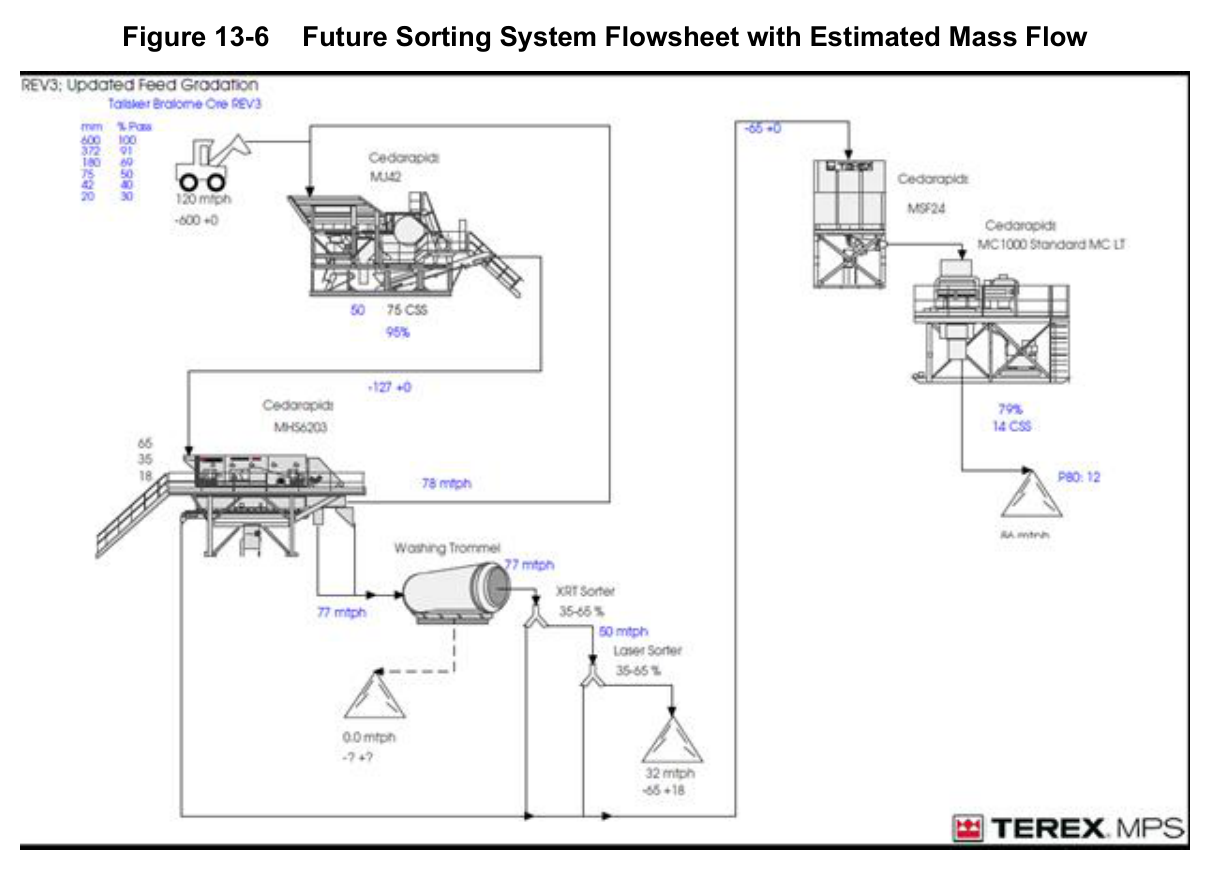
Talisker has started engineering and procurement for a mineralized material sorting facility at the site, sized to process up to 1,700 mtpd and planned for commissioning in Q2 2027. With modifications, the facility will stay in the flowsheet once operations begin. Mined material splits between this sorter and a new crushing circuit at the mill site, and both streams converge on the ball mill.
Plant throughput carries a design capacity of approximately 2,385 mtpd. Critical equipment, above all the ball mill and the tailings handling system, is sized at 2,500 mtpd of process throughput so the mill can absorb a range of sorting performance and tonnage. The mining rate itself is expected to peak at 2,850 mtpd and average 2,700 mtpd over the life of mine, with the sorting facility taking between 900 and 1,700 mtpd of that feed.
Key Process Stages
Sorting begins with two stages of crushing, an XRT sorter, and conveying and screening equipment. A washing trommel sits ahead of the two-stage rougher and scavenger arrangement so the material surface is clean for laser sorting, and the system can later be modified to add a laser sorter that recovers extra concentrate from the XRT waste stream. Slime from the wash reports to a slurry tank, then a disc filter, with the filter cake trucked to the mill alongside the sorting concentrate and the filtrate recycled to a local process water tank. The concentrate passes through a secondary cone crusher to minus 20 mm at a P80 around 12 mm before reporting to the ball mill. Sorting waste goes back underground as backfill.
The new crushing circuit runs two stages in closed circuit with a vibrating screen. A Metso C96 jaw crusher or equivalent is recommended as primary, with an open side setting around 90 mm, a product P80 near 90 mm and a top size of 150 mm. The secondary unit is a Metso HP100 short head cone crusher or equivalent with a close side setting around 17 mm, and its product recirculates to the feed bin. Screen undersize at minus 20 mm goes to the ball mill feed bin.
Grinding uses a single stage ball mill in closed circuit with hydrocyclones. The recommended mill measures 14 feet in diameter with 24 feet of effective grinding length and 2.2 MW installed, turning a feed P80 of 12 to 15 mm into a cyclone overflow P80 of 100 µm. Slurry density runs around 70% solids in the mill and 50% solids at the cyclone feed, with a circulating load assumed around 350%. A Knelson XD48 or equivalent gravity concentrator takes a portion of the cyclone underflow, flushing concentrate periodically to an intensive cyanidation circuit while gravity tails return to the mill. Gold leached from the gravity concentrate reports in high-concentration eluate to an eluate tank near the gold room, and the solid residue recycles to the ball mill.
The CIL circuit starts at a pre-leach thickener, a 20 m diameter unit, that brings the slurry to 45% solids by weight. Six agitated tanks of 12 m diameter and 14 m height give 48 hours of leach retention. Milk of lime holds the slurry pH around 11, and cyanide is maintained at 2000 ppm in the first four tanks. Air sparging keeps dissolved oxygen at the required level, and barren carbon advances countercurrent through the tanks, with loaded carbon harvested from the first tank through a loaded carbon screen.
In the carbon circuit, loaded carbon goes first to an acid wash vessel handling 2.5 metric tons per batch, where dilute HCl around 4% removes calcium and scale, followed by a raw water rinse and neutralization with dilute caustic. A modified Zadra pressure elution with hot caustic desorption strips gold into pregnant eluate. Stripped carbon is dewatered, thermally reactivated in a kiln, quenched, screened, and returned to a barren carbon tank for reuse. Eluate from the strip column and the intensive cyanidation circuit passes through an electrowinning cell, and the resulting gold sludge is filtered, dried or retorted, mixed with fluxes, and smelted into doré bullion. Slag is crushed and recycled to the grinding circuit.
Tailings filtration sits near the dry stack area. CIL tailings report to an agitated slurry tank and then to two filtration feed tanks, each 12 m in diameter and 14 m high, giving about 18 hours of retention. Plate and frame filter presses handle the duty at an assumed filtration rate of 100 kg/m²/hr, with three operating units and one standby, each carrying 100 plates of 1.5 m by 1.5 m. Filter cake at around 20% moisture travels by conveyor to the dry stack and is rehandled by truck. A sodium metabisulfite system stands ready for cake wash if cyanide in the tailings cake needs further reduction. Filtrate returns to the process water tank.
Additional Interesting Data and Summary
Reagent consumption figures come from laboratory testwork. Lime is assumed at 0.61 kg per metric ton of CIL solid feed, drawn from a 25 tonne silo and converted to milk of lime at 15% solids. Sodium cyanide consumption is 0.87 kg per metric ton of CIL solid feed, with daily consumption estimated around 2.26 tonnes once intensive cyanidation is included. Hydrochloric acid use runs about 0.14 metric tons of contained HCl per day, or 0.38 m³ of concentrated solution. Flocculant dosage is assumed at 20 g/t for the pre-leach thickener.
Several design factors shape the material handling. The crushing circuit and the sorting system each carry an assumed total utilization and availability of 65%, while grinding and gravity recovery are assumed at 90% and tailings filtration at 83%. The crushing circuit works out to a nominal feed rate of 98 mtph, grinding to 100 mtph. The secondary crushing feed bin holds 12 hours of live volume, around 2,600 metric tons with circulating load, and the ball mill feed bin carries an 8-hour buffer of 800 metric tons.
An existing sorting facility on the site will be modified and used in future operations to process part of the feed, with its concentrate feeding the downstream plant. Process makeup water is estimated at around 22 m³/hr for a facility of approximately 2,250 mtpd with dry stacked tailings, serving reagent preparation, dust suppression in crushing and process water losses. Power comes from the grid through an existing line from the previous operation, and SGS's process power estimate of around 7 MW covers the new crushing circuit, CIL and tailings handling, and the downstream ADR circuit.
Key Processes
- Two-stage crushing with an XRT sorter and washing trommel, upgradeable to include a laser sorter
- Two-stage crushing of unsorted feed with a jaw crusher and cone crusher in closed circuit
- Single stage ball mill grinding in closed circuit with hydrocyclones to a P80 of 100 µm
- Gravity concentration with intensive cyanidation of the gravity concentrate
- Pre-leach thickening to 45% solids ahead of carbon-in-leach
- Six-tank CIL leach over 48 hours at pH 11 and 2000 ppm cyanide
- Acid wash, Zadra pressure elution, carbon regeneration and electrowinning
- Smelting of gold sludge to doré bullion with slag recycled to grinding
- Tailings filtration in plate and frame presses and dry stacking of filter cake
Source: Preliminary Economic Assessment for the Bralorne Gold Project, British Columbia, Canada, 2026-11-05. Project website: Bralorne Gold Project
