

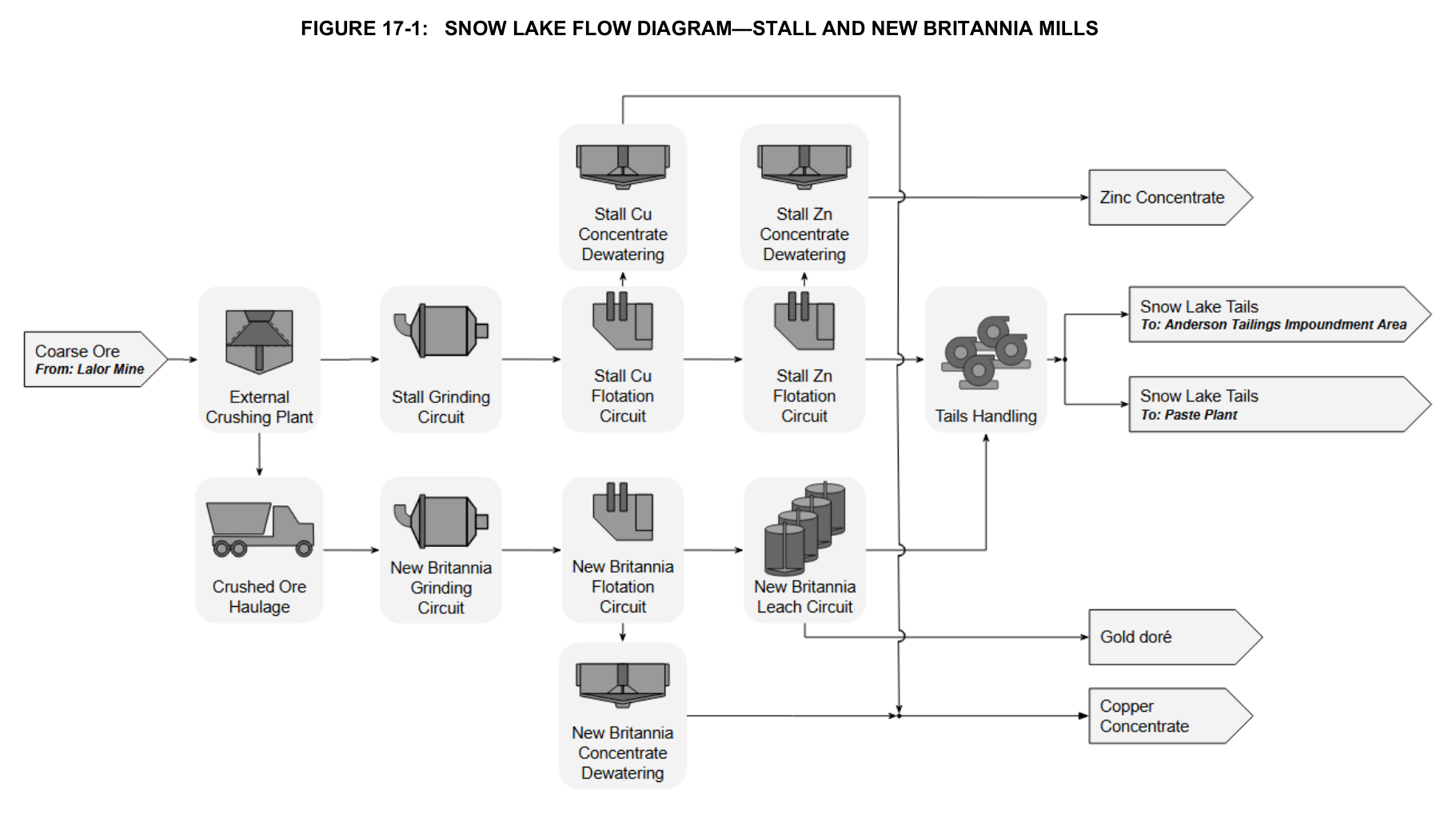
Hudbay's Snow Lake operations combine the Stall concentrator with the New Britannia Mill to process ore from a copper-focused underground mine and its satellite deposits in northern Manitoba.
Hudbay Minerals Inc. holds a 100% interest in the Lalor and Snow Lake Operations, an operating underground mine and milling complex in the Province of Manitoba, Canada, within commuting distance of the community of Snow Lake. The operation produces copper as its principal metal, with zinc, gold, and silver recovered alongside. Ore comes from the producing Lalor Underground Mine and from satellite deposits that form part of a life-of-mine plan running from 2027 to 2043. Development of the 1901 Mine continues, with full production expected at the end of 2027. The properties sit within a 90 km radius of Snow Lake.
Critical Data
| Parameter | Value | Unit | Notes |
|---|---|---|---|
| Stall concentrator nominal throughput | 3,800 | t/d | 24 h/d, 365 d/a, with scheduled maintenance downtime |
| Stall concentrator design throughput | 2,800 | t/d | Initial capacity before debottlenecking |
| Stall peak demonstrated throughput | 4,500 | t/d | Highest throughput observed |
| Stall instantaneous processing rate | >200 | t/h | Observed rate |
| New Britannia design throughput | 1,500 | t/d | Refurbishment target |
| New Britannia nominal throughput | 2,350 | t/d | Current, 365 d/a, with scheduled downtime |
| External crushing plant product size | <20 | mm | Vibratory screen undersize target |
| Stall rod mill power | 600 | kW | 3.2 m diameter x 4.9 m length |
| Stall secondary ball mill power | 1,200 | kW | 3.8 m diameter x 5.5 m length |
| Stall tertiary ball mill power | 600 | kW | 3.2 m diameter x 4.0 m length |
| Stall regrind mill power | 300 | kW | 2.44 m diameter x 3.66 m length |
| New Britannia rod mill power | 750 | kW | 3.5 m diameter x 4.5 m length listed |
| New Britannia ball mill power | 1,500 | kW | 4.2 m diameter x 6.1 m length listed |
| Stall copper flotation pH | 10.0 to 10.8 | Not applicable | Rougher and cleaner stages |
| Stall zinc flotation pH | 11.0 to 11.5 | Not applicable | Throughout the zinc circuit |
| New Britannia flotation pH | 10.0 to 10.8 | Not applicable | Rougher and cleaner stages |
| Stall copper concentrate moisture | <15 | % | After ceramic disc filtration |
| Stall zinc concentrate moisture | <11 | % | After ceramic disc filtration |
| New Britannia copper concentrate moisture | <15 | % | After pressure filtration |
| Copper concentrate grade, New Britannia | 15 to 20 | % Cu | Operating result at 90% recovery |
| Doré grade, New Britannia | 20 to 30 | % Au | With 50% to 60% Ag |
| Global gold recovery via concentrate and doré, New Britannia | 90 to 91 | % | Operating result |
| Global silver recovery via concentrate and doré, New Britannia | 80 to 84 | % | Operating result |
| Stall copper concentrate grade | 18 to 20 | % Cu | At 85% to 88% recovery |
| Stall zinc concentrate grade | 51 | % Zn | At 85% to 88% recovery |
| Gold reporting to Stall copper concentrate | 70 to 75 | % | Co-product recovery following grind and gravity improvements |
| Silver reporting to Stall copper concentrate | 60 to 65 | % | Co-product recovery |
| New Britannia tailings pipeline length | 6.8 | km | To Stall Mill |
| Reclaim water pipeline length | 5 | km | Anderson tailings impoundment area to Stall Mill |
| Fresh water pipeline length | 7 | km | From Snow Lake |
| Stall reclaim water share | ~75 | % | Balance fresh water |
| Power consumption | 0.045 to 0.055 | kWh/t | As printed in the report, per tonne milled; the unit may be a misprint for MWh/t |
| Reclaimed water volume | 3.6 | Mm3/a | Average, ATIA to Stall then New Britannia |
| Fresh water volume | 0.5 | Mm3/a | Two permitted pump houses |
Overview
All ore, whether gold or base-metal type, travels first to the external crushing plant at the Stall Mill site. A front-end loader charges run-of-mine coarse ore into an ELRUS 3054 primary jaw crusher. Primary and secondary crushed product combine on an ELRUS 7' x 20' three-deck vibratory screen set to produce undersize below 20 mm. Oversize recirculates to a Sandvik CJ612 secondary cone crusher, which closes the circuit. The plant was commissioned in 2021 alongside the New Britannia Mill, when the legacy Chisel crushing plant and the indoor Stall crushing plant were decommissioned.
Crushed gold ore goes by radial stacker to a stockpile, where a loader reclaims it for trucking to New Britannia. Crushed base-metal ore either feeds the Stall fine ore bins directly through a diverter gate or is stockpiled and reclaimed through a vibratory feeder onto the same bins conveyor.
Key Process Stages
Stall Grinding
Fine ore feeds an open-circuit primary rod mill of 600 kW. Rod mill discharge joins secondary mill discharge at the secondary cyclone cluster, which runs four cyclones in duty and five on standby. Underflow returns to the 1,200 kW secondary ball mill while overflow advances to tertiary grinding. A bleed from secondary cyclone feed passes through a Knelson XD20 gravity concentrator; the gravity concentrate goes to concentrate dewatering and the tails rejoin the cyclone feed. Tertiary cyclones, three duty and two standby, close with a 600 kW ball mill, and their overflow feeds copper flotation. Lime enters at the rod mill feed for pH control, with frother and collector added at the secondary ball mill feed.
Stall Copper Flotation
A scalping circuit opens the copper section. Five Wemco 8.5 m3 cells carry out scalping rougher flotation, and their concentrate joins recleaner tailings in the scalping cleaner bank of nine Denver DR24 cells. Cleaner concentrate reports to a Z1200/1 Jameson cell for recleaning, with tails returning to the cleaner feed and concentrate sent to dewatering. Combined scalping tails move to a conventional copper circuit, where an E3432/8 Jameson cell performs rougher flotation and ten Wemco 8.5 m3 cells handle rougher scavenging. Scavenger concentrate feeds regrind. The regrind cyclone cluster runs four duty and five standby, and underflow passes a gravity concentrator before the 300 kW regrind ball mill. Overflow advances to copper retreat, and the combined concentrates from rougher, cleaner scavenger, and retreat flotation are cleaned in an E1732/4 Jameson cell. Lime holds pH between 10.0 and 10.8, with Aerophine 3418A as collector and Flottec F189-13 as frother.
Stall Zinc Flotation
Copper tails receive copper sulphate as activator and AERO 7279 collector before entering zinc rougher flotation in an E3432/8 Jameson cell. An E2532/6 Jameson cell cleans the combined rougher and cleaner scavenger concentrates, which then go to dewatering. Cleaner tails join rougher scavenger concentrate in a bank of fourteen Denver DR24 cells, and combined rougher and cleaner scavenger tails feed a bank of seven Wemco 8.5 m3 cells for rougher scavenging. Final scavenger tails discharge to tailings handling. Lime maintains pH from 11.0 to 11.5.
Stall Concentrate Dewatering
Copper concentrate and primary gravity concentrate combine in a stock tank and are pumped with flocculant to a 3.4 m diameter thickener. Underflow moves to a thickened stock tank and then a ceramic disc filter that cuts moisture below 15%. Filtered copper concentrate is stockpiled and trucked to the Flin Flon concentrate handling facility. Zinc concentrate feeds its thickener directly with flocculant, and underflow is filtered in a ceramic disc filter to below 11% moisture before the same haulage route.
New Britannia Grinding and Flotation
Crushed gold ore arrives in a 150 tonne dump pocket with a grizzly, feeding a single 2,700 tonne fine ore bin. An open-circuit rod mill of 750 kW accepts the feed, and its discharge joins secondary mill discharge at a cyclone cluster of four duty and two standby cyclones. Underflow closes through a 1,500 kW ball mill and overflow advances to flotation. Lime and initial reagents are added at the ball mill feed.
Cyclone overflow joins cleaner tails at scalper flotation, an E1732/4 Jameson cell. Scalper concentrate goes to dewatering, and scalper tails combine with scavenger concentrate to feed rougher flotation in another E1732/4 Jameson cell. A Z1200/1 Jameson cell cleans rougher concentrate, with tails returning to the scalper. Rougher tails report to scavenger flotation and then to two 1.7 m direct flotation reactors, whose tails form the leach feed. Flotation pH runs from 10.0 to 10.8 with the same collector and frother as Stall.
New Britannia Dewatering and Leaching
Flotation concentrate is thickened in an 8 m diameter high-rate thickener and filtered in a Larox PF25/35 pressure filter to below 15% moisture. Filtered concentrate is stockpiled and trucked to Flin Flon.
Flotation tails and flocculant feed a pre-leach thickener of 12.2 m diameter. Underflow is pumped with sodium cyanide solution and hydrated lime into four leach tanks of 1,318 m3 each, arranged for cascade flow. Slurry then passes through six carbon adsorption tanks of 109 m3, with activated carbon moving countercurrent and interstage screens retaining it. Loaded carbon from the first tank advances over a screen to a strip vessel, where hot caustic cyanide solution elutes gold under pressure. Pregnant solution goes to electrowinning, and the resulting sludge is filtered, dried, fluxed, and smelted in an induction furnace to doré. Slag returns to the rod mill feed. Stripped carbon is dewatered, with undersize joining carbon safety-screen oversize as a carbon fines product, and oversize regenerated in a kiln before reuse.
Detoxification follows the INCO SO2/Air process in two parallel air-sparged tanks, using sodium metabisulphite as the SO2 source and copper sulphate as catalyst. Detox tailings pump to tailings handling.
Utilities
New Britannia tailings travel 6.8 km by pipeline to Stall, where tailings from both mills are distributed through separate pipelines either to the Anderson tailings impoundment area or to the Lalor paste plant. Paste reaches the mine through one of two nominal 8 inch hardened steel-cased boreholes to Level 780, the main distribution level, with the second borehole held as a spare.
Stall draws roughly 75% of its water as reclaim from the impoundment area and 25% fresh from Snow Lake. Stall acts as the central hub, forwarding reclaim to New Britannia through a connecting pipeline. Fresh water is restricted to washrooms, gland water, reagent mixing, and instrument cleaning. New Britannia also recycles internal process water from pre-leach and concentrate thickener overflows.
Manitoba Hydro's 115 kV substation supplies both mills under long-term service agreements. The report expects power consumption to remain at 0.045–0.055 kWh/t milled. That is far below the energy grinding alone requires, so the unit may be a misprint for MWh/t, which would be 45 to 55 kWh/t.
Additional Interesting Data and Summary
The Stall Mill dates to 1979, when it was built with two independent circuits, Stall and Chisel, to treat ore from six mines within 11 km of Snow Lake. The Chisel circuit ran about 1,000 t/d five days a week and made separate copper, lead, and zinc concentrates. The Stall circuit treated roughly 2,800 t/d and produced about 410 tonnes of copper concentrate and 162 tonnes of zinc concentrate daily. Operations ran until 1993, resumed in 1994, and paused again in 2009 before a 2010 restart. Lalor ore arrived in August 2012, zinc concentrate first and copper concentrate by October 2012. Improvements through 2014 and afterward raised average throughput to 3,800 t/d.
The New Britannia site opened in 1949 as the Nor-Acme mine and mill. It produced until 1958, recovered about 610,000 oz of gold in that period, and returned under new ownership in 1995 with the New Britannia name. Mining ended in September 2004 after 1.6 Moz of gold, and the mill went to care and maintenance in 2005. Hudbay acquired the mill in 2015 and refurbished the grinding and cyanidation circuits, adding a flotation circuit that has run since 2021.
Several projects sit in the pipeline. A SART plant is under construction at New Britannia, with commissioning and ramp-up scheduled for the first quarter of 2027. It will recycle cyanide, precipitate copper, and recover silver, with an expected 99% silver recovery through SART against 83% for the current leach and CIP route to doré. The Stall hot tailings leach project would send the zinc rougher tailings stream to New Britannia for leaching, targeting an increase of about 15% to 20% in annual gold recovery from Stall, with detailed engineering in 2026 and construction and commissioning in 2027. A lead circuit at Stall would move the flowsheet to sequential copper, lead, and zinc flotation as lead grades rise with 1901 ore. A flash flotation cell is being commissioned in the Stall primary grinding circuit.
Operationally, the New Britannia flowsheet depends on keeping zinc and lead in feed within limits, since high base-metal concentrations affect flotation selectivity and leach performance. Stall lacks tailings cyanidation, which accounts for its lower gold recovery relative to New Britannia.
Key Processes
- Campaign crushing of gold and base-metal ore in an external two-stage plant at Stall
- Open-circuit rod milling followed by closed-circuit secondary and tertiary ball milling
- Knelson gravity concentration on secondary and regrind circulating loads at Stall
- Copper scalping, rougher, cleaner, recleaner, and retreat flotation at Stall
- Regrind of copper rougher scavenger concentrate with gravity recovery
- Sequential zinc rougher, cleaner, and scavenger flotation at Stall
- Thickening and ceramic disc or pressure filtration of copper and zinc concentrates
- Two-stage grinding, Jameson flotation, and direct flotation reactor scavenging at New Britannia
- Cyanide leaching in four tanks, carbon-in-pulp adsorption, pressure stripping, electrowinning, and doré smelting
- Cyanide destruction by the INCO SO2/Air process
- Tailings pumping to the impoundment area or the Lalor paste plant
Source: National Instrument 43-101 Technical Report, Lalor and Snow Lake Operations, Manitoba, Canada, 2026-11-05. Project website: Lalor & Snow Lake Operations
