

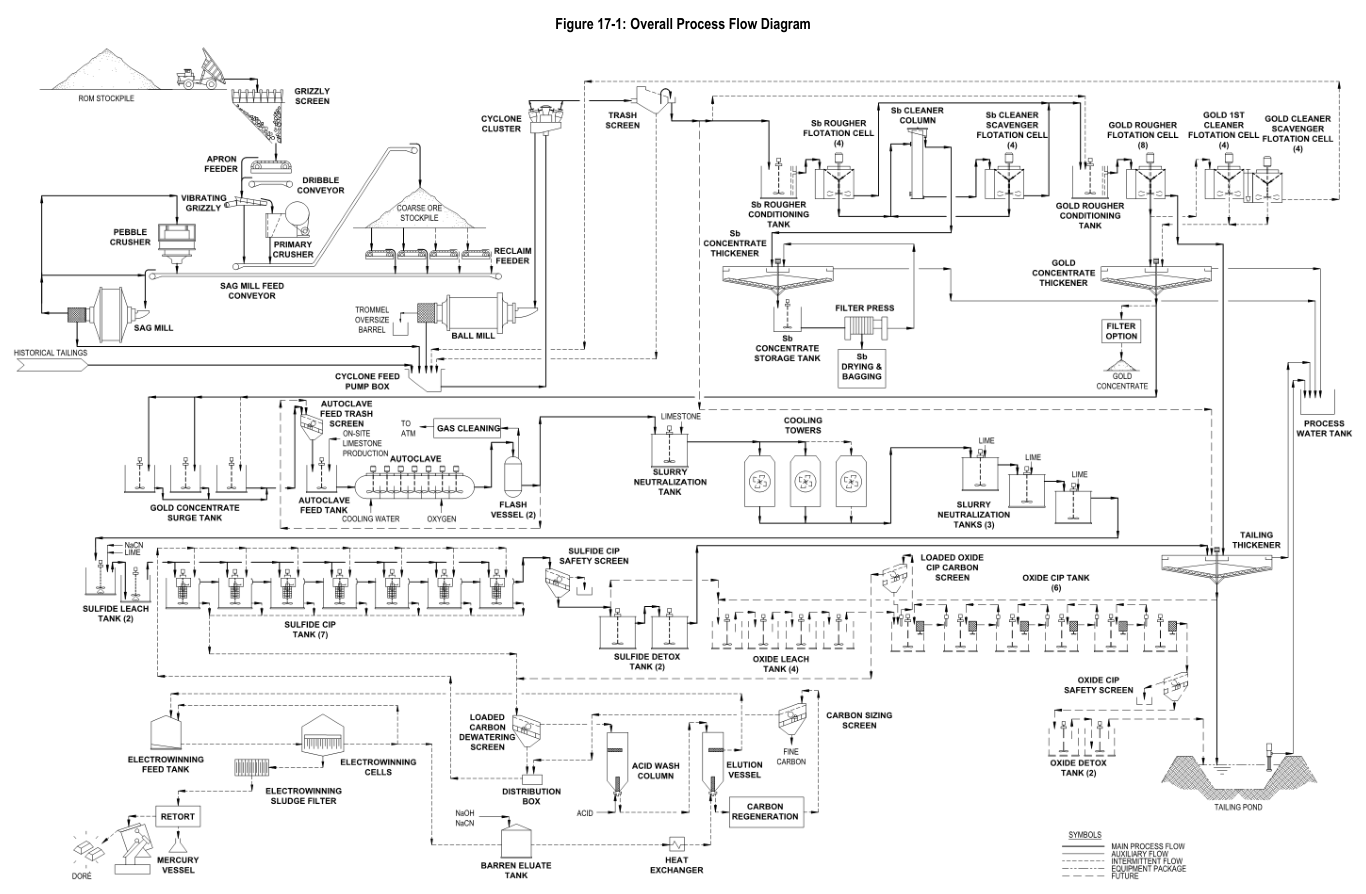
This article describes the processing route designed for the Stibnite Gold Project based on laboratory testing, historical data, and conceptual engineering.
Report context
The Stibnite Gold Project is located in Idaho and is the subject of a feasibility study technical report with an effective date of December 22, 2020. The report describes a process plant designed to treat 8.05 million tons per year (1,021 short tons per hour) at 90% design availability, processing sulfide and oxide mineralized material from three deposits (Hangar Flats, Yellow Pine, and West End) as well as Historical Tailings from former milling operations.
Processing route
Overview of the Flowsheet
The design processing route comprises crushing and grinding, followed by flotation to recover an antimony concentrate of stibnite (with some silver and minor gold) and a gold-bearing sulfide concentrate of pyrite and arsenopyrite. The sulfide concentrate is processed using pressure oxidation (POX) to enable gold and silver to be leached and recovered to doré bars. Small quantities of elemental mercury are collected in flasks. Historical Tailings are introduced into the ball mill during the first 3-4 years of operation. Tailings are deposited in a geomembrane-lined tailings storage facility (TSF).
Crushing and Stockpile
Haul trucks with 150-ton capacity transport mined material to the primary crusher pad. Mill feed is either dumped directly into the primary crusher feed hopper or onto one of four 100,000-ton ROM stockpiles that allow blending to control sulfide or carbonate concentrations. The crushing circuit design is based on a 24-hour per day, 365-day year operation at an average utilization of 75%, yielding an instantaneous design throughput of 1,225 stph. The stockpile is designed with 12 hours of live capacity (11,023 st) and total capacity of approximately 40 hours (44,500 st). Four feeders are provided for material reclaim to the milling circuit.
Grinding
The SAG mill feed conveyor delivers reclaimed material at an instantaneous design throughput of 1,021 stph based on 90% availability. The grinding circuit includes one SAG mill with a discharge trommel, one pebble crusher, one ball mill, and a cyclone cluster. Trommel screen oversize returns to the SAG mill feed conveyor after crushing. When Historical Tailings are processed, slurry from the tailings repulping plant flows into the cyclone feed pump box. Cyclone parameters are set to achieve a target size of 80% passing 75 microns at 33% solids.
Flotation
Two flotation circuits are included: one produces an antimony concentrate, and the other produces a gold-rich sulfide concentrate. Ore deliveries high in antimony are processed by the antimony circuit first, then proceed to the sulfide flotation circuit. Low-antimony mill feed bypasses the antimony circuit.
The antimony rougher operation includes one bank of four flotation tank cells with total retention time of 4 minutes (2 times the lab retention time, assuming 15% volume occupied by air bubbles). The antimony concentrate is sampled, thickened in a 25-ft diameter thickener, filtered, dried, stored, and bagged for shipment.
Gold flotation feed comes from combined antimony rougher and antimony cleaner-scavenger tailings when treating high antimony ore, or directly from ball mill cyclone overflow for low-antimony ore. The gold rougher operation includes one bank of seven flotation tank cells with total retention time of 90 minutes (2.5 times lab retention time). A gold cleaning-scavenging circuit with eight flotation tank cells (total retention time 75 minutes) is used when the sulfur grade of the rougher concentrate is less than 6.5%.
Pressure Oxidation of Gold Concentrate
The POX circuit implements the in-situ acid neutralization (ISAN) process. Underflow from the gold concentrate thickener is pumped through a trash screen to three concentrate surge tanks providing approximately 36 hours of live storage. Limestone slurry is added to attain a carbonate-to-sulfide ratio of approximately 1.25:1. Gold concentrate slurry at a target sulfide sulfur grade of 6.5% is pumped into the autoclave at high pressure.
The autoclave is designed to operate at 428 °F (220 °C) and 622 psig (4,289 kPag) with nominal retention time of 75 minutes. The autoclave design is based on a sulfide sulfur feed rate of 11.54 stph, requiring 21.6 stph of pure oxygen (26.7 stph at 95% purity, 85% utilization). Live reactor volume is 22,425 ft³ with total volume of 27,722 ft³. Oxygen utilization used in design was 85%.
Leaching, Recovery, and Detoxification
Neutralized POX discharge is leached with cyanide in two leach tanks in series providing 3 hours residence time each. Pulp then flows to seven Kemix pump-cell CIP tanks in series in a carousel arrangement. The detoxification circuit is designed to reduce cyanide concentrations to less than 50 ppm WAD cyanide before pumping to the TSF.
Leaching of Oxides or Flotation Tailings
A tailings/oxide leaching and CIP recovery circuit is planned for construction in Year 6 to be operational in Year 7. When processing transition mill feed, pulp from the sulfide CIP circuit is combined with conditioned flotation tailings. When processing oxide material, slurry from the grinding circuit is directed to the tailings thickener. Aggregate retention time is approximately 12 hours between leach and CIP tanks.
Historical Tailings Reprocessing
Approximately 3 million tons of Historical Tailings are planned for reprocessing within the first 4 years of operation at an instantaneous throughput of 124 stph with 75% availability. Historical Tailings are expected to average 0.03 oz/st gold and 0.3% sulfur, with typical particle size of 80% passing 180 microns.
Reagents
Limestone from the Middle Marble formation would be mined from the West End pit, crushed, screened, and ground to make limestone slurry for acid neutralization during POX. A coarse fraction would be feed for a vertical lime kiln. Estimated reagent consumption rates were based on metallurgical testing results for each deposit type.
Tailings Handling System
The design basis involves pumping approximately 6,000 gallons per minute of tailings at 55% solids with specific gravity of 1.53, a vertical distance of 400 ft (starter dam) to 630 ft (final dam), and horizontal distance of approximately 11,520 ft (starter dam) to 10,830 ft (final dam). Six horizontal centrifugal pumps connected in series lift tailings to the starter dam crest. HDPE-lined carbon steel pipe 24 inches in diameter is selected for the tailings pipeline.
Key reported parameters
| Parameter | Value | Basis |
|---|---|---|
| Plant throughput | 8.05 million tons/year (1,021 stph) | Design |
| Plant availability | 90% | Design |
| Crusher utilization | 75% | Design |
| Grinding target size | 80% passing 75 microns at 33% solids | Design |
| Antimony rougher retention time | 4 minutes (2x lab) | Design |
| Gold rougher retention time | 90 minutes (2.5x lab) | Design |
| Sulfide sulfur in gold concentrate (target) | 6.5% | Testwork-based design |
| Autoclave temperature | 428 °F (220 °C) | Design |
| Autoclave pressure | 622 psig (4,289 kPag) | Design |
| Autoclave retention time | 75 minutes | Design |
| Sulfide sulfur feed rate to autoclave | 11.54 stph | Design |
| Oxygen consumption | 1.87 tons O₂ per ton sulfide sulfur | Stoichiometric |
| Oxygen purity (supply) | 95% | Design |
| Oxygen utilization | 85% | Design assumption |
| Carbonate-to-sulfide ratio | 1.25:1 | Design |
| Leach tanks retention time (sulfide) | 3 hours each (two tanks) | Design |
| WAD cyanide limit (tailings discharge) | <50 ppm | Design target (ICMI guidance) |
| Historical Tailings throughput | 124 stph | Design |
| Historical Tailings availability | 75% | Design |
| Historical Tailings gold grade | 0.03 oz/st | Historical data |
| Historical Tailings sulfur grade | 0.3% | Historical data |
| Historical Tailings particle size | 80% passing 180 microns | Historical data |
| Tailings slurry flow | ~6,000 gpm at 55% solids, SG 1.53 | Design |
| Tailings pipeline diameter | 24 inches HDPE-lined carbon steel | Design |
Project website: https://perpetuaresources.com/project/
Project website: https://www.investors.perpetuaresources.com/feasibility-study
Technical qualifications
The process design criteria were developed from multiple sources including: the PEA (SRK, 2012), the PFS (M3, 2014), client-provided historical data from prior owners and operators, metallurgical testing conducted primarily by SGS Minerals Inc. and AuTec Innovative Extractive Solutions Ltd. (directed and supervised by Blue Coast Metallurgy and Hydromet (Pty) Ltd.), vendor data or recommendations, and industry practice.
Metallurgical testing indicates that approximately 6.5% sulfide sulfur is adequate for autothermic pressure oxidation of gold concentrates.
On average, 16% of material would be processed through the antimony recovery circuit. Approximately 2.6% of material is oxide and responds well to conventional cyanidation but poorly to flotation. An additional 25.2% is characterized as transition material yielding variable gold recoveries by both flotation and conventional cyanidation. The remaining 72.2% is considered refractory to direct leaching but responds well to concentration by flotation followed by pressure oxidation.
The mine schedule indicates that gold, sulfur, and calcium concentrations within the Project deposits are highly variable. After year six, the blend trends toward lower gold and sulfur but higher calcium concentrations.
Source: Stibnite Gold Project , 2020 Feasibility Study Technical Report, Sections 17 and 18, effective date December 22, 2020.
