

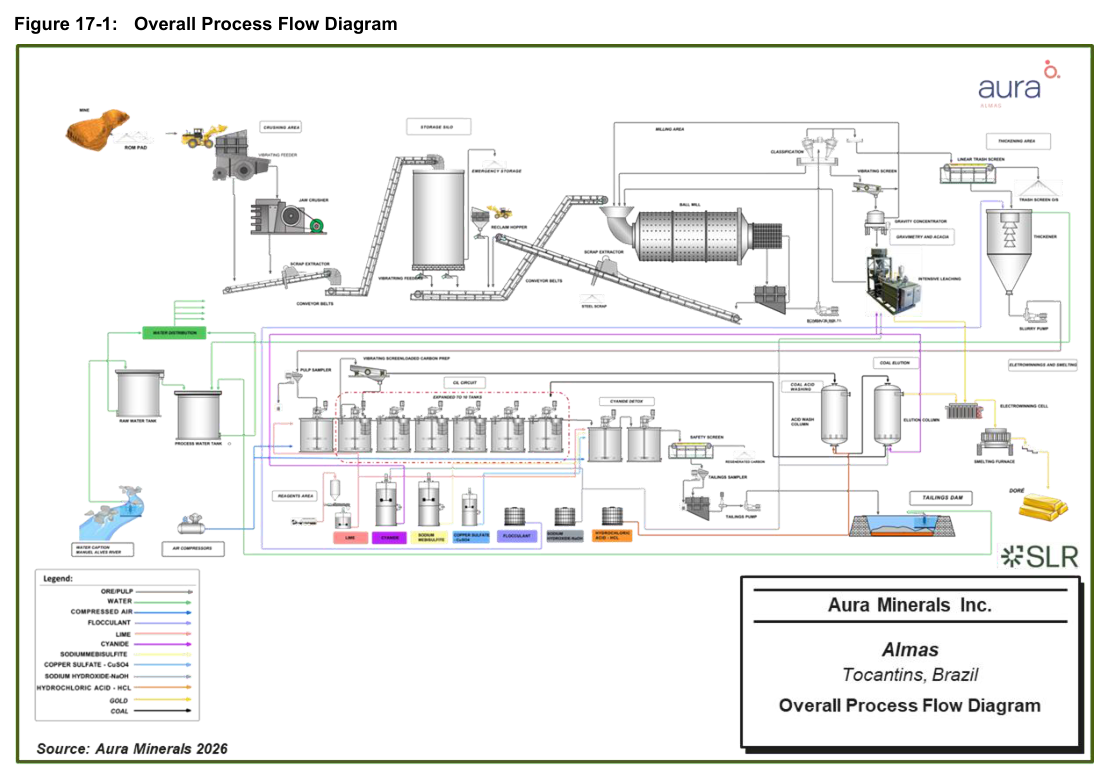
The recovery methods at the Almas gold project in Brazil use a conventional flowsheet of crushing, grinding, gravity concentration, and cyanide leaching. A recent expansion to eleven leach tanks has restored recovery near design levels, and a further expansion targeting 3 Mtpa is in detailed engineering.
The Almas Project, owned and operated by Aura Minerals Inc., is an operating gold mine located in the Tocantins State of Brazil. The project has been in production since June 2023 and is currently in an expansion phase. The process plant was commissioned with an original design throughput of approximately 1.3 Mtpa of run-of-mine (ROM) ore. A series of phased expansions have since lifted throughput, with a Phase 2 expansion completed in December 2025 that brought the plant to a nominal capacity of 2.35 Mtpa. A Phase 3 expansion, currently in detailed engineering, targets a further increase to 3 Mtpa.
Critical Data
| Parameter | Value | Unit | Notes |
|---|---|---|---|
| Nominal Plant Throughput (Original Design) | 5,479 | tpd | Design value |
| Head Grade (Design) | 1.13 | g/t Au | Design value |
| Crushing Plant Availability | 72 | % | Design value |
| Mill Availability | 92 | % | Design value |
| Bond Ball Mill Work Index (BWi) | 10.1 | kWh/t | Test result |
| Primary Grind Size (P80) | 75 | µm | Design value |
| L-CIL Residence Time | 17.4 | h | Design value |
| L-CIL Extraction | 92.5 | % | Design value |
| Gold Recovery (2023) | 90.3 | % | Test result |
| Gold Recovery (2024) | 90.7 | % | Test result |
| Gold Recovery (2025) | 88.5 | % | Test result |
| Pre-leach thickener settling rate | 48.4 | t/d/m² | Design value |
| Detox Residence Time | 101 | minutes | Design value |
| Phase 3 Target Throughput | 3 | Mtpa | Design value |
| Phase 3 Crushing Capacity | 4.0 | Mtpa | Design value |
| Phase 3 Cyclone Circulating Load | 2,583 | t/h | Design value |
| UG Recovery Assumption | 85.17 | % | Engineering estimate |
Overview
The process design is based on test work completed for a 2021 feasibility study and historical testing. The flowsheet selected for that study uses typical industry unit operations for gold processing plants. The original flowsheet includes primary crushing followed by grinding to achieve a particle size distribution of 80% passing 75 µm. Part of the cyclone underflow is processed in a gravity circuit. The cyclone overflow feeds a pre-leach thickener. Thickener underflow is processed through a leach-CIL circuit. CIL tailings are treated for cyanide destruction. Loaded carbon from CIL goes to elution, and the eluate solution goes to electrowinning in the gold room followed by refining.
As part of the Phase 2 Expansion, four additional leach tanks were installed. This modification increased the available leach volume and maintained the residence time required for the higher plant feed rate. Two high-frequency trash screens were installed to replace the linear screen previously used on the cyclone overflow. A secondary hydrocyclone cluster is planned for installation. Under the modified configuration, the cluster is designed to receive the primary cyclone overflow, with underflow directed to the leach circuit and overflow routed to the thickener. These changes are intended to support a nominal plant throughput of 2.35 Mtpa.
Key Process Stages
The process plant has not reached the design throughput of 5,479 tpd. In 2024 the average throughput was 4,300 tpd. The process design gold leach extraction is 92.5%. The operating plant averaged 90.8% gold leach extraction since commissioning in 2023, which is 2% below design. Aura implemented a series of incremental debottlenecking measures to increase plant throughput. Operating data show that as throughput increased above the original 1.3 Mtpa, the effective CIL residence time decreased and overall gold recovery declined.
In August 2023, throughput was increased to approximately 1.5 Mtpa by upgrading the crushing plant conveyor motors. Average overall recovery decreased to about 90.8%. In August 2024, during what is referred to as Expansion Phase 1, throughput was further increased to about 1.8 Mtpa by upgrading the tailings pumping system with higher capacity pumps and a larger pipeline diameter. Average overall recovery decreased to around 89.6%. In April 2025, additional incremental changes, including installation of a dilution line to the pre-leach thickener, upgrading the grinding feed conveyor motor, and upgrading the thickener underflow pump, allowed throughput to reach approximately 2.0 Mtpa. At this rate, the average overall recovery further decreased to about 88.7%.
To restore gold recovery to design levels at higher throughput, Aura developed and implemented an expansion of the leach/CIL circuit. The key elements of Expansion Phase 2, completed in December 2025, were the installation of four additional CIL tanks, increasing the CIL circuit from seven to eleven tanks in series. Existing linear screen on the cyclone overflow was replaced with two high-frequency screens for trash removal to the pre-leach thickener. Provision was made for a second hydrocyclone cluster receiving the primary cyclone overflow, with underflow reporting directly to the CIL circuit and overflow reporting to the thickener. The expanded CIL circuit was engineered to support a nominal throughput of approximately 2.35 Mtpa, restoring an effective leach/CIL residence time comparable to the original 1.3 Mtpa design. Following commissioning of the additional tanks, plant data indicates that overall recovery increased to approximately 92%.
Current detailed engineering work for Expansion Phase 3 is documented in the Phase 3 process design criteria and associated mass balance calculations. The objective of Phase 3 is to increase the sustainable plant capacity from 2.35 Mtpa to 3 Mtpa. Phase 3 includes the detailed engineering and construction of a new crushing plant with a nominal design capacity of 4.0 Mtpa ROM, intended to serve both the 3 Mtpa Phase 3 case and the conceptual 4.0 Mtpa Phase 4 case. The new crushing facility comprises a ROM feed hopper and truck dump with fixed grizzly and rock breaker, a vibrating grizzly feeder, a primary jaw crusher, a double-deck inclined vibrating screen, a secondary cone crusher, and a conical crushed ore stockpile with reclaim tunnel and three vibrating feeders.
Although the new crushing plant is designed for a nominal capacity of 4.0 Mtpa, the overall plant throughput in Phase 3 is constrained to 3 Mtpa by the capacities of the grinding and CIL circuits. The additional crushing capacity is a strategic provision for the potential Phase 4 expansion.
Additional Interesting Data and Summary
Internal technical documentation considers a scenario in which the plant is operated at throughputs of approximately 3.0 Mtpa. Based on the documented trend of decreasing recovery as throughput increased from 1.3 Mtpa to 2.0 Mtpa without additional CIL volume, it is reasonable to expect overall gold recovery at approximately 89% if the plant operates in the order of 3.0 Mtpa without a thermal carbon regeneration plant and without additional CIL volume. This expectation shows reduced effective CIL residence time at higher throughput, progressive carbon fouling in the absence of regeneration, and higher dissolved gold concentrations in solution across the CIL train.
The Phase 3 technical note indicates that installation of a thermal carbon regeneration furnace could significantly improve carbon activity. Under such improved conditions, it is technically plausible that overall recoveries at approximately 3.0 Mtpa could approach the low 90s. For the purposes of this technical report, 3.0 Mtpa operation with thermal regeneration should be regarded as a potential upside case until sufficient operating data are available to confirm sustained performance at that throughput.
The qualified person notes that underground material has not yet been the subject of a dedicated metallurgical test work program. All existing comminution parameters used in the current process design were developed from near surface open pit samples. For planning purposes, Aura applies an assumed gold recovery of approximately 85.17% for UG material. This figure is intended to be conservative. The QP considers it appropriate to declare Mineral Reserves that include UG material using this conservative recovery assumption so long as Aura commits to undertaking dedicated UG metallurgical test work in advance of UG production.
Key Processes
- Primary crushing via a mobile jaw crusher fed by a vibrating grizzly, with crushed material conveyed to a surge bin providing 1.6 hours of live storage.
- Single-stage SAG mill in closed circuit with hydrocyclones, with a SAG mill feed size F80 of 85 mm and product size P80 of 75 µm.
- Gravity concentration circuit using one semi-batch centrifugal concentrator fed from a portion of the cyclone underflow.
- Intensive leach reactor for gravity concentrate using a heated mixture of NaCN, NaOH, and LeachAid.
- Pre-leach thickening to increase solids concentration to 50% w/w ahead of leaching.
- Leach and adsorption circuit with one leach tank and ten CIL tanks providing 17.4 hours total residence time.
- Cyanide destruction using the SO2/air method with two tanks reducing CNWAD from 150 mg/L to less than 2.0 mg/L.
- Zadra elution for gold stripping operating at 140°C and four to six bar pressure.
- Electrowinning and smelting to produce doré bars in a secure gold room.
Source: NI 43-101 Technical Report, Almas Project, Tocantins State, Brazil, December 31, 2025. Project website: Almas Project
