

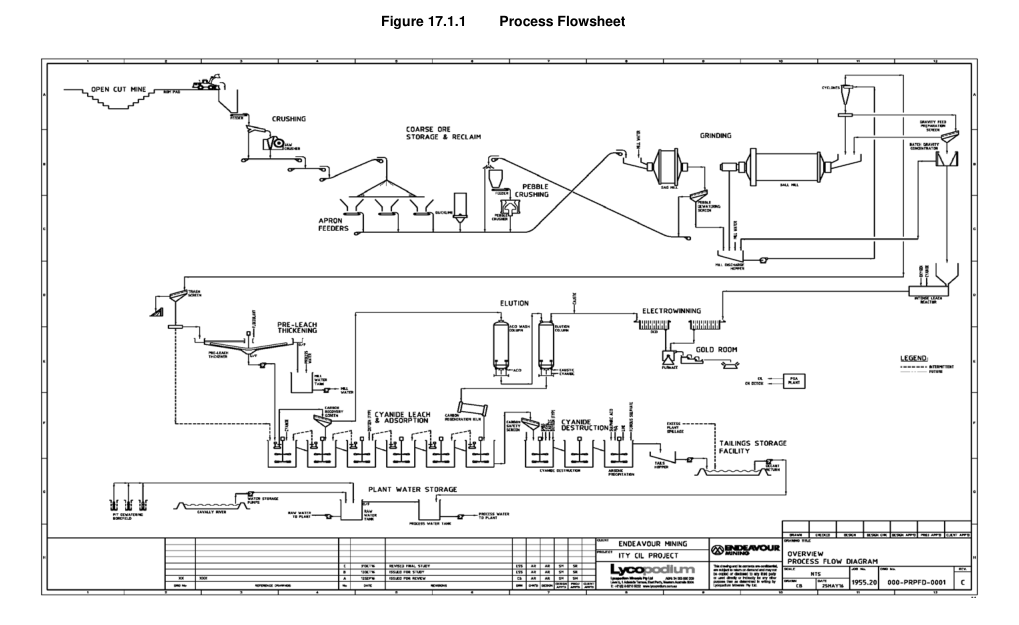
The Amapá Project in Amapá State, Brazil, employs a conventional crushing, grinding, and carbon-in-leach processing plant. The design throughput is between 3.5 and 3.6 million tonnes of ore per year, targeting approximately 1.01 million ounces of gold over the Life of Mine, with an assumed average metallurgical recovery of 89.7%.
The Amapá Project is owned by Amapá Minerals Holdings Inc. and is located in Amapá State, Brazil. The project targets gold mineralization and is in the preliminary assessment stage, as detailed in the NI 43-101 Technical Report dated January 31, 2026. The process facility at the project is designed around a conventional gold processing flowsheet that includes crushing, grinding, and carbon-in-leach (CIL) processing. The plant was designed to treat ore mined from open pit operations and to recover gold through cyanide leaching processes. Expected construction timing is not stated in the Recovery Methods section.
Critical Data
| Parameter | Value | Unit | Notes |
|---|---|---|---|
| Plant throughput (design) | 3.5 to 3.6 | Mt/y | Depending on ore hardness and operating conditions |
| Life of Mine ore processed | ~31.7 | Mt | Over operating life of project |
| Life of Mine gold production | ~1.01 | Moz | Based on planned throughput and recovery assumptions |
| Average metallurgical recovery | ~89.7 | % | Assumed in production forecast |
| Target grind size | P80 ≈ 75 | µm | Provides gold liberation prior to leaching |
| Process water consumption | ~300 | m³/h | Sourced from Igarapé William and pit dewatering systems |
| Lime consumption | ~1.4 | kg/t ore | Hydrated lime for pH control |
| Grinding media consumption | ~0.65 | kg/t ore | Steel balls for SAG and ball mills |
| Electrical power sustained load | ~10 | MW | Supplied from hybrid system |
| Electrical power total available capacity | 20 | MVA | Hybrid system: grid connection and on-site UTE |
| Grid connection contracted | 10.5 | MVA | Equatorial concession; 9.0 MVA available |
| On-site UTE installed | 16 | MVA | Tecnogera; 11 MVA available |
| Detoxification process | Not stated | Not applicable | SO₂/Air (INCO process) mentioned in source text |
| Tailings storage | Not stated | Not applicable | Slurry pumped to tailings storage facility |
| Ore types | Not stated | Not applicable | Oxide and fresh rock encountered in deposits |
Overview
The processing plant at the Amapá Project uses conventional gold processing technology that is widely used in similar gold mining operations. The major stages of the process flowsheet are primary crushing, grinding and classification, cyanide leaching, CIL, gold recovery through electrowinning, and doré smelting. The flowsheet was designed to recover gold from both oxide and fresh rock ore types that are encountered in the Amapá Project deposits.
Key Process Stages
The process description begins with run-of-mine ore delivered from the open pits. The ore is first discharged into a ROM stockpile located near the processing plant. From the stockpile, the ore is reclaimed and fed to the primary crushing circuit, where the material is reduced in size to prepare it for downstream grinding operations. Crushed material is then transferred to the grinding circuit via conveyor systems. Equipment specifications for this stage are provided in Table 38 of Chapter 13.
The grinding circuit is designed to liberate gold particles from the host rock through size reduction. The circuit consists of a semi-autogenous grinding mill, a ball mill, and hydrocyclone classification. The grinding circuit operates in closed circuit with the hydrocyclones to achieve the desired grind size. The target grind size is approximately P80 of 75 micrometres, which provides adequate liberation of gold prior to leaching.
Following grinding, the slurry is directed to the leaching circuit. Gold extraction is achieved through cyanide leaching in the CIL circuit. In this process, cyanide solution dissolves gold from the ore, and activated carbon adsorbs the dissolved gold from the slurry. The CIL circuit consists of a series of mechanically agitated tanks that are designed to provide sufficient residence time for gold dissolution and adsorption onto the activated carbon. Loaded carbon is periodically removed from the circuit and transferred to the carbon stripping circuit. Equipment specifications are provided in Tables 38 and 39 of Chapter 13.
Gold adsorbed onto the activated carbon is recovered through a carbon stripping process. Loaded carbon is transferred to the stripping circuit, where gold is desorbed using a hot caustic cyanide solution using the Zadra process. The resulting gold-rich solution is then processed through electrowinning cells, where gold is plated onto cathodes. The cathode sludge is collected, filtered, and dried before being smelted in a furnace to produce gold doré bars. The doré bars are shipped to specialised refineries for final refining.
Tailings generated from the CIL circuit are treated in a cyanide detoxification circuit prior to discharge to the tailings storage facility. The detoxification process uses SO₂ and air in the INCO process to reduce residual cyanide concentrations in the tailings slurry to environmentally acceptable levels. Following detoxification, the slurry is pumped to the tailings storage facility for final disposal. Water recovered from the tailings facility is recycled back to the processing plant to reduce overall water consumption.
Additional Interesting Data and Summary
The metallurgical recovery assumptions used in the production forecast are based on historical plant performance and metallurgical testwork conducted on representative ore samples, as described in detail in Chapter 13. The average gold recovery assumed for the project is approximately 89.7 percent. This recovery factor has been applied to the contained gold within the processed ore to estimate recoverable gold production. Recovery may vary depending on ore characteristics, including the proportion of oxide and fresh rock material processed during different periods of the mine life.
The Life of Mine production forecast indicates total gold production of approximately 1.01 million ounces of gold over the operating life of the project. Annual gold production will vary depending on the grade of ore delivered to the processing plant during different stages of the mine plan, as shown in the LOM production schedule in Table 70.
The CIL processing plant requires several principal inputs. Electrical power is needed at approximately 10 MW sustained load, supplied from a hybrid system with a total available capacity of 20 MVA. This includes the Equatorial concession grid connection with 10.5 MVA contracted and 9.0 MVA available, and the on-site UTE from Tecnogera with 16 MVA installed and 11 MVA available. Process water is sourced primarily from the Igarapé William and pit dewatering systems, with water consumption at approximately 300 cubic metres per hour. The water right, identified as Outorga No. 012/2016, is subject to renewal as noted in Section 20. Hydrated lime is used for pH control at approximately 1.4 kg per tonne of ore. Supplemental oxygen is injected into leach tanks for enhanced gold dissolution. Grinding media consisting of steel balls for SAG and ball mills is consumed at approximately 0.65 kg per tonne of ore. All process materials are commercially available and sourced through established supply chains.
Key Processes
- Primary crushing of reclaimed ROM ore
- SAG mill and ball mill grinding with hydrocyclone classification in closed circuit
- Cyanide leaching and carbon-in-leach with mechanically agitated tanks
- Carbon stripping using the Zadra process with hot caustic cyanide solution
- Electrowinning to plate gold onto cathodes
- Cathode sludge filtration and drying followed by doré smelting
- Tailings detoxification using the SO₂/Air INCO process
- Water recovery and recycling from the tailings facility
Source: Amapá Project NI 43-101 Technical Report, January 31, 2026. Project website: Amapá Project
