

A two-phase recovery strategy uses flotation concentration at the Quebec mine site followed by acid baking and hydrometallurgical refining in Saguenay to produce a mixed‑rare earth carbonate product.
The Ashram Rare Earths Project is a rare earth element project located in Nunavik, Quebec, Canada. The project is owned by Mont Royal Resources Limited. The preliminary economic assessment (PEA) technical report is effective 29 May 2026. The project is not yet in operation. The development includes a mineral processing facility (concentrator) at the mine site and a separate hydrometallurgical processing facility (Hydromet) located in Saguenay. The concentrator is designed to process run‑of‑mine mineralised material at 1.88% average rare earth oxide (REO) grade.
Critical Data
| Parameter | Value | Unit | Notes |
|---|---|---|---|
| Total processing rate | 1,788,500 | dry tonnes per year | Design value |
| Nominal processing rate | 4,900 | dry tonnes per day | Design value |
| Feed material grade | 1.88 | % REO | Design value |
| Concentrator operating time | 92.0 | % | Design value; crushing circuit is 66.7% |
| Concentrate recovery | 63.2 | % REO | Design value based on flotation testing |
| Concentrate grade | 30.5 | % REO | Design value |
| Concentrator installed power | 14.8 | MW | Design value |
| Concentrator operational power | 12.6 | MW | Design value |
| Hydromet flotation concentrate feed | 69,505 | dry metric tonnes per annum | Design capacity |
| Hydromet MREC product | 33,849 | dry metric tonnes per annum | Design capacity |
| Hydromet operating factor | 90.4 | % | Design value |
| Hydromet electrical power | 1,930 | kW | Estimated value |
| Hydromet natural gas | 43 | GJ/hr | Estimated value |
| Construction timing | Not stated | Not applicable | Not stated |
Overview
The recovery method for the Ashram Project is a two‑stage process. A mineral processing facility at the mine site, located just north of the open pit, crushes, grinds, and floats the ore to produce a rare earth concentrate. That concentrate is then shipped south to a hydrometallurgical plant in Saguenay. The hydrometallurgical plant uses acid baking, water leaching, solvent extraction for thorium removal, oxalate precipitation, and metathesis to produce a mixed‑rare earth carbonate product (MREC). The concentrator is designed to produce an average of 190 tonnes per day of concentrate at around 30% REO, with the grade varying from 28% to 34% with feed grade.
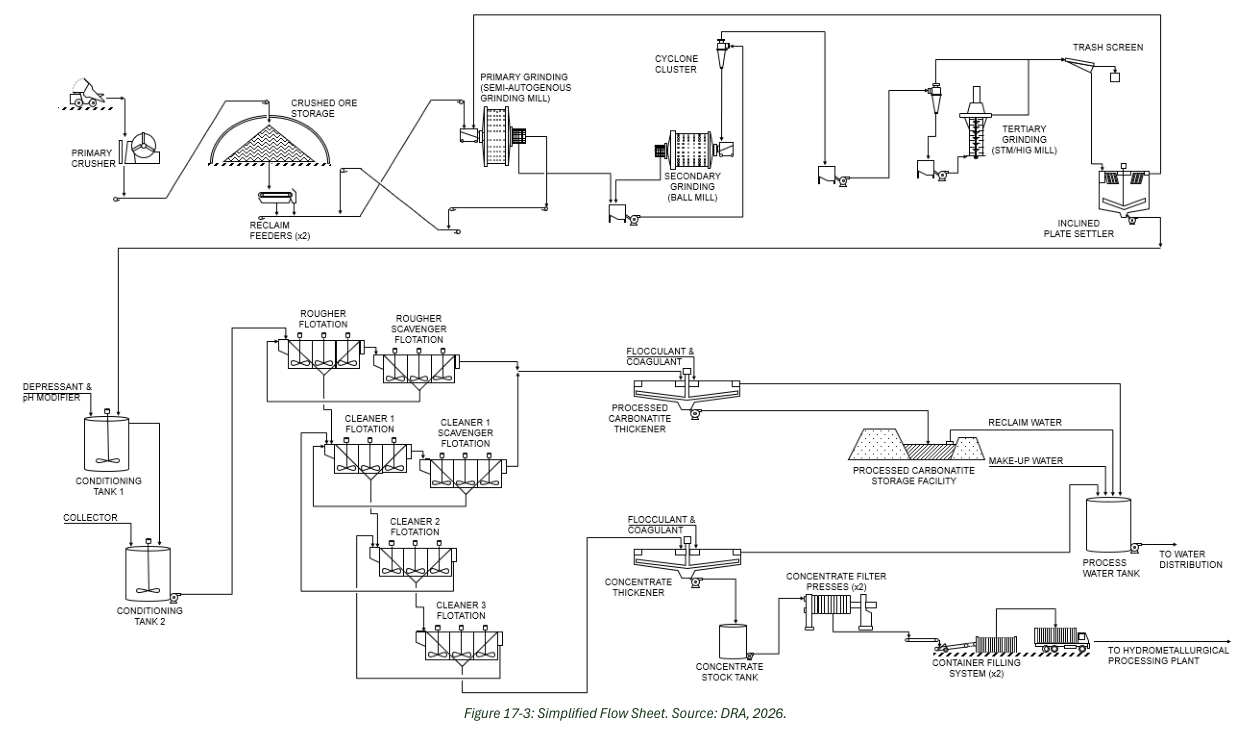
The mineral processing facility’s four main areas are crushing, grinding, flotation, and dewatering. The crushing circuit operates independently from the rest of the concentrator, decoupled by a stockpile. The concentrator operates 24 hours per day, 7 days per week, 52 weeks per year, with an effective operating time of 92%. The crushing circuit has a design operating time of 66.7%.
The hydrometallurgical plant is designed to process 69,505 dry metric tonnes per annum of flotation concentrate and produce 33,849 dry metric tonnes per annum of MREC. The plant operates 330 days per year, 24 hours per day, with an operating factor of 90.4%. The overall hydrometallurgical process recovers rare earth elements at rates ranging from 72.4% for scandium to 90.8% for praseodymium and neodymium, based on the heat and material balance.
Key Process Stages
Mineral Processing Facility (Concentrator)
The crushing area starts with run‑of‑mine material dumped into a ROM feed bin. A static grizzly and fixed rock breaker provide top‑size control. An apron feeder delivers material to a jaw crusher designed to produce a product with P₈₀ of 110 mm. Primary crushed material is conveyed to a covered stockpile.
Two reclaim feeders withdraw crushed material for the grinding circuit. A semi‑autogenous grinding (SAG) mill operates in closed circuit with a trommel screen. The SAG mill is designed to produce a transfer size around 80% passing 1.20 mm. A ball mill in closed circuit with cyclones provides further grinding. Tertiary grinding uses a HIGmill to achieve a P₈₀ of 25 μm. The circuit includes trash screens to remove debris and an inclined plate settler to increase solids density to 50% by weight ahead of flotation.
The flotation circuit uses two conditioning tanks with depressant, pH modifier, and collector before flotation. The circuit consists of rougher, rougher scavenger, three stages of cleaner flotation, and a first‑cleaner scavenger. Flotation feed grade averages 1.88% REO. The flotation circuit tailings grade averages 0.72% REO. The concentrate grade averages 30.5% REO with a recovery of 63.2%. The flotation circuit and dewatering circuits were designed considering the range of anticipated feed grades.
Concentrate dewatering uses a high‑rate thickener with coagulant and flocculant to achieve 65% solids underflow. Two plate‑and‑frame filter presses produce a filter cake. The cake is discharged onto feeders and telescopic conveyors to fill 20‑foot shipping containers, each loaded with around 20 tonnes of concentrate. Containers are stored or loaded directly for shipment south. Tailings from flotation are thickened to 65% solids and pumped to the processed carbonatite storage facility.
Hydrometallurgical Plant (Hydromet)
Area 100 – Pre‑Leach conditions the flotation concentrate by removing acid‑consuming gangue minerals. Barren acidic solution from the oxalate precipitation area is reacted with concentrate in a cascade of three agitated tanks. The reaction completes during thickening. Pre‑leached concentrate is dewatered in a filter press and dried in a rotary dryer to 4% residual moisture. The leach solution goes to effluent treatment.
Area 200 – Acid Bake and Water Leach converts rare earth minerals to water‑leachable sulphate salts. Pre‑leached concentrate is mixed with hot, concentrated sulphuric acid at a 0.56 tonnes acid per tonne solids ratio in a pug mill. The mixture feeds a multi‑zone rotary calciner with 120‑minute residence time and 320°C discharge temperature. The calcined solids are cooled and mixed with water in three agitated tanks to dissolve rare earth sulphates. The slurry is concentrated by decanter centrifuge and filtered on a vacuum belt filter. The residue goes to effluent treatment. The pregnant leach solution is polished in candle filters before thorium recovery.
Area 300 – Thorium Recovery removes thorium from the pregnant leach solution. A battery of six mixer‑settlers uses 30% v/v Cyanex 923 in D80 kerosene at a 1:1 organic‑to‑aqueous ratio. All thorium is extracted along with minor niobium and titanium. The thorium‑free PLS goes to oxalate precipitation. The loaded organic is stripped with oxalic acid in three agitated tanks. A three‑phase separator decants the stripped organic for recycle and sends the aqueous thorium oxalate slurry to effluent treatment.
Area 400 – Oxalate Precipitation selectively recovers rare earths. Thorium‑free PLS reacts with solid oxalic acid and recycled sodium oxalate solution in three agitated tanks. The resulting rare earth oxalates are filtered and washed on two vacuum belt filters. The barren solution returns to the pre‑leach area.
Area 500 – Metathesis converts mixed rare earth oxalates to mixed‑rare earth carbonate product. Rare earth oxalates react with sodium carbonate solution at 90°C in four agitated tanks with hydrocyclones for partial dewatering between stages. The MREC product is filtered on a vacuum belt filter and dried in an indirect rotary dryer to 0.1% residual moisture. The MREC is then packaged and distributed.
Area 600 – Effluent Treatment processes all process effluents. Thorium oxalate residue is thickened and centrifuged to a waste paste. Barren solutions and residues are neutralised to pH 8 with quicklime in three agitated tanks, followed by thickening and filter pressing. The solid is disposed of as tailings.
Area 700 – Plant Scrubbing treats the sulphuric acid recovery vent. The vent gas, containing sulphuric acid vapour, hydrofluoric acid, carbon dioxide, and water vapour, is neutralised with slaked lime in a flue gas desulphurisation scrubber.
Area 800 – Reagents and Utilities stores and distributes major reagents. Sulphuric acid (93 wt%) is delivered by railcar. Oxalic acid is supplied in bulk containers and dissolved on site. Sodium carbonate is delivered by truck or rail and stored in a silo. Quicklime is pneumatically conveyed and slaked on site. Solvent extraction reagents are delivered by truck in isotainers. Fresh water is stored in an insulated tank. Fire water shares the same tank with priority outlets. Potable water is produced from fresh water using softening, chemical dosing, and filtration. Cooling water is generated by evaporative cooling towers at approximately 20°C. Compressed plant air and instrument air are supplied by dedicated compressor systems.
Additional Interesting Data and Summary
The concentrator equipment design factor for crushing equipment is 25%. The design factor for the remaining concentrator is 15%. Major equipment includes a 6.4m diameter SAG mill with 2,000 kW installed power, a 4.6m diameter ball mill with 2,000 kW, and a HIGmill 2300/15000 with 2,300 kW. Rougher flotation uses six 100m³ mechanical cells. The overall rare earth element recovery for the hydrometallurgical plant varies by element, with praseodymium and neodymium achieving 90.8% and cerium achieving 83.1% based on the heat and material balance. The mineral processing facility is designed to achieve 63.2% average REO recovery based on flotation testing. The hydrometallurgical process design criteria is preliminary economic assessment level. The core section has matured to pre‑feasibility level, but additional work is required for full process design criteria to reach that level.
Key Processes
- Crushing: ROM feed through jaw crusher to covered stockpile (P₈₀ 110 mm)
- Grinding: SAG mill, ball mill, and HIGmill tertiary grinding (P₈₀ 25 μm)
- Flotation: Rougher, rougher scavenger, three cleaner stages, and first‑cleaner scavenger
- Flotation reagents: Sulphuric acid (pH modifier), dispersant, depressant, collector, frother
- Concentrate dewatering: Thickener to 65% solids, plate‑and‑frame filter press, container loading
- Tailings dewatering: Thickener to 65% solids, pumped to storage facility
- Hydromet pre‑leach: Acidic leach to remove gangue, dewatering, drying
- Hydromet acid bake: Pug mill with sulphuric acid, rotary calciner at 320°C
- Hydromet water leach: Dissolution of rare earth sulphates, centrifugation, belt filtration
- Thorium removal: Six‑stage solvent extraction with Cyanex 923
- REE oxalate precipitation: Three agitated tanks with oxalic acid, belt filtration
- Metathesis: Sodium carbonate conversion at 90°C, belt filtration, drying
- Effluent treatment: Neutralisation to pH 8 with quicklime, thickening, filter pressing
- Off‑gas scrubbing: Flue gas desulphurisation with slaked lime
- Reagents handling: Rail, truck, and container delivery; on‑site dissolution and storage
Source: Preliminary Economic Assessment for the Ashram Rare Earths Project, 2026-05-29. Project website: Ashram Rare Earths Project
