

The Diablillos silver-gold project, located in Argentina and owned by AbraSilver Resource Corp., is a mineral resource development project targeting silver and gold. The project is not yet in operation. Its processing plant is designed with a daily capacity of 9,000 metric tons of material, based on a throughput stipulation by AbraSilver. The plant design assumes 350 operating days per year, for a yearly throughput of 3.15 million metric tons. Construction timing is not stated in the provided source material. The recovery methods described in this article are drawn from a technical report prepared for AbraSilver.
Critical Data
| Parameter | Value | Unit | Notes |
|---|---|---|---|
| Daily throughput | 9,000 | mtpd | Design value |
| Annual throughput | 3,150,000 | mtpy | Based on 350 operating days per year |
| Average head grade, Au (Oculto) | 0.88 | ppm | Resource model |
| Average head grade, Ag (Oculto) | 74 | ppm | Resource model |
| Average head grade, Au (JAC) | 0.13 | ppm | Resource model |
| Average head grade, Ag (JAC) | 202 | ppm | Resource model |
| Final grind size | 150 | micron | P80, design specification |
| Leach retention time | 36 | hr | Design specification |
| Gold recovery (Oculto) | 83.0 | % | Design value based on laboratory testing |
| Silver recovery (Oculto) | 79.8 | % | Design value based on laboratory testing |
| Gold recovery (JAC) | 83.8 | % | Design value based on laboratory testing |
| Silver recovery (JAC) | 84.9 | % | Design value based on laboratory testing |
| CCD stages (Oculto) | 6 | Not applicable | Design specification |
| CCD stages (JAC) | 7 | Not applicable | Design specification |
| Merrill-Crowe gold recovery | 99.5 | % | Expected recovery from test work |
| Merrill-Crowe silver recovery | 98.5 | % | Expected recovery from test work |
| Total power requirement | 20 | MW | Estimated from mine site |
| Sodium cyanide consumption (Oculto) | 0.83 | kg/mt | Design consumption |
| Sodium cyanide consumption (JAC) | 1.79 | kg/mt | Design consumption |
| Lime consumption (Oculto) | 0.93 | kg/mt | Design consumption |
| Lime consumption (JAC) | 2.19 | kg/mt | Design consumption |
| Raw water requirement | 184 | mtph | Design value |
Overview
The Diablillos deposit contains gold and silver mineralized material that laboratory test work has shown can be economically recovered through cyanidation. The process flowsheet combines centrifugal gravity concentration with the Merrill-Crowe zinc precipitation process. Metallurgical test work was conducted primarily on Oculto material in 2022. JAC material, representing about 15% of the total resource, was tested in 2023 and shows somewhat different metallurgical performance. The process design criteria and flowsheet address both ore types. When JAC material is processed alone, certain circuit adjustments are required, including seven stages of counter current decantation instead of six and larger thickener diameters.
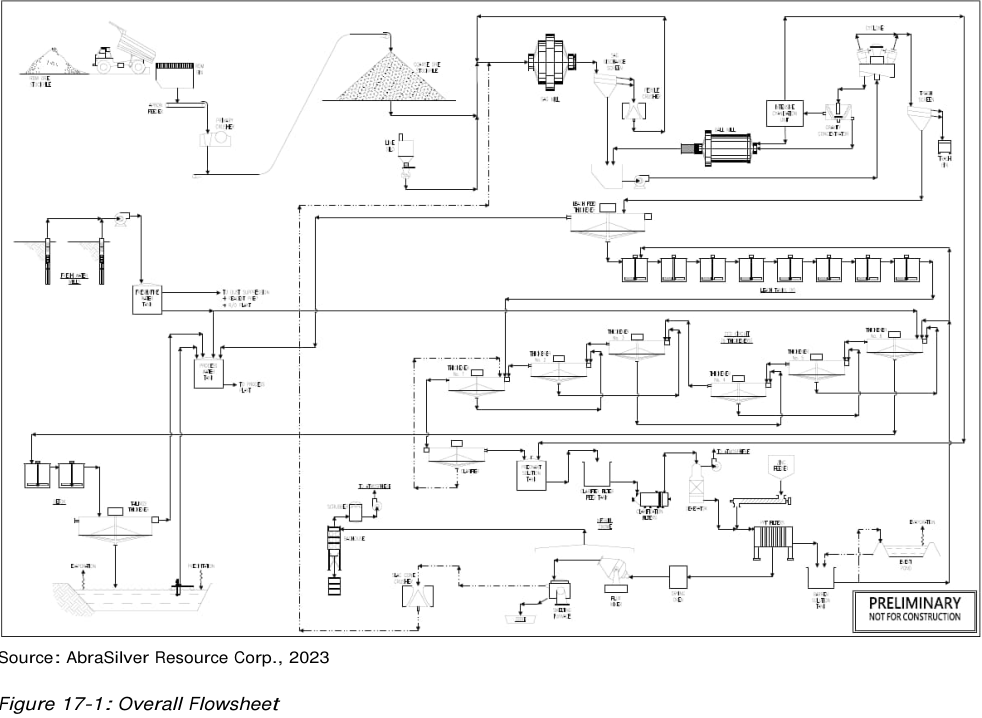
The plant is designed around several unit operations. Crushing uses a primary jaw crusher in open circuit. Grinding is accomplished in a semi-autogenous grinding mill and ball mill circuit with pebble crushing. Gravity concentration treats cyclone underflow, and gravity concentrates undergo intensive cyanidation. Tank leaching follows, with a 36-hour retention time. The leached slurry is washed in a counter current decantation circuit. Pregnant solution reports to the Merrill-Crowe plant for gold and silver recovery by zinc dust precipitation. The precipitate is processed in a foundry to produce doré bullion. Tailings are detoxified using the INCO process before thickening and deposition.
Key Process Stages
The crushing circuit begins with ore trucked from the mine to a run-of-mine stockpile. A front-end loader feeds material to the jaw crusher dump pocket, which has a live capacity of 200 metric tons. A stationary grizzly retains oversize boulders. A hydraulic rock breaker handles material too large for the grizzly. Material is conveyed from the dump pocket by apron feeder to the jaw crusher. The crusher open side setting is 152 mm. Crusher product has an expected P80 around 152 mm and a top size of 254 mm. A belt scale monitors the crushing production rate. Pebble lime is metered onto the stockpile feed conveyor to establish an alkaline environment for grinding. The coarse ore stockpile is enclosed due to high wind velocity at the mine site. Live capacity is 13,000 metric tons. Total stockpile capacity is about 52,000 metric tons. Two variable speed belt feeders, one operating and one standby, reclaim material onto the SAG mill feed conveyor. Dust control uses two wet type dust collector systems.
In the grinding circuit, material from the stockpile goes to the SAG mill. Dilution water maintains slurry density inside the SAG mill at about 75% solids by weight. The SAG mill is 7.92 m in diameter with an effective grinding length of 3.66 m and a 4,500 kW variable speed drive. Ball charge is controlled between 8% and 15% by volume. The SAG mill discharge passes over a vibrating screen with 10 mm aperture. Screen oversize goes to a cone crusher, a HP 100 short head or equivalent, with a close side setting around 9 mm or smaller. Crushed pebbles are recycled to the SAG mill. Pebble recycle rate is typically 15% to 35% of fresh feed. The pebble screen undersize discharges to a pump box that also receives ball mill discharge. The ball mill is 5.49 m in diameter with an effective grinding length of 8.53 m and installed power of 4,500 kW. It operates at 76% of critical speed with a maximum ball charge of 33 volume percent. Dilution water maintains cyclone feed slurry density around 55% solids by weight. Two cyclone feed pumps are installed, one operating and one standby. Cyclone overflow is the final grinding product at about 150 microns. Ball mill circulating load is 250%. An online particle size analyser monitors the grinding circuit product.
The gravity concentration and intensive cyanidation circuit treats a portion of the cyclone underflow. Two Falcon SB5200 gravity concentrators or equivalent are installed. Mass pull is about 190 kg per hour. Each concentrator operates on about a one-hour cycle. Concentrate is flushed to an intensive cyanidation circuit using an SLR6000 unit manufactured by Sepro Mineral Systems or equivalent. Gravity tails report back to the ball mill feed continuously. Laboratory testing indicates that for Oculto material, 10.1% of gold and 7.8% of silver report to the gravity concentrate. For JAC material, those figures are 17.3% for gold and 9.1% for silver. The intensive cyanidation process assumes 99% gold and 97% silver recovery to pregnant solution.
In the cyanide leach circuit, cyclone overflow goes to a 34 m diameter pre-leach thickener. For JAC material only, the pre-leach thickener would be 40 m in diameter with underflow density around 50% solids by weight. The leach retention time is 36 hours. Barren solution dilutes the leach slurry to 45% solids. Milk of lime maintains pH at 10.5. Eight leach tanks, each 15 m diameter and 20 m height, in series, with agitators and air injection. Sodium cyanide solution maintains free cyanide at about 1.5 grams per liter. Laboratory testing indicates about 83% gold recovery and 80% silver recovery for Oculto material. For JAC material, gold recovery is about 84% and silver recovery about 85%.
The counter current decantation circuit uses six stages of high-rate thickeners with flocculant for Oculto material. Wash ratio is 3.0. First CCD thickener diameter is 32 m. The remaining thickeners are 30 m diameter. An additional thickener for clarification, 32 m diameter, minimizes total suspended solids in the pregnant solution. For JAC material alone, seven CCD stages are required. The first CCD thickener would be 40 m diameter, the remaining six would be 38 m diameter. About 99.6% of gold and silver in solution is recovered to pregnant solution for Oculto material, and about 99.8% for JAC material.
The Merrill-Crowe circuit treats the pregnant solution. Maximum solution total suspended solids is recommended below 100 ppm. Four diatomaceous earth coated clarifiers operate, with three running and one on standby. Each clarifier has about a twelve-hour operating cycle. DE precoat thickness is 3 mm. Clarified solution has total suspended solids less than 1 ppm. Two deaeration towers, 3.2 m diameter and 6.3 m height, remove dissolved oxygen to below 0.5 ppm. Four filter presses are included, with three operating and one standby. Zinc dust is added at the filter feed pipe. From test work, 99.5% gold and 98.5% silver recoveries are expected through the Merrill-Crowe process.
In the foundry, a retort unit removes mercury and moisture from the wet precipitate. Mercury is collected in flasks and shipped off site. Dry precipitate is mixed with fluxes and placed in a fuel fired smelting furnace. Slag is crushed and recycled to the grinding mill.
Tailings detoxification uses two cyanide destruction tanks in series with the INCO process. Sodium metabisulfite and copper sulphate are dosed based on WAD cyanide content. Total retention time is one hour. Slurry after detox contains less than 1 ppm WAD cyanide. A tailings thickener, 40 m diameter, achieves at least 60% solids by weight for Oculto material. For JAC material, underflow density is controlled around 55% solids. Thickener overflow is recovered to the process solution tank.
Additional Interesting Data and Summary
Total raw water requirement is 184 mtph. Raw water comes from wells about 13 km away. The freshwater tank is 20 m diameter and 24 m height, holding 24 hours of water with an additional fire water reserve of 1,760 m3. Process air requirements include 3,138 Nm3/h for cyanide leach tanks and 2,713 Nm3/h for cyanide destruction tanks. Total power requirement for the mine site is about 20 MW. Power comes from a hybrid facility with a photovoltaic plant and dual fuel diesel or natural gas gensets. The photovoltaic plant has one 3 MW array with battery storage and one 17 MW array without batteries, with excess energy stored in the 3 MW battery system. Off-site facilities use diesel generators.
The process design criteria are based on either Oculto or JAC feed. Equipment size differences appear mainly in the metal recovery circuit, particularly the Merrill-Crowe plant, CCD, and tailings handling. For a potential ore blend, equipment size changes would be minimal with minimal impact on process capital costs. Process operating costs for the two ore types should be considered in ore blending for cash flow analysis.
The overall process flowsheet is depicted in the technical report, showing the sequence from crushing through grinding, gravity concentration, intensive cyanidation, tank leaching, CCD, Merrill-Crowe precipitation, foundry, and tailings detoxification.
Key Processes
- Crushing: Primary jaw crusher in open circuit, open side setting of 152 mm, product P80 around 152 mm, enclosed coarse ore stockpile with live capacity of 13,000 metric tons
- Grinding: SAG mill 7.92 m diameter by 3.66 m effective grinding length, ball mill 5.49 m diameter by 8.53 m effective grinding length, final grind P80 of 150 microns
- Gravity concentration: Two Falcon SB5200 concentrators treating cyclone underflow, mass pull about 190 kg per hour
- Intensive cyanidation: SLR6000 unit treating gravity concentrate, 99% gold and 97% silver recovery assumed
- Tank leaching: Eight tanks in series, 36 hours retention time, 45% solids, pH 10.5
- Counter current decantation: Six stages for Oculto, seven for JAC material, wash ratio of 3.0
- Merrill-Crowe: DE coated clarifiers, deaeration towers, zinc dust cementation filter presses, 99.5% gold and 98.5% silver recovery expected
- Foundry: Retort for mercury removal, flux mixing, smelting to doré bullion, slag crushed and recycled
- Cyanide destruction: INCO process, sodium metabisulfite and copper sulphate, one hour retention time, less than 1 ppm WAD cyanide in final effluent
- Tailings handling: 40 m diameter thickener, underflow at least 60% solids for Oculto, 55% for JAC material
Source: NI 43-101 Mineral Resource Estimate Diablillos Silver-Gold Project, 19 June 2026. Project website: Diablillos Silver-Gold Project
