Silvercorp Metals Inc. operates two processing plants in Henan Province, China, with a third scheduled to start up in 2027. The Ying property is an operating silver-lead-zinc-gold mining district about 240 km west-southwest of Zhengzhou. Silvercorp holds an effective interest of 77.5% in most mines through wholly owned subsidiaries. Combined design capacity across the two existing plants is 4,300 tpd, with actual demonstrated capacity at 4,000 tpd.
Critical Data
| Parameter | Value | Unit | Notes |
|---|---|---|---|
| Plant 1 design capacity | 800 | tpd | Xiayu Plant; since March 2007 |
| Plant 1 actual capacity | 700 | tpd | FY2025 average 676 tpd (97% of stated capacity) |
| Plant 2 design capacity | 3,500 | tpd | Zhuangtou Plant; after Phase III completed November 2024 |
| Plant 2 actual capacity | 4,000 | tpd | Combined Plants 1 and 2 demonstrated capacity |
| Plant 2 FY2025 average throughput | 2,245 | tpd | 64% of stated 3,500 tpd capacity |
| Plant 3 design capacity | 3,000 | tpd | Planned operation in 2027 |
| Combined design capacity (Plants 1+2) | 4,300 | tpd | After Phase III (November 2024) |
| Combined design capacity (Plants 2+3) | 6,500 | tpd | After Plant 3 startup |
| Plant availability | 330 | day/yr | Both plants |
| FY2025 total ore processed | 1,013,659 | t | Wet tonnes; all mines combined |
| SGX contribution to FY2025 feed | 33 | % | Largest mine contributor |
| TLP contribution to FY2025 feed | 28 | % | Second largest contributor |
| FY2025 Pb recovery (weighted average) | 93.63 | % | Design target: 90% |
| FY2025 Ag recovery (weighted average) | 95.88 | % | Design target: 90% |
| FY2025 Zn recovery (weighted average) | 69.74 | % | Design target: 85% |
| FY2025 Au recovery (weighted average) | 79.21 | % | Design target: 80% |
| FY2025 Pb grade in Pb concentrate | 48.38 | % | Design value: 60% |
| FY2025 Zn grade in Zn concentrate | 49.21 | % | Design value: 45% |
| Plant 1 total installed power | 3,317 | kW | Includes standby |
| Plant 2 total installed power | 10,696 | kW | Includes standby |
| Plant 1 average power consumption | 34.43 | kWh/t | FY2025 |
| Plant 2 average power consumption | 41.51 | kWh/t | FY2025 |
| TSF1 storage capacity | 2.83 | million m³ | Valley type; closure initiated |
| TSF1 dam height | 70 | m | Final elevation 650 mRL |
| Overall water usage | 3.0 to 3.5 | m³/t ore | |
| Net freshwater usage | 0.1 | m³/t ore | After recycling |
Overview
Silvercorp runs two processing plants for the Ying operations. Plant 1, called the Xiayu Plant or No. 1 Mill, has operated since March 2007. Plant 2, called the Zhuangtou Plant or No. 2 Mill, came online in phases starting December 2009. The two plants sit within 2 km of each other. Both were designed based on laboratory testing completed by HNMRI in 2005.
Plant 1 started at 600 tpd design capacity and was later expanded to 800 tpd. Plant 2 Phase I added 1,000 tpd in December 2009. Phase II added another 1,000 tpd in October 2011 with a parallel flotation bank. Phase III added 1,500 tpd in November 2024 with a third flotation line, bringing Plant 2 to 3,500 tpd design. Combined design capacity for both plants is 4,300 tpd. The actual demonstrated capacity is 4,000 tpd.
A third processing plant called No. 3 Mill or Plant 3 is planned to begin operation in 2027. It is in the final design and construction planning stages. Design capacity will be 3,000 tpd. The preliminary design was done by Changchun Gold Design Institute. Construction is expected to start in March 2026 once the land use application is approved. Plant 3 will process Ag-Pb-Zn ore and Ag-Pb ore. After Plant 3 starts, the company intends to operate the newer larger lines and close Plant 1 when its capacity is no longer required.
Tailings from the two plants have been directed to two tailings storage facilities called TSF1 and TSF2. A third facility called TSF3 or Shimengou TSF was built and put into pilot operation in November 2024. With some upgrading, TSF3 was permitted by the provincial government to start formal operation in December 2025. TSF1 closure was initiated in 2023. Tailings discharge from Plant 1 to TSF1 stopped in February 2025. Since then Plant 1 tailings have been pumped to TSF2 through pipelines.
Ore from the Ying mines is shipped by truck to the plants. An ore transportation tunnel from SGX to HPG was built, and the haul road from HPG to the plants was upgraded. A transportation tunnel from TLP to DCG was completed in October 2020. The KP mine is under construction with no fixed plans for milling its future production yet. Metallurgical testing on KP ore has been initiated for flowsheet development.
Key Process Stages
The process at both plants includes crushing, grinding, gravity separation for gold recovery, flotation, and product dewatering. Plant 1 operates one processing train at 800 tpd design. Plant 2 operates three parallel trains totaling 3,500 tpd design. Plant 3 will have one train at 3,000 tpd design using a SAG mill and ball mill circuit.
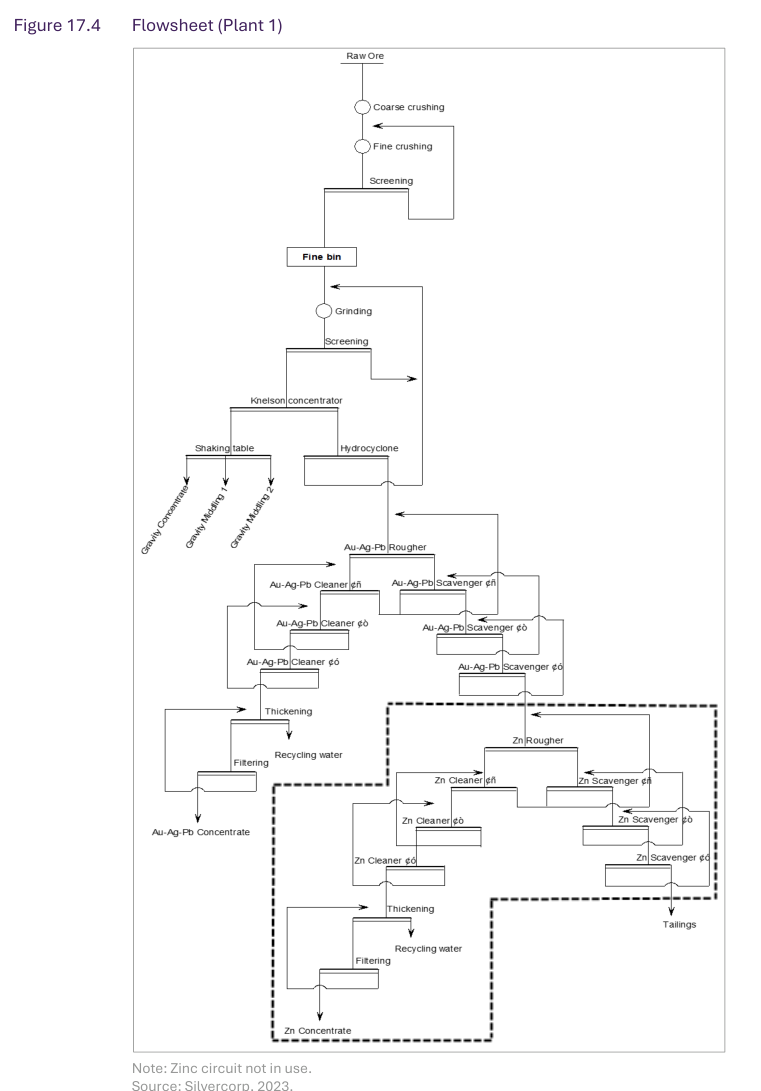
Crushing at Plant 1 uses a closed circuit with a primary jaw crusher and one secondary cone crusher with a vibrating screen. The jaw crusher has an 80 mm closed-side setting. Screen aperture is 15 mm. Live storage capacity in fine-ore bins is 100 t. Dust is collected under vacuum in a baghouse filter and the slurry goes to flotation.
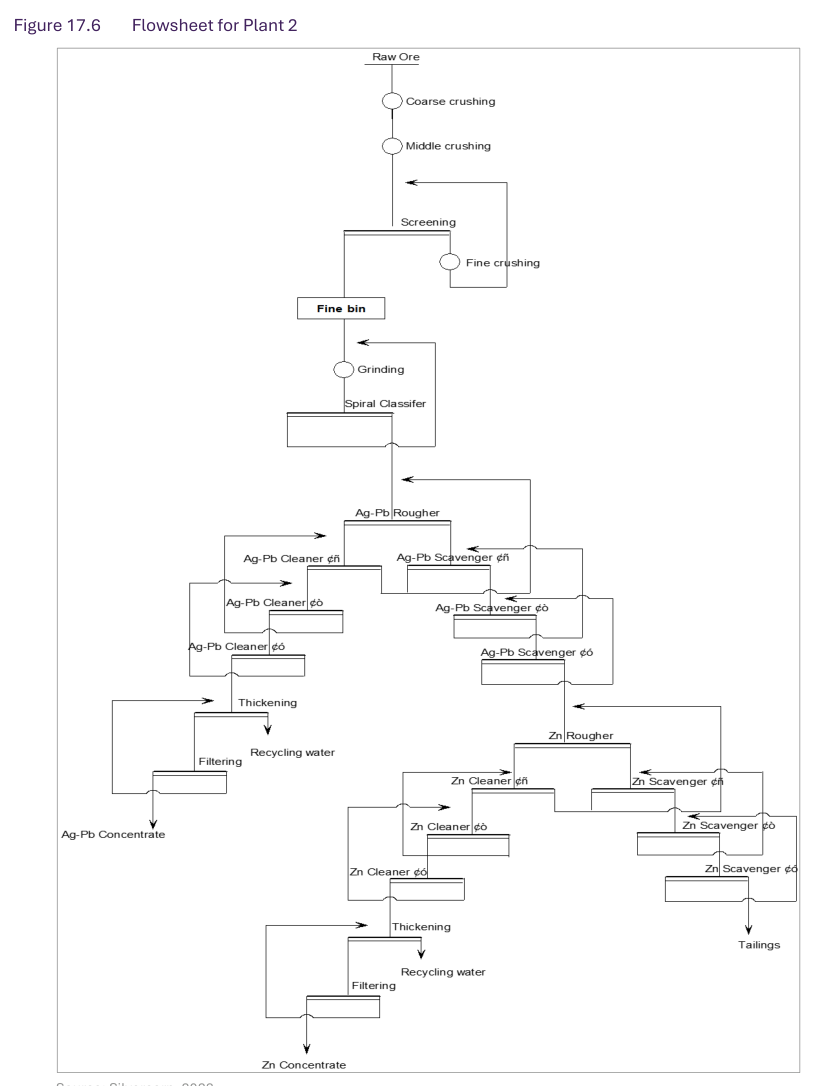
Crushing at Plant 2 uses three-stage crushing in closed circuit. A primary jaw crusher with 80 mm setting feeds a secondary cone crusher with 15 mm setting. Product goes to a 15 mm vibrating screen. Oversize reports to a tertiary cone crusher also set at 15 mm. Undersize feeds crushed ore storage bins with 1,000 t live capacity.
In parallel with the 2024 extension of Plant 2, Silvercorp trialed and moved to full-scale production with XRT intelligent ore sorting. The system sits next to the ROM ore yard at Plant 2. Primary ores processed through ore sorting come from TLP, SGX, and DCG mines. About 8% of waste rock is separated and rejected before crushing and grinding.
Grinding at Plant 1 uses two ball mill trains. Each train has a grate-discharge ball mill. One uses a screw classifier, the other uses hydrocyclones. The target grind size is 61% to 63% passing 75 µm. Overflow density is maintained at 40% solids for flotation feed.
Grinding at Plant 2 uses three parallel ball mill trains. Train 1 and Train 2 use 2.7 m diameter by 4.0 m length mills. Train 3 uses a 3.6 m diameter by 4.5 m length mill. Classifiers are 10.5-inch hydrocyclones or spiral classifiers.
Gravity separation at Plant 1 was added following metallurgical testing by Changchun Gold Research Institute in 2021. A Knelson concentrator recovers coarse gold from ball mill discharge. A linear screen ahead of the Knelson removes particles larger than 2 mm. Concentrate from the Knelson is cleaned on a shaking table. Tailings are classified by cyclone with coarse material going back to the ball mill and fines entering flotation.
Gravity separation at Plant 2 was added to the third processing line. A Knelson concentrator recovers coarse gold from ball mill discharge. A linear sieve screens out particles larger than 2 mm.
Flotation at Plant 1 produces lead concentrate only. The zinc circuit is not in use because zinc feed grades are low. The bank has one stage of roughing, two stages of scavenging using BF-4 type cells, and three stages of cleaning using BF-1.2 type cells. Knelson tailings report to lead flotation feed.
Flotation at Plant 2 uses differential flotation to produce lead sulphide concentrate first, then zinc sulphide concentrate. Each of the three trains has rougher, scavenger, and cleaner cells. Train 1 and Train 2 use BF-16 and BF-4 cells. Train 3 uses XCF/KYF-30, XCF/KYF-16, and XCF/KYF-8 cells. No copper flotation equipment has been installed.
Concentrate dewatering at Plant 1 uses a concrete settling structure followed by a ceramic filter. Filter cake moisture runs 7% to 10%. Product goes to Plant 2 for blending. Plant 2 uses larger thickeners and ceramic disc filters for both lead and zinc concentrates. High-grade lead concentrate from Plant 2 at 55% to 65% Pb is blended with medium-grade from Plant 1 at 40% to 50% Pb before shipping to customers.
Additional Interesting Data and Summary
In FY2025, Plant 1 averaged 676 tpd, which is 97% of its current stated operating capacity of 700 tpd. Plant 2 averaged 2,245 tpd, which is 64% of its stated capacity of 3,500 tpd. The lower rate for Plant 2 was because the third processing line only started in November 2024.
From FY2020 to FY2025, lead and silver recovery averaged 95.21% and 95.48% respectively. Both are above the design target of 90%. Zinc recovery averaged 64.80% over the same period, well below the target of 85%. The QP attributes this to lower than anticipated zinc content in the ore feed. Pb grade in lead concentrate averaged 48.38% in FY2025, below the design value of 60%. Zn grade in zinc concentrate averaged 49.21%, above the design value of 45%.
For FY2025 across all mines, lead recovery ranged from 73.81% to 96.44% with weighted average 93.63%. Silver recovery ranged from 81.37% to 98.16% with weighted average 95.88%. Gold recovery averaged 79.21%. Zinc recoveries were 65.98% for HPG, 70.13% for SGX, and 37.14% for LME. No mines achieved zinc recovery design value of 85%.
The proportion of SGX ore in the feed is decreasing. The QP notes that recoveries appear to be maintained on lower grade feedstock based on recent performance. Pb recovery met or exceeded 90% for SGX, HPG, TLP, and LMW. Ag recovery exceeded 90% for SGX, HZG, TLP, LME, and LMW.
Water management uses reclaimed water from tailings ponds and in-plant recycle. Overall water usage is 3.0 to 3.5 m³ per tonne of ore processed. Net freshwater usage is about 0.1 m³ per tonne. Recycled water from tailings ponds provides about 65% of total water demand. In-plant recycled water provides about 10%.
Power consumption in FY2025 was 34.43 kWh/t at Plant 1 and 41.51 kWh/t at Plant 2. Plant 1 has 3,317 kW installed including standby. Plant 2 has 10,696 kW installed including standby.
Process control uses a PLC system installed in 2019 for the Plant 2 crushing operation. Ore feed to ball mills is controlled by electronic scale. Water addition is manually adjusted based on density measurement. Chemical reagent dosage uses a localized PLC system with adjustments based on assay feedback every half hour. A central monitoring room uses TV imaging to watch key points.
The site laboratory does sample preparation, fire assay, wet chemistry, and photometric analysis. Silvercorp QA/QC includes inserting standards in sample batches and sending duplicate pulps to an external lab.
Reagents used across both plants include sodium sulphide, zinc sulphate, sodium sulphite, and copper sulphate as depressants or modifiers. Collectors include di-ethyl dithiocarbamate, ammonium dibutyl dithiophosphate, and butyl xanthate. No. 2 oil is used as frother and is added directly.
After Plant 3 starts, tailings from Plant 1 and some from Plant 2 will go to TSF2. Part of Plant 2 tailings and all of Plant 3 tailings will go to TSF3. In later years both Plant 2 and Plant 3 tailings will discharge to TSF3 depending on production and TSF operations.
Key Processes
- Crushing in closed circuit (two-stage at Plant 1; three-stage at Plant 2; jaw and cone crushers with vibrating screens)
- Grinding in ball mills (two trains at Plant 1; three trains at Plant 2) to 61% to 63% passing 75 µm
- Gravity gold recovery using Knelson concentrators with shaking table cleaning and linear screens ahead of concentrators
- Differential flotation producing lead sulphide concentrate then zinc sulphide concentrate (zinc circuit not operating at Plant 1)
- Concentrate dewatering using ceramic filters (concrete settling at Plant 1, ceramic disc at Plant 2)
- XRT intelligent ore sorting at Plant 2 rejecting about 8% waste rock before crushing
- Concentrate blending between plants for product grade optimization
- Water recycling from tailings storage ponds and in-plant recycle
Source: NI 43-101 Technical Report Update on the Ying Ag-Pb-Zn-Au Property in Henan Province, People’s Republic of China, 12 June 2026. Project website: Ying Ag-Pb-Zn-Au Property
Additional process diagram from the technical report