admin

Great Burnt Copper-Gold Project PEA — 2022 Technical Report

This report outlines the recovery methods for the Great Burnt Copper-Gold Project. Based on metallurgical test work, a conventional process flowsheet is proposed involving crushing and fine grinding to a P80 of 50 µm at 1,000 tpd. Two stages of flotation using a special copper gold collector (3418A) produce a cleaner concentrate. Due to the remote location and limited mineral resource (1 Mt), building a local facility is uneconomic. Toll processing at the existing Nugget Pond plant is considered, requiring finer primary grind. Mineralized material sorting technology was tested to reduce mass shipped, showing potential but requiring further economic analysis.

Great Burnt Copper-Gold Project PEA — 2022 Technical Report Read Post »

Guanaceví Project — 2022 Technical Report

The Guanaceví Project is an operating mining facility located in Guanaceví, Mexico, operated by Endeavour Silver Corp. The project focuses on the extraction of silver and gold through a well-established processing plant. In 2021, the mine produced 4,316,819 ounces of silver and 13,378 ounces of gold, with a plant throughput of 414,355 tonnes at an average grade of 370 g/t silver and 1.09 g/t gold. Recoveries averaged 86.9% for silver and 91.8% for gold.

Guanaceví Project — 2022 Technical Report Read Post »

Escalones Copper Project PEA NI 43-101 Technical Report

This NI 43-101 Technical Report outlines the Preliminary Economic Assessment (PEA) for the Escalones Copper Project by World Copper Ltd. The project proposes an open-pit mining operation utilizing a conventional heap leach system to recover copper from mineralized material. The processing circuit is designed for a 365-day per year, 24-hour per day operation, targeting a throughput of 50,000 tonnes per day of mineralized material.

Escalones Copper Project PEA NI 43-101 Technical Report Read Post »

Figure 13.1 2021 PRO metallurgical investigation test program flowsheet.

Shovelnose Gold Property – South Zone Technical Report

This technical report outlines the recovery methods for the Shovelnose Mineral Resource, specifically focusing on metallurgical testwork and process design. Available testwork indicates that a high percentage of gold and silver can be recovered using conventional processes, with recoveries exceeding 90% when combining rougher flotation concentrate production and cyanidation of flotation tails. Gravity concentration was found to be ineffective due to the fine distribution of gold and the non-refractory nature of the ore.

Shovelnose Gold Property – South Zone Technical Report Read Post »

Nampala Gold Mine — Recovery Methods Report

This technical report section details the recovery methods employed at the Nampala Gold Mine located in Mali. The primary gold recovery process utilized is Carbon-in-Leach (CIL), which has remained consistent with the flowsheet information presented in the previous 2018 technical report by InnovExplo Inc. The author of this specific item is Kerr-Gillespie F., M.Sc., P.Geo., confirming the continuity of the technical assessment.

Nampala Gold Mine — Recovery Methods Report Read Post »

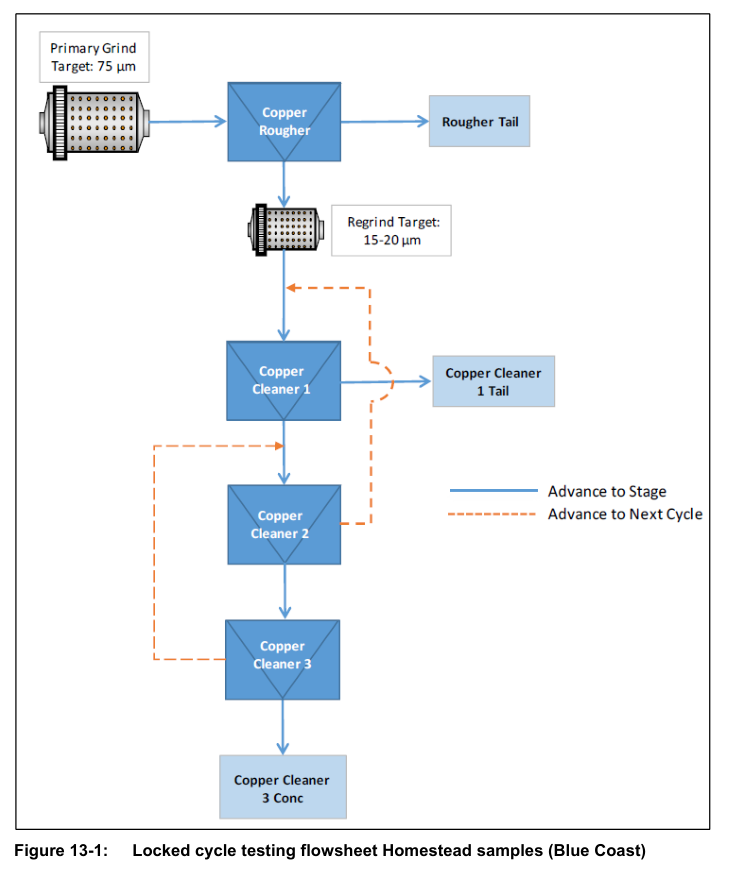
Figure 13-1: Locked cycle testing flowsheet Homestead samples (Blue Coast)

Planalto — 2025 NI 43-101 Technical Report

This NI 43-101 Technical Report details the recovery methods for the Planalto project, focusing on a conventional concentrator design capable of processing 8 million tonnes per annum (Mtpa). The metallurgical study, conducted by Consensum Engenharia and ONIX Engenharia, outlines a flowsheet designed to treat a blend of Homestead and Cupuzeiro ores, with a 70:30 ratio assumed for the first six years of production. The process targets a copper concentrate grade of 28% Cu with a copper recovery of 90.8% and a gold recovery of 51%.

Planalto — 2025 NI 43-101 Technical Report Read Post »

Karma Project — 2023 Technical Report

This technical report outlines the proposed design for the Karma process plant, which is based on gold heap leach technology. The plant is designed to process 4 million tonnes per annum (Mtpa) of oxide and transition ore, with an additional 1.2 Mtpa of hard rock ore, delivered from five separate open pit mines: GGI, GGII, Kao, Rambo, and Nami. The ore is primarily oxide and transition material, with only a minimal amount of sulphide ore from Rambo and Nami pits being processed. The sulphide material from other pits is considered refractory and cannot be treated via heap leaching.

Karma Project — 2023 Technical Report Read Post »

Rainbow Lake Lithium Project — Technical Report

Volt Energy Technologies is developing the Rainbow Lake Lithium Project in Alberta, Canada. The project utilizes proprietary IES-300 Direct Lithium Extraction (DLE) technology to produce 22,700 tonnes per year of Lithium Hydroxide Monohydrate (LHM). The operation involves a decentralized brine production plan across two Development Areas (Muskeg and Keg River Formations) with a combined throughput of ~260,000 m³/d. The process includes brine pre-treatment, lithium extraction, concentration, and a central processing facility for final conversion to battery-grade LHM.

Rainbow Lake Lithium Project — Technical Report Read Post »

Turk and Angelus Mine — 2012 Technical Report

This technical report details the recovery methods employed at the Turk and Angelus Mine operated by New Dawn Mining Corp. The processing plant utilizes a conventional milling circuit consisting of three parallel ball mills with a combined capacity of approximately 600 tonnes per day. Ore is ground using steel balls and classified via hydro cyclones in a closed circuit. A Deswick stirred mill is employed for ultra-fine grinding of dump material to liberate residual gold.

Turk and Angelus Mine — 2012 Technical Report Read Post »

Shirley Basin ISR Uranium Project — 2023 Technical Report

This Preliminary Economic Assessment outlines the recovery methods for the Shirley Basin ISR Uranium Project, operated by Ur-Energy. The project is designed as a satellite facility to the Lost Creek Mine, located approximately 32 miles north of Wamsutter, Wyoming. The primary recovery method involves In-Situ Recovery (ISR) where uranium is extracted from the underground deposits using an Ion Exchange (IX) circuit housed in a metal building at the project site.

Shirley Basin ISR Uranium Project — 2023 Technical Report Read Post »

Scroll to Top