admin

Banio Potash Project — 2024 Technical Report

The Banio Potash Project Preliminary Economic Assessment (PEA) outlines a solution mining approach for extracting potash-rich brines from the wellfield, favoring this over conventional underground mining. The proposed processing regime targets the production of Muriate of Potash (MOP) at three capacity scenarios: 400 kt/a, 600 kt/a, and 800 kt/a, primarily as granular solids with a K60 grade (95% KCl purity). The process is designed to maximize resource recovery, producing a high-grade vacuum salt by-product alongside the potash.

Banio Potash Project — 2024 Technical Report Read Post »

Upper Beaver Deposit — PEA Report No. 239

This Preliminary Economic Assessment (PEA) outlines the recovery methods for the Upper Beaver Deposit. Based on metallurgical testwork, a conventional process flowsheet is selected. The process involves crushing and grinding to a 70 micron grind at an average rate of 2,000 tpd. Copper is recovered via flotation to a rougher concentrate, which is then reground and re-floated in a two-stage cleaner circuit. The final concentrate is filtered to 8% moisture for shipment. Flotation tailings undergo leaching in a conventional cyanidation circuit to recover gold.

Upper Beaver Deposit — PEA Report No. 239 Read Post »

Blue River Tantalum–Niobium Project — 2012 Technical Report

This section outlines the recovery methods for the Blue River Tantalum–Niobium Project based on a Preliminary Economic Assessment (PEA) effective September 29, 2011. The process plant is designed for a nominal capacity of 7,500 tonnes per day, handling Run-of-Mine (ROM) material from underground operations. The flowsheet utilizes conventional technology to crush, grind, and separate tantalum and niobium minerals via flotation, followed by refining processes to produce high-purity chlorides and oxides.

Blue River Tantalum–Niobium Project — 2012 Technical Report Read Post »

West Cache PEA Favours Toll Milling at a Nearby Gravity-CIP Plant, With Gravity Recovering a Third of the Gold

This Pre-Feasibility Study (PEA) for the West Cache Gold Property outlines metallurgical testwork and processing options for gold recovery. Based on recent testwork, two primary flowsheets were evaluated: a dedicated gravity-float-leach option and toll processing at existing regional facilities. The preferred flowsheet involves gravity concentration of free gold using centrifuges and tabling, followed by flotation of a gold-sulphide concentrate and cyanidation of the reground float concentrate. This option achieved combined recoveries averaging 97% and produces cyanide-free flotation tailings suitable for mine backfill.

West Cache PEA Favours Toll Milling at a Nearby Gravity-CIP Plant, With Gravity Recovering a Third of the Gold Read Post »

Strange Lake Project — 2014 Technical Report

The Strange Lake project involves the mining and beneficiation of mineral resources at the Strange Lake site, followed by transport of the flotation concentrate to a processing facility at the Bécancour Industrial Park for the recovery of rare earths and yttrium. The beneficiation process at Strange Lake comprises crushing, grinding, and flotation, while the Bécancour facility utilizes acid thermal processing (acid bake) and water leaching to extract payable elements into solution.

Strange Lake Project — 2014 Technical Report Read Post »

Gemfield Project — Technical Report

The Gemfield Project Technical Report outlines a comprehensive recovery method designed to produce doré bars containing gold and silver. The process flowsheet includes three-stage crushing and screening to produce leach feed, followed by heap leaching using sodium cyanide solution. The pregnant solution is processed through a carbon adsorption plant, followed by stripping, regeneration, electrowinning, and smelting to produce doré bars for shipment to third-party refiners.

Gemfield Project — Technical Report Read Post »

Cauchari-Olaroz — 2026 Technical Report

This technical report details the lithium recovery methods for the Cauchari-Olaroz Salars project, operated by Lithium Argentina AG. The process involves extracting brine from wells, concentrating it through a sequential solar evaporation system, and processing it in a chemical plant to produce lithium carbonate. The design includes brine production, liming for impurity reduction, and a comprehensive lithium plant featuring boron removal, purification, forced evaporation, and carbonation.

Cauchari-Olaroz — 2026 Technical Report Read Post »

Figure 13.1 Flow Sheet for 2017 – 2018 METTS Composites

Igor Project — 2019 Technical Report

The 2019 Technical Report and Preliminary Feasibility Study (PFS) for the Igor Project (Callanquitas mine) outlines a heap-leach operation for oxide ores. The design considers a two-stage development starting at 350 tpd and expanding to 500 tpd. The process involves three-stage crushing, cement agglomeration, cyanide heap leaching, and gold-silver recovery via a Merrill-Crowe circuit. Estimated reserves are 1,030,000 tonnes with a mine life of 8.6 years. Gold recovery is estimated at 80% and Silver at 33%.

Igor Project — 2019 Technical Report Read Post »

Process diagram from technical-report PDF page 86

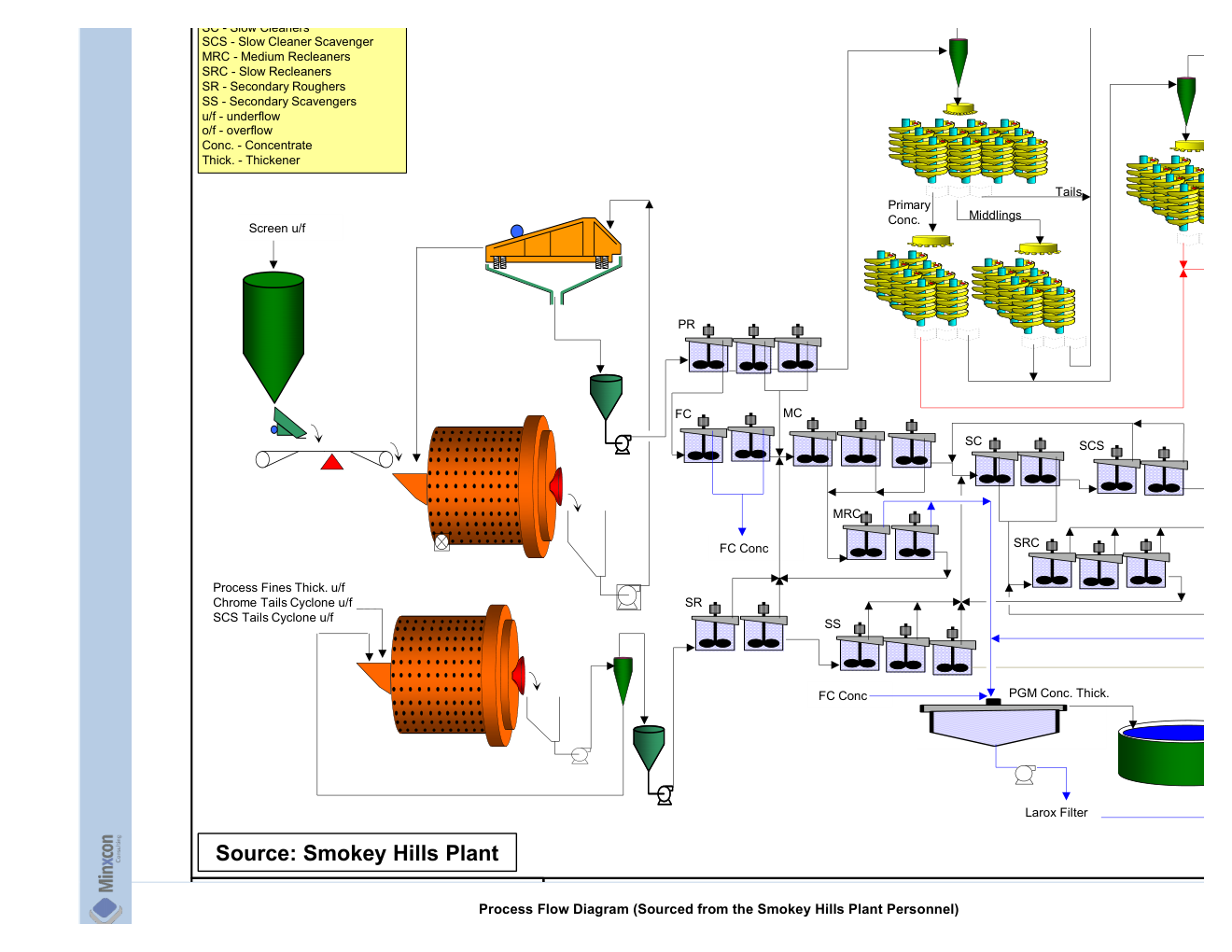
Smokey Hills Platinum Mine — 2016 Technical Report Update

This technical report update details the recovery methods and processing efficiencies for the Smokey Hills Platinum Mine, located in the Limpopo Province of South Africa. The plant utilizes a typical UG2 processing configuration with a mill-float-mill-float (MF2) setup, designed with a capacity of 60 ktpm. The processing circuit includes primary and secondary crushing, ball milling, forced air flotation cells, and a chrome spirals recovery circuit. Historic data from 2011 to 2012 indicates an average throughput of 28.6 ktpm with a 4E recovery rate averaging 78.2%.

Smokey Hills Platinum Mine — 2016 Technical Report Update Read Post »

NI 43-101 Technical Report — Cadan Project

This technical report section outlines the recovery methods for the Cadan Project, focusing on the existing TMC Mineral Processing Plant. The plant is designed for a throughput of 200 tonnes per day and utilizes a conventional Carbon in Pulp (CIP) or Carbon in Leach (CIL) circuit for gold and silver recovery. Laboratory work indicates that this processing method allows for suitable recovery of the mineralized material.

NI 43-101 Technical Report — Cadan Project Read Post »

Scroll to Top