

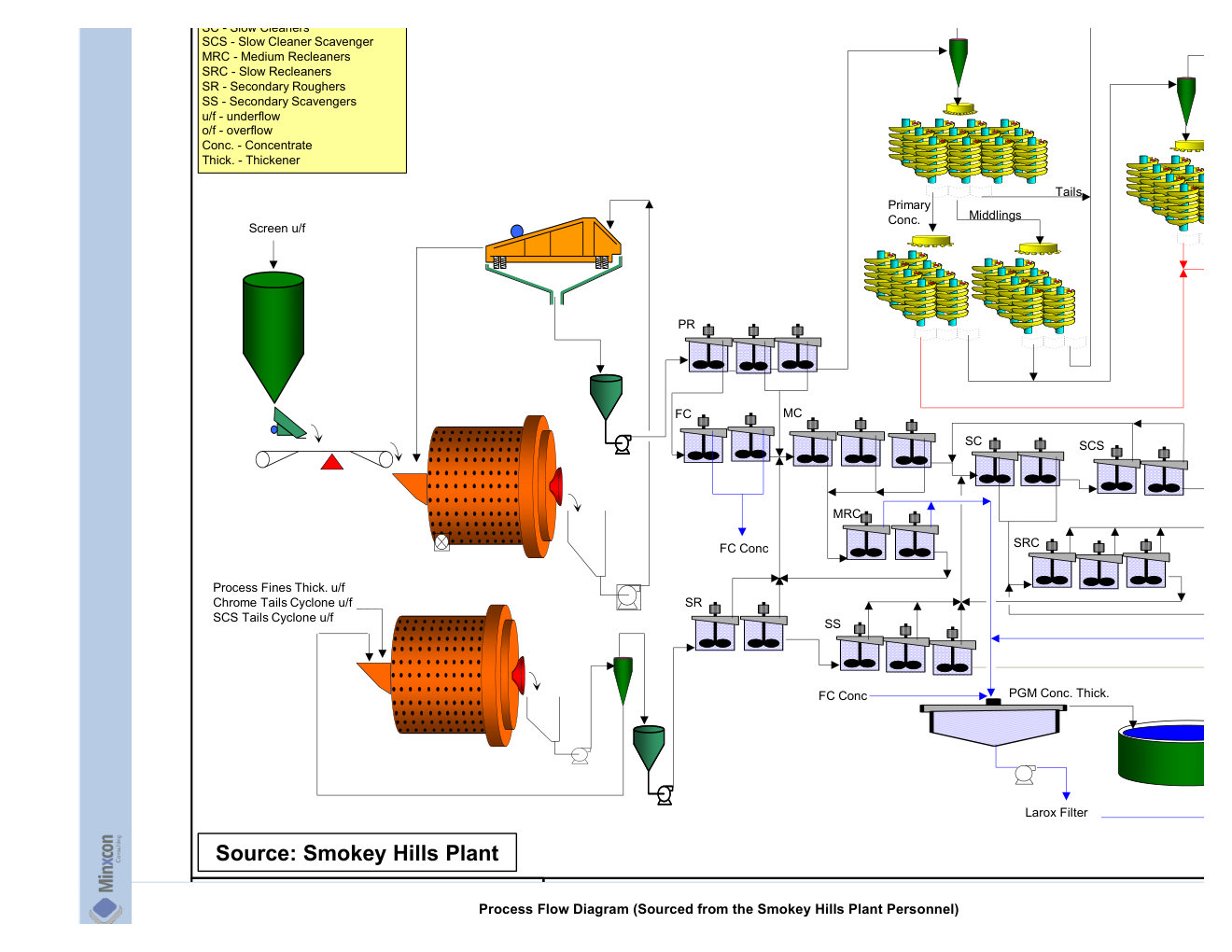
This report details the processing facilities and historical operating data for the Smokey Hills UG2 plant as of the April 2016 update.
Report context
This technical report update, dated April 2016, describes the Smokey Hills Platinum Mine located in Limpopo Province, South Africa. The report documents the processing plant configuration, historical production performance between January 2011 and August 2012, and expected future operating parameters based on the financial model.
Processing route
Plant configuration
The Smokey Hills Plant is a typical UG2 processing plant with a mill-float-mill-float (MF2) configuration and a design capacity of 60 ktpm. The plant includes the following circuits: jaw crushing; cone crushing in closed circuit with a screen; primary ball mill in closed circuit with a screen; primary flotation; a chrome spirals recovery circuit; secondary ball mill in closed circuit with a cyclone; secondary flotation; PGM concentrate and tails thickening; PGM concentrate filtering and storage; reagent make-up and dosing circuits; and water recycling and storage.
Crushing circuit
Underground run-of-mine (RoM) material is transported via trucks and tipped onto a static grizzly. Undersize gravitates into an ore receiving bin and onto a vibrating grizzly feeder (VGF). Oversize from the VGF feeds a 55 kW Sandvik jaw crusher, with its product combined with the VGF undersize on a conveyor. The combined material feeds a vibrating screen. Screen oversize (+25 mm) is transferred into a feed bin and vibrating feeder ahead of a 132 kW Sandvik cone crusher. The cone crusher product is recycled back to the vibrating screen. Screen undersize is transferred into a concrete silo prior to milling. A belt magnet located at the head of the sizing screen feed conveyor removes tramp metal.
Primary milling and classification
Ore is transferred from the mill feed silo via a variable speed belt feeder with a weightometer installed to measure feed tonnes. The primary milling circuit comprises a 1,400 kW Outotec ball mill in closed circuit with a screen. Ball mill discharge passes over a scalping screen; the oversize (scats) is returned to the ball mill feed conveyor via a load-in chute through manual operation performed once per shift. Scalping screen undersize gravitates into a sump and is diluted with process water before being pumped to the classification screen. Screen undersize is pumped to the primary rougher circuit through an automated cross stream sampler. Screen oversize gravitates back to the primary mill feed chute. Steel balls are added using an automated ball charger based on mill feed tonnage.
Primary flotation
The primary roughers (PR) flotation circuit comprises a bank of three forced air tank cells in series. As per the original design, tails from the PR were pumped to the chrome removal circuit. Currently, the plant is setup to pump PR tails directly to secondary milling, with the secondary rougher tails treated through the chrome spirals circuit. A fast floating concentrate from the first PR is pumped to the fast cleaners (FC). A medium floating concentrate from the last two PRs combines with the tails from the FC before being pumped to the medium cleaners (MC). The FC concentrate is pumped to the PGM concentrate thickener. The MC concentrates are pumped to the medium recleaners (MRCs). The MRC concentrate is pumped to the PGM concentrate thickener while the MRC tails is recycled back to the MC cells. The MC tails is pumped to the slow cleaner (SC) circuit. Concentrate from the SC cells is pumped to the slow recleaners (SRC), while the SC tails are pumped to the slow cleaner scavengers (SCS). SCS concentrate is recycled back to the SC, and SCS tails are pumped to the SCS tails cyclone. Cyclone overflow is sent to the process thickener before being pumped to the secondary mill. SCS cyclone underflow is pumped directly to the secondary mill. The SRC consists of two sets of cells: SRC1 and SRC2. Concentrate from SRC1 is pumped to the SRC2 cells, with its concentrate subsequently pumped to the PGM concentrate thickener. The SRC2 tails is recycled to the front of the SRC1 cells. The SRC1 tails is pumped to the SC circuit.
Chrome removal circuit
The chrome removal circuit is made up of a series of spirals producing a chrome concentrate and tails, including roughers, cleaners, middlings and middling cleaner spirals. In the original plant design, the spirals treated PR tails. In this scenario, the spiral tails streams were classified with cyclones, with cyclone overflows thickened in the process thickener prior to secondary milling and cyclone underflow pumped directly to the secondary mill. The chrome circuit operated from November 2010 to February 2011, during which time the plant treated Smokey Hills RoM ore from underground as well as chrome tailings from a nearby dump in separate campaigns. The chrome circuit was stopped in February 2011 as it was believed to be contributing to PGM losses.
Subsequent to the chrome circuit stoppages, it was reconfigured to treat secondary flotation tails instead and was recommissioned in May 2012. However, with the decision in June 2012 to put the plant on care and maintenance, the chrome circuit was shut down in July 2012. Currently, the spirals circuit has been modified to treat secondary flotation tails, and the spiral tails are thickened and pumped to the tailings storage facility (TSF). Metallurgical testwork showed favourable chrome recoveries after primary flotation.
Secondary milling and flotation
The secondary milling circuit comprises a 1,400 kW Outotec ball mill in closed circuit with a cyclone. Mill discharge gravitates into a sump where water is added before being pumped to the secondary mill cyclone. Cyclone overflow is pumped to the secondary roughers (SR) through an automated cross-cut sampler. Cyclone underflow gravitates back to the secondary mill feed chute. Steel balls are added manually on a daily basis using a dedicated ball kibble and hoist arrangement.
The SR circuit consists of two rougher cells. The SR concentrate is combined with the MRC tails and pumped to the MC cells. The SR tails is treated in three secondary scavengers (SS). The SS concentrate is combined with the SRC tails and pumped to the SC circuit. Currently, the SS tails is pumped to the spirals recovery plant to produce a chrome concentrate.
Concentrate handling and filtration
Final concentrate from the flotation plant is pumped to a single rake-driven concentrate thickener via a trash screen to prevent ingress of foreign trash. Diluted flocculant is added in the feed launder or feed well to assist flocculation and settlement. Thickener underflow is pumped to an agitated filter feed tank and then to the Larox filtration circuit. Thickener overflow gravitates to a collection tank and is pumped to the flotation circuit for use as launder wash down water. An automatic cross-cut sampler is installed above the filter feed tank on the concentrate thickener underflow line for metal accounting purposes. The filter cake from the Larox filter discharges onto a conveyor and is transferred onto stockpiles for loading and despatch. Filtrate is recycled within the filtration circuit, with excess pumped back to the concentrate thickener.
Tails handling
The SR tails is pumped to a single rake-driven tails thickener with diluted flocculant added to assist flocculation. Thickener underflow is pumped to an agitated tails tank and then to the TSF. Overflow from the tails thickener gravitates to the process water system and is reused in the plant. Tailings material is deposited on the TSF using the cyclone deposition method, with return water pumped back to the plant for reuse.
Reagents, air, power, and water
Reagents required include frother (delivered by bulk tanker, diluted with water, and dosed into flotation cells); collector as sodium iso-butyl xanthate (SIBX) pellets (mixed in bulk bags, pumped to a steady head tank, and dosed into flotation cells); depressant (powdered, pneumatically transferred and mixed with raw water, then dosed into flotation cells); and flocculant (powdered, pneumatically transferred, wetted in a proprietary wetting head, mixed, hydrated, and dosed via dedicated dosing pumps to all plant thickeners). Air for flotation agitation and plant and instrumentation air is provided by air blowers and compressors respectively. The estimated total power draw is 1,584 MWh per month. The process water system comprises a process fines thickener and the process water dam.
Plant expansions
Although the plant has a compact design, sufficient space is available for future plant expansions.
Key reported parameters
| Parameter | Unit | Design / Proposed | Historical Actual | Testwork |
|---|---|---|---|---|
| Plant capacity | ktpm | 60 (design) | , | , |
| RoM milled (Jan 2011 – Aug 2012) | ktpm | , | 28.6 average (range 7.5 – 42.2) | , |
| Expected steady state throughput | ktpm | 45 (proposed) | , | , |
| 4E (PGM) grade – RoM | g/t | 4.00 (financial model) | 3.50 – 4.02 (monthly range) | , |
| 4E recovery – historical average | % | , | 78.2 | , |
| 4E recovery – expected | % | 80 (financial model, conservative); up to 85 (expected) | , | , |
| 4E recovery – monthly range (Jan 2011 – Aug 2012) | % | , | 66.36 – 80.52 | , |
| Total 4E production (Jan 2011 – Aug 2012) | kOz | , | 54.3 | , |
| Concentrate grade – historical | g/t | , | 150 – 196 (monthly range) | , |
| Concentrate grade – expected | g/t | 180 (financial model) | , | , |
| Mass pull | % | 1.78 (financial model) | , | , |
| Concentrate production (proposed) | ktpm | 0.8 (at 45 ktpm feed, 5 g/t PGM grade) | , | , |
| Chrome concentrate produced (July 2012) | tonnes | , | 1,178 at 40.1% Cr₂O₃ | , |
| Power draw | MWh/month | 1,584 (estimated) | , | , |
| Average plant costs (Jan 2011 – May 2012) | ZAR/t | , | 208 | , |
Project website: https://www.juniorminingnetwork.com/junior-miner-news/press-releases/384-tsx/aab/18126-aberdeen-updates-mine-operations-at-african-thunder-platinum.html
Technical qualifications
The report states that the chrome circuit operated from November 2010 to February 2011 and was reconfigured to treat secondary flotation tails from May 2012 until July 2012 shutdown. However, due to the short time the chrome plant operated, there is not enough long-term production data to determine chromite recoveries. The expected plant mass balance of 45 ktpm RoM feed at 4.00 g/t 4E grade producing 0.8 ktpm concentrate at 180 g/t 4E with 80% recovery and 1.78% mass pull is based on the financial model and does not include chromite recovery. The concentrate prill split is assumed to be the same as the RoM prill split, in line with historic data. The report notes that an advanced process control system is recommended to be trialled once the plant reaches steady state operation.
Source: A Technical Report on the Smokey Hills Platinum Mine, Limpopo Province, South Africa – Update, April 2016, Item 17 – Recovery Methods.
